
Daubei moth
Thysanoplusia daubei
Description
How to identify
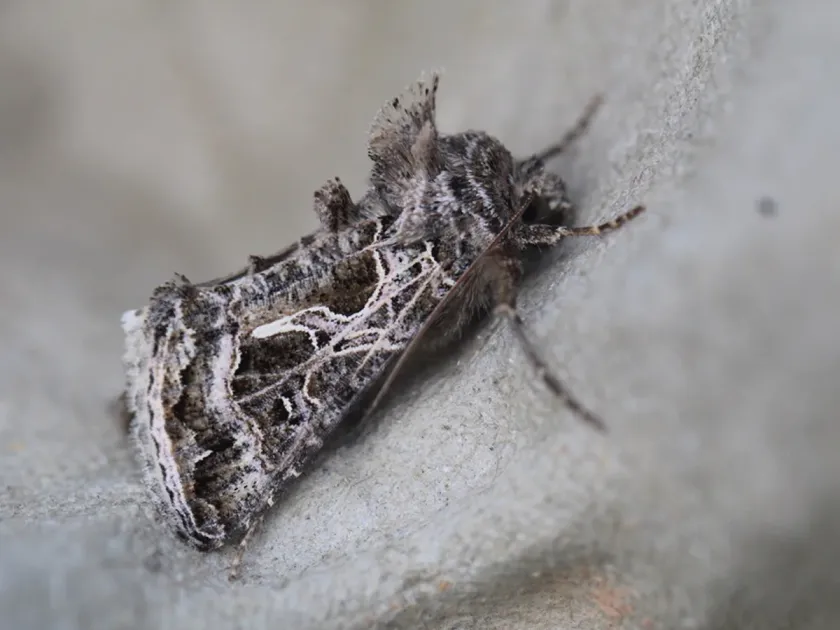
The Daubei moth (Thysanoplusia daubei) belongs to the Noctuidae family, within the order Lepidoptera. This insect species is characterized by a robust, hairy body and wings that are folded flat or tent-like when at rest.
Adult moths typically have a wingspan of 30–35 mm. The forewings are decorated with intricate brown and reddish-brown patterns, providing excellent camouflage against soil, bark, or leaf surfaces during daylight hours.
The larvae, known as loopers, possess reduced abdominal prolegs, which forces them to move in a distinctive looping fashion. Their coloration is usually a shade of green that perfectly blends with the host plant foliage.
The life cycle follows a complete metamorphosis: egg, larva, pupa, and adult. Each stage is strictly adapted to survive within specific micro-environments of the host plant or the surrounding soil.
Pupation occurs within a loose silk cocoon often spun among the foliage of the host plant or in the upper soil layers, protecting the pupa from extreme temperatures and predation.
What it damages
This pest is highly polyphagous, meaning it feeds on a wide array of agricultural crops. The damage is primarily caused by middle and late-instar larvae that have high metabolic and dietary requirements.
Common host plants include various members of the Solanaceae family, such as tomatoes and potatoes, as well as several Cruciferous (Brassicaceae) vegetable crops widely grown in commercial settings.
Larvae consume leaf tissue, initially creating small holes, but as they grow, they cause extensive defoliation, leaving behind only the tougher primary and secondary leaf veins.
In addition to foliage, larvae are known to attack reproductive structures, including flower buds and developing fruits, which often results in significant economic losses for farmers.
Feeding wounds create entry points for secondary infections, such as bacterial soft rot or fungal diseases, which can compromise the structural integrity and marketability of the entire crop.
When it appears
The seasonal activity of the Daubei moth begins in late spring, following the emergence of adults from overwintering pupae once environmental temperatures reach critical levels.
Depending on the climate and availability of host plants, the species can produce multiple overlapping generations throughout a single growing season, leading to persistent pest pressure.
Peak infestation levels usually occur in mid-to-late summer, driven by optimal temperatures and high humidity, which accelerate the development cycle of the larval population.
As autumn approaches and temperatures drop, the metabolic activity slows down. However, in regions with late-season vegetable production, the moth remains a threat until the first frost.
Overwintering typically takes place in the pupal stage, buried within the soil, where the insects remain in diapause until conditions become favorable for emergence the following year.
Signs of infestation
The first signs of infestation are often ragged edges or irregular "windowing" on the leaf blades caused by young larvae feeding on the lower epidermis.
The presence of frass (larval excrement) on leaves or on the ground beneath the plant is a critical diagnostic indicator of active larval feeding and infestation density.
Careful observation of the undersides of leaves can reveal small, dome-shaped eggs, often laid singly, which indicates the starting point of a new population cycle.
Severely infested plants appear stunted, with visible leaf loss, and in cases of fruit-bearing crops, the flowers and young fruit may show clear signs of external scarring or excavation.
Plants under high pressure often exhibit signs of physiological stress, including leaf rolling or drooping, as the plant attempts to cope with the loss of photosynthetic area.
Control measures
Integrated Pest Management (IPM) is essential for controlling the Daubei moth, focusing on minimizing chemical reliance while maximizing the effectiveness of preventative strategies.
- Deep fall plowing to destroy pupae overwintering in the soil.
- Strict weed management to remove alternative host plants around fields.
- Use of biological insecticides containing Bacillus thuringiensis.
- Monitoring adult flights with pheromone traps to time interventions correctly.
- Targeted application of insecticides when larvae are in early instars.
Cultural practices, such as proper crop rotation and the destruction of crop residues post-harvest, are highly effective in disrupting the life cycle of the moth and reducing the initial pest load.
Chemical control should be applied judiciously, focusing on the specific stages of the life cycle that are most vulnerable to treatment, while always respecting pre-harvest intervals.
Biological control methods, including the strategic release of parasitoid wasps like Trichogramma, can provide significant population suppression when timed accurately with egg-laying periods.
Taxonomy
- Latin name
- Thysanoplusia daubei
- Order
- Lepidoptera (butterflies)
- Family
- Noctuidae
- EPPO code
- THYPDA
Discussion
No discussions yet — be the first.