
Thripobius javae
Thripobius javae
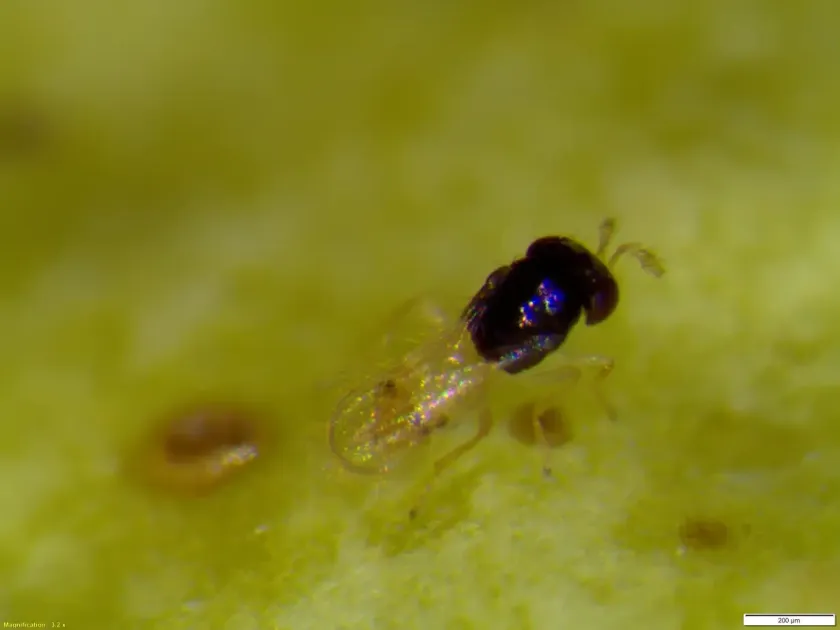
Description
How to identify
Thripobius javae is a specialized parasitic wasp belonging to the family Eulophidae (Order Hymenoptera). It is recognized by entomologists and agronomists as a highly efficient biological control agent targeting various species of thrips.
These wasps are extremely small, typically measuring between 1 and 1.5 millimeters in length. Their bodies are usually dark with a metallic sheen, making them quite difficult to spot in dense foliage without a magnifying glass or microscope.
The life cycle involves the female wasp laying eggs inside the larval stages of thrips. The wasp larva develops within the host, eventually killing it before emerging as an adult to continue the cycle of regulating the pest population.
The efficacy of Thripobius javae is most pronounced in stable environments such as greenhouses and nurseries, where humidity and temperature can be maintained at levels favorable for the wasp's activity.
As a key component of integrated pest management (IPM), this parasitoid is highly valued for its ability to target the juvenile stages of pests, thereby preventing them from maturing into egg-laying adults.
What it damages
Thripobius javae itself does not cause any damage to plants; it is a beneficial organism. The plant damage is caused by the target host, thrips, which pierce plant cells and suck out the internal contents.
Feeding by thrips leads to characteristic silvery or necrotic patches on leaves and stems. These damaged areas disrupt photosynthesis, eventually resulting in leaf senescence, stunted growth, and significantly reduced yield quality.
Left unchecked, thrips populations reproduce rapidly, causing extensive damage to sensitive horticultural crops. The presence of the parasitoid wasp serves as a critical defense line, keeping the thrips population below the economic damage threshold.
A wide range of crops is susceptible to thrips, including greenhouse vegetables like tomatoes, cucumbers, and peppers, as well as numerous ornamental flower species. Protecting these crops is essential for economic profitability.
By controlling the number of thrips, Thripobius javae helps maintain the aesthetic and commercial value of the plants, reducing the need for intensive synthetic pesticide applications.
Control measures
To maximize the benefits of Thripobius javae, it is essential to manage the greenhouse environment carefully. Maintaining stable, favorable temperatures is crucial for the wasp's survival and reproduction.
The most important control measure is to minimize or eliminate the use of broad-spectrum insecticides. Such chemicals are often toxic to the parasitoids and can disrupt the natural biological balance, leading to pest resurgence.
When chemical intervention is unavoidable, choose selective pesticides that are compatible with integrated pest management programs and have minimal impact on beneficial insects like Thripobius javae.
Good agricultural practices, such as rigorous sanitation of greenhouse facilities and the removal of weeds that act as alternative hosts for thrips, are fundamental to successful pest management.
Monitoring pest levels using sticky traps allows for timely releases of the parasitoid. The goal is to establish a self-sustaining population of wasps that can suppress the thrips throughout the growing season.
Taxonomy
- Latin name
- Thripobius javae
- Order
- Hymenoptera
- Family
- Eulophidae
- EPPO code
- THRBSE
Discussion
No discussions yet — be the first.