
Bluehead wrasse
Thalassoma bifasciatum
Description
How to identify
The Bluehead wrasse belongs to the family Labridae, order Perciformes. It is a small tropical fish that exhibits pronounced sexual dimorphism and has the capacity for sex reversal during its life cycle.
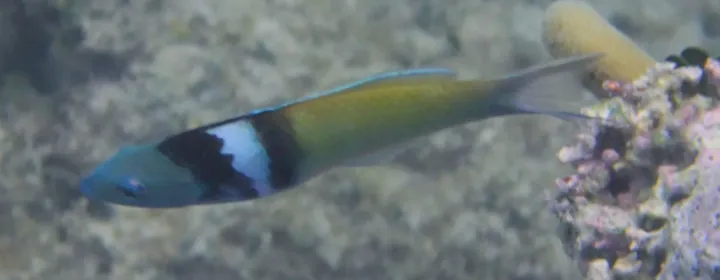
Adult males are characterized by a vibrant blue head separated by black vertical stripes, and a greenish body. Females and juveniles are typically yellow, which often leads to identification challenges in natural habitats.
This species is highly mobile and active during daylight hours. They possess highly developed jaw structures specifically adapted for capturing and crushing small organisms inhabiting coral reef structures.
The biology of the species is intrinsically linked to the maintenance of coral community structures. In the wild, they fulfill a dual role, acting as both cleaners and consumers of biota essential for reef health.
Reproduction occurs via spawning, during which fish form temporary aggregations. The larval stage is pelagic, ensuring the wide dispersal of the species throughout Atlantic reef ecosystems.
What it damages
This species is classified as a pest within the context of marine aquariums and commercial coral farming, as it causes significant damage to symbiotic organisms.
The wrasse actively consumes small invertebrates, including polychaetes and crustaceans, which are necessary for natural filtration and maintaining balance in artificial reef systems.
In closed systems, the fish exhibits aggressive behavior toward polyps, biting off soft coral tissues, which leads to necrosis and the subsequent death of the entire colony.
High population density in confined spaces causes rapid destruction of biodiversity, making the coexistence of the fish with sensitive hydrobiont species impossible.
The damage manifests as a disruption of symbiosis, leading to the degradation of artificial reef plantations and significant economic losses for marine farms.
Signs of infestation
The first sign of infestation or presence of this species is the appearance of characteristic bite marks on the edges of coral tissues, appearing as ragged margins without visible signs of disease.
There is a sharp decline in the population of small crustaceans and beneficial filter-feeding worms within the substrate, which are consumed by the wrasse first.
Visual confirmation of the pest is provided by frequent outbursts of aggression by the fish against coral polyps, which begin to retract and lose pigmentation at the damage sites.
With prolonged presence in the system, a decrease in water clarity is noted due to coral decay products and a shift in biological balance caused by the deficiency of cleansing species.
During nighttime, restlessness of coral colonies that cannot recover after daytime attacks is evident, indicating systemic stress of the entire ecosystem.
Control measures
The primary control method is the mechanical isolation of the fish from valuable coral colonies using specialized netting or moving them to quarantine tanks.
To prevent damage, it is recommended not to introduce the Bluehead wrasse into reef aquariums, preferring species-only or fish-only tanks without soft corals.
Dietary regulation is an effective approach; frequent feeding with specialized diets reduces the fish's interest in nipping at the natural biota of the reef.
In commercial coral cultivation, biological barriers and acoustic deterrent methods are used, though these require high precision in equipment calibration.
In extreme cases, where coexistence is impossible, full removal of individuals using traps is conducted, which allows for the restoration of beneficial microorganism populations in the system.
Taxonomy
- Latin name
- Thalassoma bifasciatum
- Family
- Labridae
- EPPO code
- THASBI
Discussion
No discussions yet — be the first.