
Tetrastichus tymber
Tetrastichus tymber
Description
How to identify
Tetrastichus tymber is an insect belonging to the order Hymenoptera and the family Eulophidae. These are tiny parasitic wasps that, within their life cycle, can exhibit both beneficial entomophagous properties and harmful gall-forming behaviors.
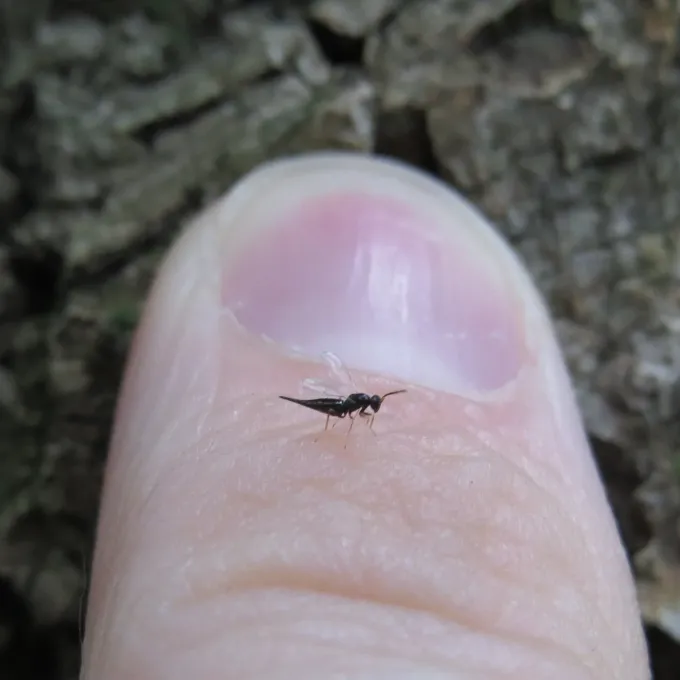
Adult individuals possess a body structure typical of chalcid wasps. Their size is extremely small, making detection by the naked eye in field conditions quite challenging without specialized equipment.
The coloration of these insects typically ranges from dark brown to black, often with a metallic sheen. Their wings are transparent with minimal venation, which is a hallmark feature of the family.
Tetrastichus tymber larvae lead a concealed lifestyle within plant tissues. Depending on the developmental stage, they appear whitish or yellowish with a soft, unsclerotized body.
Differentiating this species from related beneficial entomophages requires laboratory analysis, as morphological distinctions between beneficial and harmful members of the genus are often minimal.
What it damages
This pest primarily affects woody plants and shrubs by forming specific tissue growths known as galls. This leads to the deformation of plant organs and a disruption of normal physiological processes.
The greatest damage is inflicted upon young shoots and buds, which stunts the overall growth of the crop. Mass infestation leads to the suppression of the entire aerial part of the plant.
Damage to tissues by gall-forming larvae creates favorable conditions for secondary infections, including fungal diseases and bacterial pathogens.
A reduction in the photosynthetic activity of leaves near the pest's location leads to an overall weakening of the plant's immune system and a loss of productivity.
In nurseries, Tetrastichus tymber can cause significant quality degradation of planting material, rendering seedlings unmarketable due to external deformities.
When it appears
The pest's activity is closely linked to the plant's growing season. Adult emergence in spring coincides with the phase of active sap flow and bud break, which serve as primary substrates for oviposition.
The summer generation develops within the formed galls. Optimal conditions for reproduction include moderate temperatures and high humidity.
Overwintering occurs at the larval or pupal stage within plant debris or directly inside host tissues, where the pest is protected from extreme temperature fluctuations.
The number of annual generations depends on the climatic zone, though peak harmful activity is typically observed in mid-summer when population density reaches its maximum.
The autumn period is characterized by the pest entering diapause, which allows the species to successfully survive unfavorable winter conditions.
Signs of infestation
The primary diagnostic sign of infestation is the presence of galls — pathological growths on leaves or young shoots. These often possess a characteristic shape and color distinct from healthy tissue.
Upon close inspection, one may notice small exit holes on the surface of the galls, through which the adults emerge after completing their metamorphosis.
Curling, premature yellowing, and leaf drop in localized spots of infestation are also indicators of the pest's presence.
Reduced shoot growth intensity and stem distortion serve as long-term signs of chronic plant infestation.
The presence of specific secretions or associated fungal mold on damaged areas also serves as a signal that phytosanitary control is required.
Control measures
The primary method of control is regular sanitary pruning and the destruction of infested shoots and leaves. This significantly reduces the population size early in the season.
Systemic insecticide application is effective only during the adult emergence period, before larvae can penetrate deeper into plant tissues and form protective galls.
Agrotechnical practices, such as balanced fertilization, help enhance the overall resistance of plants to pest colonization.
- Monitoring using pheromone or sticky color traps.
- Biological control by encouraging natural predators.
- Timely disposal of plant residues in autumn.
Maintaining crop rotation and proper spatial isolation of nurseries is crucial for preventing the rapid spread of the pest between plantings.
Taxonomy
- Latin name
- Tetrastichus tymber
- Order
- Hymenoptera
- Family
- Eulophidae
- EPPO code
- TETSTY
Discussion
No discussions yet — be the first.