
Bicarinate ant
Tetramorium bicarinatum
Description
How to identify
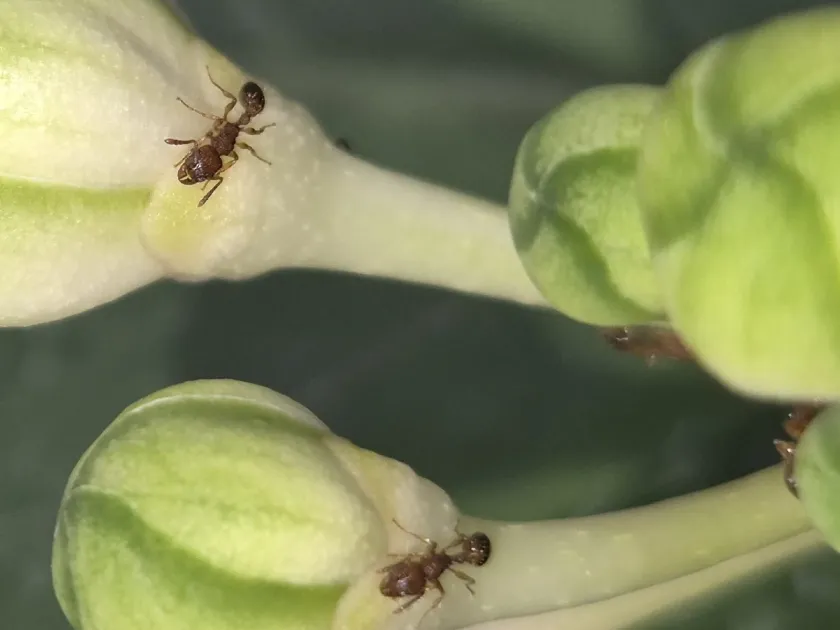
The bicarinate ant (Tetramorium bicarinatum) belongs to the family Formicidae of the order Hymenoptera. It is an invasive species of small ants, with worker individuals typically measuring between 2.5 and 3.5 mm in length.
Their coloration ranges from yellowish-brown to dark reddish-brown. A key diagnostic feature is the presence of distinct ridges (carinae) on the head and thorax, as well as a specific shape of the petiole, which allows experts to distinguish them from native ant species.
This species is characterized by high social plasticity and the ability to form polygynous colonies, where multiple egg-laying queens coexist. This social structure makes the population highly resilient and capable of rapid recovery after disturbances.
These ants often nest in the soil, under stones, in rotting wood, or within the root zones of plants. They thrive in warm and humid environments, making them particularly problematic in greenhouses and indoor nursery settings.
While cosmopolitan in distribution, they are highly problematic in tropical and subtropical agricultural systems, where they successfully outcompete local fauna and dominate disturbed habitats.
What it damages
Bicarinate ants cause significant indirect damage to crops by acting as mutualists to sap-sucking insects. They protect aphids, mealybugs, and scale insects from predators and parasitoids in exchange for honeydew.
This protective behavior leads to massive outbreaks of sap-sucking pests, which drain nutrients from plant stems and leaves, causing wilting, stunting, and overall weakening of the host plants.
The excessive honeydew excreted by the aphids provides a substrate for sooty mold growth. This black fungus covers the leaf surface, severely inhibiting photosynthesis and reducing the yield and quality of the affected crops.
In nursery settings, these ants can damage seeds during germination or disturb the root systems of young seedlings while excavating nest galleries. This can result in poor stand establishment and loss of young nursery stock.
Furthermore, they serve as mechanical vectors for plant pathogens. By moving between infested and healthy plants, they can carry fungal spores and bacteria on their bodies, facilitating the spread of various plant diseases.
When it appears
The activity of Tetramorium bicarinatum is closely linked to temperature. In climate-controlled greenhouses, they can remain active throughout the entire year, posing a continuous threat to indoor crops.
In outdoor environments, their activity peaks during the spring and summer months when soil temperatures reach optimal levels (20–30°C) for brood development. During colder periods, they retreat to deeper soil layers or sheltered structures.
Nuptial flights and the establishment of new colonies are often triggered by high humidity levels, frequently occurring during rainy seasons or periods of heavy irrigation. This allows them to expand their territory efficiently.
Because their life cycle from egg to adult is relatively short (4–6 weeks under favorable conditions), a single colony can grow significantly during a single growing season, making early detection vital.
Effective management requires monitoring during the early spring before the first generation of workers begins to actively forage and tend to aphid colonies on young crops.
Signs of infestation
One of the most obvious signs of infestation is the presence of active foraging trails leading toward plants infested with aphids or mealybugs. Seeing ants moving up and down the stems is a primary indicator of their presence.
Small mounds of soil or nests found at the base of plants are another common sign. This activity often coincides with wilting or chlorosis of the foliage, caused by the disruption of the root-soil interface.
The presence of a sticky honeydew film on leaves, followed by the appearance of black sooty mold, is a strong secondary indicator that ants are actively farming and protecting sap-sucking insects in the area.
Direct sightings of the ants during routine weeding or soil cultivation in pots and greenhouse beds confirm the infestation. Their preference for moist substrate makes them easy to spot when turning over soil or lifting containers.
Finally, a general decline in plant vigor, leaf curling, and stunted growth in localized patches is a strong symptom that a thriving ant colony is supporting pest populations on the host plants.
Control measures
Controlling the bicarinate ant requires a combined strategy that targets both the ants and the pests they protect. The use of slow-acting toxic baits is the most effective way to eliminate the entire colony, including the queens.
Aggressive management of sap-sucking insects (aphids, mealybugs) using insecticides or biological control agents reduces the availability of honeydew, making the area less attractive to the ants and forcing them to move.
In greenhouse environments, physical barriers such as sticky bands applied to the base of plant stems prevent ants from accessing the foliage, effectively isolating the aphid colonies from their guardians.
Good sanitation practices, such as removing weeds that harbor aphid populations and clearing plant debris, are essential for reducing nesting sites and limiting the ants' ability to establish colonies.
- Use slow-acting boric acid-based baits to target queens.
- Apply sticky barriers to stems of greenhouse plants.
- Control aphid and scale populations to remove food sources.
- Maintain clean greenhouse floors to eliminate nesting sites.
- Regularly disturb soil in pots to disrupt gallery construction.
Taxonomy
- Latin name
- Tetramorium bicarinatum
- Order
- Hymenoptera
- Family
- Formicidae
- EPPO code
- TETMBI
Discussion
No discussions yet — be the first.