
Shipworm
Teredo
Description
How to identify
The shipworm is a marine bivalve mollusk of the family Teredinidae that is frequently mistaken for a worm due to its elongated body shape.
The anterior end of the organism features a specialized shell that acts as a drill, allowing the bivalve to bore into submerged wooden structures.
Adult specimens can grow to lengths of several dozen centimeters, creating long, narrow tunnels within the wood they occupy.
These organisms possess two siphons used to filter water and intake nutrients, while their protective tunnels are lined with a calcareous substance.
The reproductive cycle includes a free-swimming larval stage, during which the larvae disperse to find new suitable wooden surfaces for colonization.
What it damages
Shipworms infest all types of submerged timber, including bridge pilings, harbor docks, piers, and the wooden hulls of boats and ships.
While they do not digest cellulose as their primary food source, they bore into wood to create permanent living chambers, resulting in massive mechanical damage.
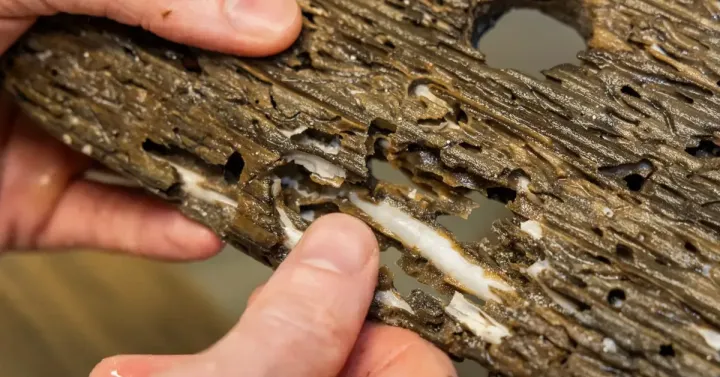
As they feed on organic matter filtered from the water, they leave a complex, labyrinthine network of tunnels that destroys the wood's internal structure.
This process of internal degradation often occurs without leaving any visible external damage until the structural integrity of the timber is severely compromised.
The cumulative damage often results in the sudden collapse of wooden foundations, leading to significant economic losses and safety risks.
Signs of infestation
Identifying a shipworm infestation is challenging because the mollusk remains almost entirely hidden beneath the wood surface during its life cycle.
External signs are limited to tiny circular entrance holes, which are easy to overlook in an active aquatic environment.
When the wood is cut or damaged, one can clearly see the internal galleries that occupy the wood, often lined with a white calcium carbonate coating.
A loss of structural stability or "hollow" sounds when tapping on submerged wooden pilings are indicators of advanced infestation.
If a timber element breaks easily under pressure, it is likely that the internal cross-section has been extensively honeycombed by shipworm activity.
Control measures
Chemical preservation is the primary defense, involving the pressure treatment of timber with creosote or copper-based compounds to prevent colonization.
Applying high-quality anti-fouling coatings to boat hulls creates a toxic barrier that discourages larvae from settling and boring into the surface.
Physical protection methods include wrapping wooden pilings in protective plastic or concrete sleeves to eliminate any contact with marine water.
Choosing alternative materials, such as marine-grade steel, reinforced concrete, or composite polymers, effectively eliminates the risk of shipworm damage.
Regular maintenance inspections by divers or engineers remain the most reliable way to monitor for early signs of infestation in critical harbor infrastructure.
Taxonomy
- Latin name
- Teredo
- Family
- Teredinidae
- EPPO code
- TERDSP
Discussion
No discussions yet — be the first.