
Ghost ant
Tapinoma melanocephalum
Description
How to identify
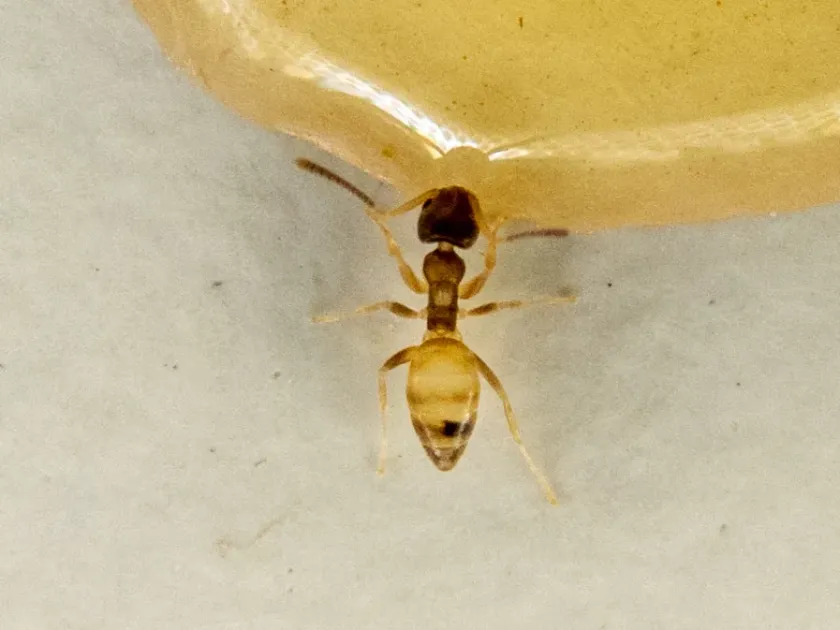
The ghost ant (Tapinoma melanocephalum) belongs to the family Formicidae and the order Hymenoptera. It is a tiny ant, with workers measuring only 1.5 to 2 mm in length.
The insect has a distinctive bicolored body: the head and thorax are dark brown to black, while the abdomen and legs are pale, translucent, and yellowish-white.
This species is highly invasive and polygynous, meaning colonies contain multiple queens, making it extremely resilient and difficult to eradicate with traditional methods.
Ghost ants are highly mobile and tend to nest in various cavities, including hollow plant stems, soil crevices, and spaces within man-made structures.
They establish clear pheromone trails to facilitate efficient food gathering, allowing them to rapidly colonize greenhouse environments and indoor plant displays.
What it damages
The primary damage caused by ghost ants is indirect; they maintain symbiotic relationships with honeydew-secreting insects such as aphids, mealybugs, and scale insects.
By protecting these pests from natural predators and parasitoids, ghost ants indirectly promote high infestation levels that lead to leaf deformation and plant decline.
The accumulation of honeydew secreted by these pests encourages the growth of sooty mold, a black fungus that covers leaves and interferes with essential photosynthesis.
Ghost ants may occasionally damage soft plant tissues, such as young buds or shoots, while searching for nectar or plant juices in areas punctured by other pests.
In containerized plant production, mass infestations can severely disrupt the root zone, potentially causing the plant to wilt or die due to soil disturbance.
When it appears
In tropical climates, the ghost ant remains active year-round, whereas in temperate greenhouses, activity peaks during the warmer spring and summer months.
Colony reproduction and expansion are most aggressive during periods of high temperature and humidity, which typically coincide with active plant growth cycles.
As outdoor temperatures drop, colonies often migrate into warmer environments, such as heated greenhouses or buildings, to continue their lifecycle throughout the winter.
The developmental cycle from egg to adult takes approximately one month, allowing populations to multiply exponentially within a single growing season.
Observing foraging ants in early spring serves as a critical warning, necessitating immediate intervention to prevent the establishment of multiple nesting sites.
Signs of infestation
The most common sign is the appearance of distinct, rapid-moving trails of tiny bicolored ants traversing plant stems, particularly near aphids or scale colonies.
Sticky honeydew residues on foliage, followed by the appearance of dark, powdery sooty mold, are strong indicators of ghost ant activity on the premises.
Nests found within potted plant soil, under loose bark, or inside hollow plant stems confirm an active, well-established colony nearby.
Behavioral identification: when disturbed, ghost ants display erratic, rapid movement patterns, distinguishing them from other ant species that tend to be more deliberate.
Sudden wilting or stunted growth in young plants may also suggest that ant nest construction is interfering with the root system's ability to access water and nutrients.
Control measures
Effective management requires a multi-faceted approach, as contact insecticides often fail to eliminate the multiple queens present in the nest.
The most successful strategy involves using slow-acting, non-repellent bait stations, which workers carry back to the colony to eliminate the queens and larvae.
Simultaneously controlling the sap-sucking pests (aphids and scale) is essential, as their presence provides the primary food source that sustains the ant population.
- Regular monitoring of plant foliage for ant trails.
- Placement of gel-based baits in foraging paths.
- Sanitation measures to reduce attractants like honeydew.
Biological control options, such as the use of entomopathogenic fungi, can be implemented in contained greenhouse environments to suppress population growth.
Taxonomy
- Latin name
- Tapinoma melanocephalum
- Order
- Hymenoptera
- Family
- Formicidae
- EPPO code
- TAPIME
Discussion
No discussions yet — be the first.