
Tanais dulongii
Tanais dulongii
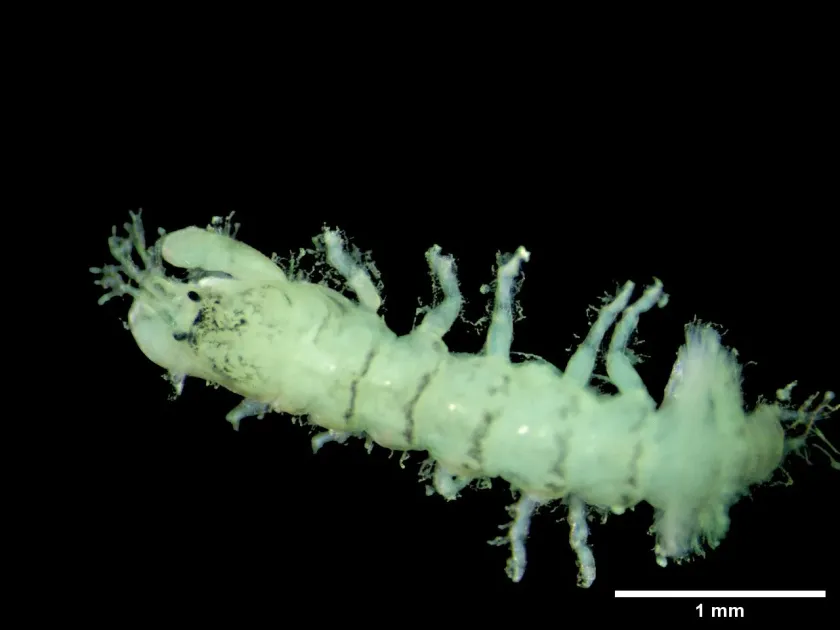
Description
How to identify
Tanais dulongii is a small crustacean belonging to the order Tanaidacea, family Tanaidae. These organisms are predominantly marine, typically found in coastal and estuarine environments where they thrive on various submerged substrates.
The morphology of this species is characterized by an elongated, cylindrical, and segmented body. The first pair of thoracic appendages is modified into prominent chelae, which are vital for defense, movement, and the construction of protective housing.
The biological strategy of Tanais dulongii involves the construction of tubes made from secreted substances and environmental particles. These structures serve as robust shelters, protecting the individuals from predators and allowing them to survive in dynamic water environments with fluctuating currents.
The life cycle includes the development of embryos within the female's marsupium, followed by the release of larvae. These larvae undergo several molts, gradually increasing in size and complexity, which requires consistent feeding to support rapid growth phases.
While playing a role in natural ecosystems, this species is considered a pest in marine aquaculture. Its ability to colonize cultivation structures and feed on cultured macrophytes makes it a notable organism of interest for agronomic management.
What it damages
This crustacean feeds primarily on organic detritus and the tissues of living algae. In aquaculture settings, their feeding activity can cause significant damage to commercial seaweed crops, negatively impacting total biomass and product quality.
Damage is typically seen as localized grazing on the thalli of the seaweed. As the crustaceans feed, they create irregular holes or skeletonized patches, which significantly diminish the aesthetic and market value of the harvested seaweed.
Injured tissues are highly susceptible to secondary infections caused by opportunistic bacteria and fungi. These pathogens can rapidly spread from the feeding sites to healthy parts of the plant, often leading to widespread necrosis and plant death.
Beyond direct tissue consumption, the physical presence of crustacean tube colonies on the seaweed surface blocks light absorption. This reduction in photosynthetic activity leads to stunted growth and weakened plant physiology, even when nutrient availability is optimal.
High population densities of Tanais dulongii can result in substantial financial losses for aquaculture farmers. The destruction of juvenile crops is particularly damaging, as it undermines the stability and profitability of the entire production cycle.
Signs of infestation
The primary sign of infestation is the visible accumulation of small, brownish or greyish tubes on the surfaces of the seaweed thalli. These constructs are often the first indicator that a population has successfully colonized the growing environment.
A closer inspection with a magnifying lens or microscope reveals the active presence of the crustaceans within their protective tubes. Upon disturbance, they often retreat into their shelters, confirming that the tubes are currently occupied by living individuals.
Tissue damage manifests as patchy areas of degradation or irregular edges along the margins of the seaweed. If these areas start to turn pale or brownish, it is a clear indicator that the crustaceans have been grazing there and that tissue death is occurring.
Stunted growth within a seemingly healthy crop batch often points to the hidden presence of these pests. When plants fail to meet expected growth rates, it is advisable to inspect the base and structural surfaces for evidence of tube colonies.
Finally, the presence of loose tube fragments and mixed organic detritus accumulating at the base of the cultivation ropes or meshes confirms that the pest population is well-established and actively expanding across the crop surface.
Control measures
Management begins with the rigorous sanitation of all cultivation hardware, such as ropes, nets, and frames. Cleaning these materials with hot water or appropriate disinfecting agents before deployment is crucial to eliminate any remaining eggs or larvae.
Biological control methods represent an effective long-term strategy. Introducing small, predatory fish species that naturally feed on crustaceans can help maintain the Tanais dulongii population at sub-economic levels without chemical intervention.
In closed aquaculture systems, manipulating environmental factors can be beneficial. Short-term exposure to altered salinity levels can cause stress to these marine crustaceans, forcing them to detach or resulting in high mortality rates, thereby clearing the infestation.
Constant monitoring is essential for early detection. Farmers should perform routine checks of their seaweed stocks to identify hotspots of infestation. Removing and destroying affected plants immediately is a necessary step to prevent the spread to adjacent areas.
Integrated farm management, including the optimization of stocking density and the selection of more resistant plant varieties, reduces the ecological niche available for these pests, ultimately leading to more sustainable and productive aquaculture outcomes.
Taxonomy
- Latin name
- Tanais dulongii
- Family
- Tanaidae
- EPPO code
- TNAIDU
Discussion
No discussions yet — be the first.