
Short-beaked echidna
Tachyglossus aculeatus
Description
How to identify
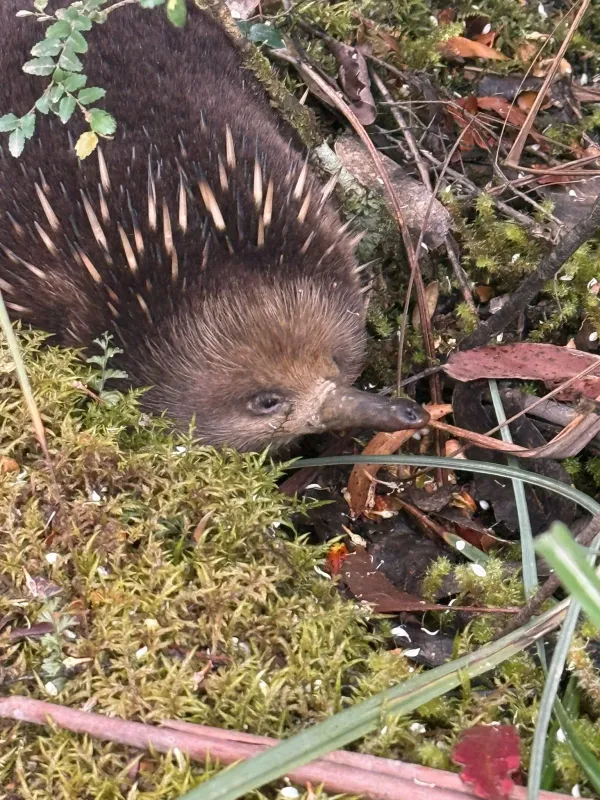
The short-beaked echidna (Tachyglossus aculeatus) is a monotreme mammal native to Australia, belonging to the Tachyglossidae family.
The animal is easily identified by its coat of coarse fur and sharp spines, along with a distinct, elongated, and toothless snout used for foraging.
Its forelimbs are exceptionally strong and equipped with long, powerful claws, which are anatomically adapted for rapid digging in hard soil.
The species is generally solitary and nocturnal, making them elusive visitors that are more likely to be identified by their damage than by direct sightings.
They are famous for their unique reproductive biology, laying a single egg directly into a pouch where the young joey develops until it grows spines.
What it damages
Echidnas are primarily insectivores and do not intentionally eat cultivated plants, but their foraging behavior causes significant agricultural disruption.
The primary concern for gardeners is the destruction of lawn surfaces, flower beds, and seedling rows caused by deep, aggressive soil digging.
By digging for ants, termites, and grubs, they frequently undermine the root systems of young trees and shrubs, leading to plant stress or dehydration.
Heavy disturbance of the soil surface can lead to the erosion of mulch and topsoil, negatively affecting the health and growth rate of young crops.
In irrigation-heavy areas, echidnas may accidentally damage soft piping or drip irrigation systems while trying to access moisture or insects buried beneath.
Signs of infestation
The most visible sign of an echidna visit is the presence of numerous conical holes, often 20 to 30 centimeters deep, scattered across the landscape.
Gardeners often notice large patches of turned-over soil or "plowed" turf areas where the animal has searched for subterranean insect prey.
In softer soil, distinct claw marks and tracks can be found near the disturbed areas, often accompanied by piles of displaced loose earth.
Plants may appear suddenly wilted or physically displaced from their holes, as the echidna’s digging often inadvertently exposes and damages roots.
During the night, scratching sounds in the undergrowth or characteristic heavy sniffing near flower beds indicate the presence of an active echidna.
Control measures
The most effective long-term solution is the installation of fine-mesh metal fencing buried at least 20 centimeters into the ground to block entry.
Reducing the population of subterranean insects like ants and grubs can make the area less attractive as a food source for echidnas.
Ultrasonic repellers may provide a temporary deterrent, though their effectiveness varies depending on the animal's habituation to the environment.
For sensitive high-value gardens, using protective wire cages around the root zones of saplings can prevent physical damage during digging sessions.
If you encounter an echidna, maintain a safe distance and avoid touching the animal, as their spines can cause injury and they are protected species in many regions.
Taxonomy
- Latin name
- Tachyglossus aculeatus
- Family
- Tachyglossidae
- EPPO code
- TCHGAC
Discussion
No discussions yet — be the first.