
Celery looper
Syngrapha falcifera
Description
How to identify
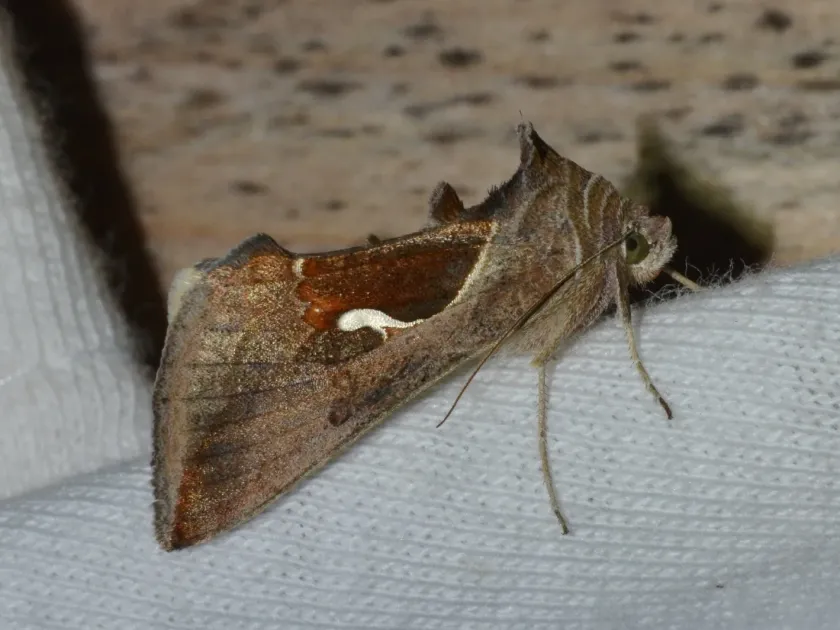
The celery looper (Syngrapha falcifera) is a moth belonging to the Noctuidae family. The adult moth has a wingspan of approximately 30 to 35 mm. Its forewings are mottled with gray and brown tones, featuring a distinctive, metallic, hook-shaped or silver-comma mark that makes it easily recognizable to specialists.
These moths are primarily nocturnal, though they exhibit activity during dusk as well. They are strong fliers and capable of long-distance migration, which allows them to colonize new agricultural areas rapidly during the growing season when environmental conditions are optimal.
The larvae, known as loopers, are light green with thin white lines along their bodies. Their common name comes from their distinctive movement: they lack some of the middle prolegs found in other caterpillars, forcing them to arch their backs into a loop when crawling across foliage.
Pupation occurs within a loose, white, silken cocoon often spun on the underside of leaves or within debris on the soil surface. This stage is crucial for the insect's survival, as it prepares the transition from the larval stage to the reproductive adult stage.
The number of generations per year depends heavily on the regional climate. In warmer southern regions, several overlapping generations can occur within a single season, posing a continuous threat to various vegetable and field crops throughout the summer and early autumn.
What it damages
The celery looper is a generalist feeder with a wide host range. It commonly infests crops such as celery, lettuce, tomatoes, cabbage, peas, and potatoes. Its ability to thrive on diverse plant species makes it a persistent challenge for commercial vegetable producers and smallholders alike.
Damage is almost exclusively caused by the larval stage. Early-instar larvae feed on the underside of leaves, creating small holes or "windowpane" marks where they consume the tissue while leaving the leaf veins intact. This behavior can be overlooked by casual observers.
As the larvae mature, they become voracious eaters, consuming large portions of the leaf blade. This heavy defoliation drastically reduces the plant's photosynthetic capacity, which directly results in stunted growth, lower crop yields, and poor quality of the harvested product.
In addition to foliage destruction, older larvae may attack developing fruits or vegetables directly. This is particularly destructive for crops like tomatoes or cabbages, where larvae bore into the fruit or head, leaving behind debris and inviting secondary fungal or bacterial pathogens.
Mass infestations can destroy entire fields within a short period if not addressed. The economic threshold is often reached quickly, especially when young plants are attacked, as the destruction of the terminal bud or stem can cause total plant loss.
Signs of infestation
One of the first signs of an infestation is the presence of small, irregular holes in the leaves. Careful inspection of the lower leaf surfaces often reveals small green larvae resting along the veins during the cooler parts of the day.
Accumulations of frass (larval excrement) on the foliage or at the base of the plant are reliable indicators of feeding activity. These dark, granular droppings are a clear signal that a population of larvae is actively developing on the crop.
The presence of fine webbing on the leaves is another diagnostic sign. Loopers often use this silk to anchor themselves or to construct simple shelters within folded leaves, which helps protect them from predators and pesticides.
Late-season damage is marked by deep holes in fruiting structures. For vegetable crops, this leads to rot and decay, rendering the produce unmarketable. Any visual evidence of feeding on the fruit itself requires immediate intervention to prevent further spread.
Monitoring using pheromone traps is the most accurate way to detect the presence of adult moths before egg-laying begins. By tracking the flight patterns of the moths, growers can predict the onset of larval activity and apply controls at the most vulnerable stage of the pest.
Control measures
Cultural control practices are fundamental to managing celery looper populations. Tilling the soil after harvest destroys pupae overwintering in the ground. Furthermore, keeping fields free of weeds removes alternative host plants that support the larvae early in the season.
Biological control is highly effective when used correctly. The application of Bacillus thuringiensis (Bt) based sprays is a common strategy. This bacteria specifically targets the larvae, causing them to stop feeding and die while leaving beneficial insects like ladybugs or lacewings unharmed.
Chemical control should be applied when economic thresholds are met. Systemic insecticides are generally effective, but they should be used in rotation to prevent the development of pesticide resistance. Evening applications are recommended to ensure maximum contact with the nocturnal larvae.
Integrated Pest Management (IPM) is the best approach for long-term control. This involves combining biological treatments, regular field scouting, and strategic crop timing to minimize the impact of the pest while maintaining a balanced ecosystem within the farm environment.
- Maintain a strict crop rotation schedule.
- Utilize Trichogramma wasps as a form of biocontrol for eggs.
- Conduct weekly field inspections during peak growing periods.
Taxonomy
- Latin name
- Syngrapha falcifera
- Order
- Lepidoptera (butterflies)
- Family
- Noctuidae
- EPPO code
- SYNGFA
Discussion
No discussions yet — be the first.