
Stenopus spinosus
Stenopus spinosus
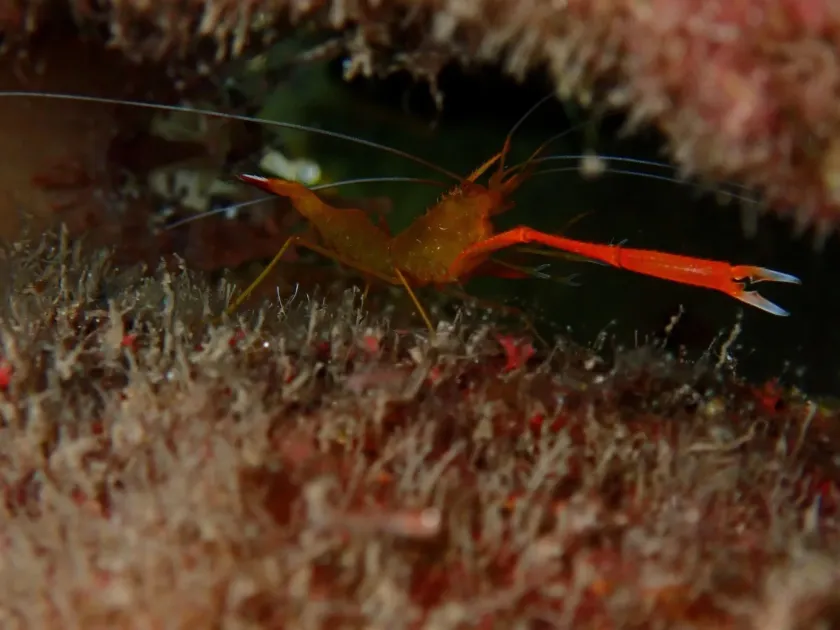
Description
How to identify
Stenopus spinosus, commonly known as a type of coral shrimp, is a decapod crustacean belonging to the family Stenopodidae.
It is distinguished by its vibrant reddish-orange coloration and its long, prominent claws that are often covered in small spines.
This species is strictly marine and is found primarily in rocky crevices and coral reef environments in the Mediterranean and Atlantic.
Its morphology is adapted for life in deep or sheltered water, where it uses its keen eyesight to navigate.
Taxonomically, it is placed within the order Stenopodidea, which is distinct from the common shrimp species seen in commercial markets.
What it damages
Stenopus spinosus is not a plant pest and poses no threat to agricultural crops, including grains, vegetables, or fruits.
It does not feed on vegetation; instead, its diet consists of smaller marine organisms and detritus within its aquatic habitat.
There is no record of this species damaging farming infrastructure, as it cannot survive or operate in terrestrial environments.
Its impact is limited to the marine ecosystem, where it interacts with other marine life as a predator or scavenger.
In conclusion, this crustacean has no agricultural significance and is not recognized as a pest in any farming industry.
When it appears
This species remains active throughout the year, primarily influenced by water temperatures rather than agricultural seasons.
There is no specific seasonal appearance linked to crop growth, planting, or harvesting schedules.
Reproduction cycles are aligned with the warmer months of the year, facilitating larval development in the open sea.
Daily activity cycles are more relevant, as the species is nocturnal and spends the daylight hours hidden in crevices.
Environmental changes in water temperature are the main drivers of its lifecycle activity.
Signs of infestation
Evidence of this species can only be observed by divers or researchers exploring marine reef systems.
The primary sign of their presence is seeing the individuals within their natural habitats, such as deep rocky holes.
They are relatively shy, often retreating deeper into their dens when they detect movement in the water.
Because they do not interact with crops, there are no feeding marks, tunnels, or damage symptoms to look for.
Occasionally, discarded exoskeletons may be found near their habitat, indicating a recent molt.
Control measures
No protection measures are required against Stenopus spinosus as it is not a pest for land-based agriculture.
In aquaculture settings, population control is achieved simply by manual removal if the presence of the crustacean becomes disruptive.
The use of chemical pesticides is strictly prohibited and unnecessary, as it would cause significant ecological damage to the aquatic environment.
Maintaining a balanced environment in managed aquatic systems is the most effective way to prevent dominance by any single species.
Monitoring the density of these crustaceans in reef ecosystems is done purely for scientific purposes, not for pest management.
Taxonomy
- Latin name
- Stenopus spinosus
- Family
- Stenopodidae
- EPPO code
- STNQSQ
Discussion
No discussions yet — be the first.