
Mantis shrimp
Squilla mantis
Description
How to identify
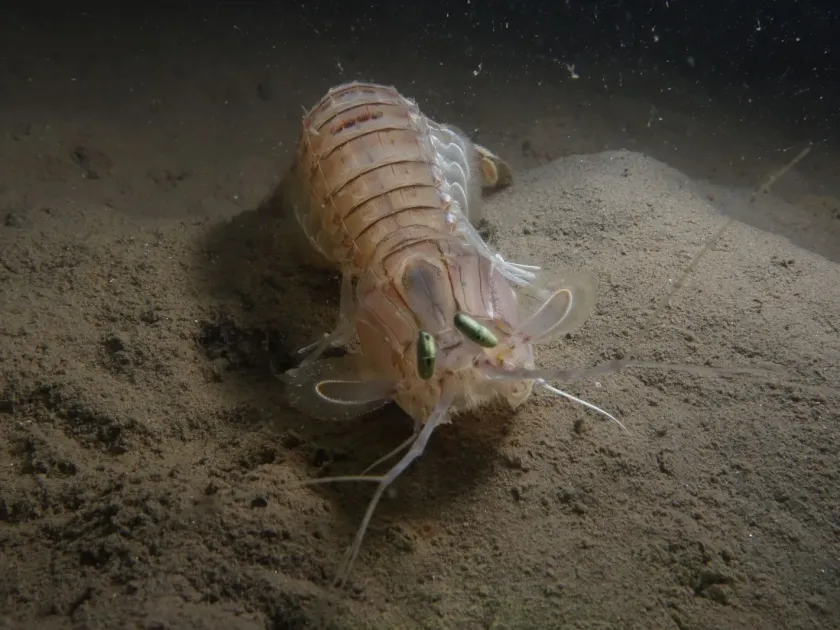
The mantis shrimp (Squilla mantis) is a predatory marine crustacean belonging to the order Stomatopoda and the family Squillidae, known for its complex vision and powerful limbs.
Adult specimens measure between 15 and 20 cm, featuring a flattened body protected by a sturdy exoskeleton, usually colored in shades of grey, brown, or yellow.
Their most defining feature is the pair of raptorial appendages, which are highly specialized for striking prey with extreme speed and force, functioning like a spring-loaded trap.
They possess stalked compound eyes capable of detecting polarized light and multiple color bands, allowing them to perceive depth and environment with incredible accuracy.
Mantis shrimps are burrowing animals that reside in U-shaped or Y-shaped tunnels within soft sandy or muddy sediments, predominantly emerging at night to hunt.
What it damages
In aquaculture environments, Squilla mantis is considered a biological nuisance that poses significant risks to the structural integrity of underwater installations.
Their burrowing activity in the soft sea floor disturbs the placement of seabed-based cultivation systems, often causing structures to shift, sink, or become unstable.
The sharp raptorial appendages can puncture high-strength netting and containment membranes, allowing cultured species to escape and exposing them to external marine predators.
Sediment displacement caused by tunnel construction leads to localized silting, which suffocates sedentary organisms and alters the nutrient levels necessary for the growth of sea plants.
As opportunistic carnivores, these crustaceans also consume cultured bivalves and small fish, leading to direct economic losses for farmers operating in coastal shallow waters.
Signs of infestation
The most visible indicator of an infestation is the appearance of well-defined burrow entrances on the sea floor, often surrounded by small mounds of excavated material.
Torn protective meshes with clean, slit-like punctures suggest the presence of mantis shrimp, as their limbs are capable of piercing industrial-grade polymers.
A decline in the density of bivalve populations within the farmed area, not associated with disease or water quality issues, often points to predation by these crustaceans.
Discovery of discarded exoskeletons near equipment is a clear sign that the population is growing and molting within the immediate vicinity of your aquaculture site.
Increased activity near the sea floor at night, captured by underwater video surveillance or movement sensors, serves as a primary alert for management teams.
Control measures
Utilizing high-density, abrasion-resistant nets is the most effective way to prevent physical damage caused by the crustacean's sharp raptorial limbs.
Implementing artificial barriers or gravel beds underneath cultivation racks makes it physically difficult for the shrimp to establish their tunnels and stay within the farm zone.
Targeted trapping programs using tunnel-style bait traps are highly efficient during the breeding season to manage and reduce the density of the local population.
Regular visual inspections of the submerged infrastructure are essential for early detection, allowing for the repair of potential vulnerabilities before they become major damage points.
Promoting a balanced ecosystem by encouraging the presence of natural fish predators can help maintain a healthy population size without the need for intensive chemical or mechanical interference.
Taxonomy
- Latin name
- Squilla mantis
- Family
- Squillidae
- EPPO code
- SQUIMA
Discussion
No discussions yet — be the first.