
Tropical armyworm
Spodoptera litura
Description
How to identify
The tropical armyworm (Spodoptera litura) is a significant moth species belonging to the family Noctuidae, recognized globally as a devastating agricultural pest.
Adult moths feature a wingspan of 30–40 mm with distinct brown forewings marked by complex patterns of white and silver streaks, which provide excellent camouflage against plant debris.
The insect undergoes a complete metamorphosis through egg, larval (six instars), pupal, and adult stages, with developmental speed highly correlated with ambient temperature and humidity levels.
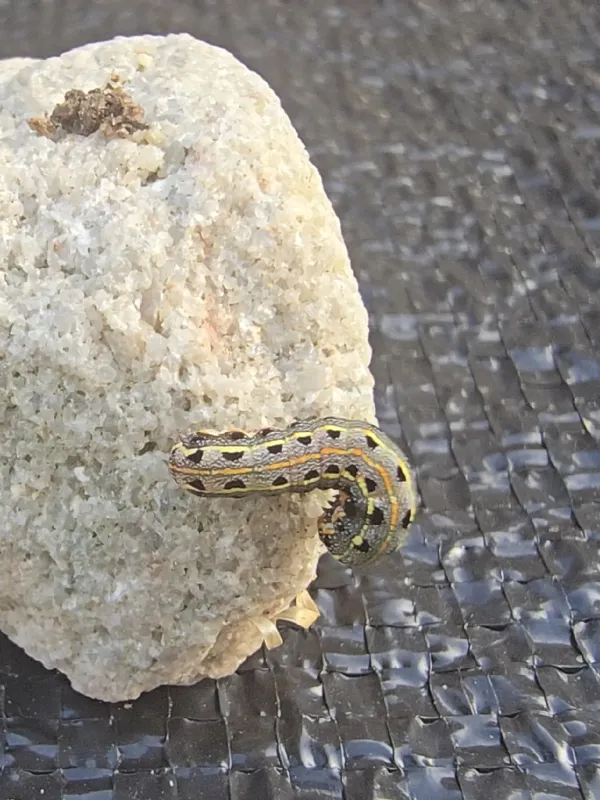
Larvae exhibit variable coloration, often presenting dark grey or velvety black bodies with longitudinal yellow stripes, becoming more vibrant as they progress through developmental instars.
Females are highly prolific, capable of laying hundreds of eggs in clusters on the undersides of leaves, which are typically protected by a layer of scales from the adult moth's body.
What it damages
As a highly polyphagous species, the tropical armyworm infests over 120 host plants, representing a major threat to crops such as cotton, tobacco, soybeans, maize, and various vegetables.
Early-stage larvae aggregate on leaves, causing windowing or skeletonization by feeding on the leaf epidermis, while older larvae disperse and consume entire leaf surfaces.
In addition to foliage damage, older larvae can bore into stems, flower buds, and fruits, which significantly reduces the economic value and marketability of the harvested crop.
High population densities can lead to total defoliation of fields in a matter of days, forcing larvae to migrate en masse to adjacent healthy fields in search of new food sources.
Feeding damage also introduces pathways for secondary pathogens, including bacteria and fungi, which can exacerbate crop loss even after the primary pest activity has been controlled.
Control measures
Integrated Pest Management (IPM) for Spodoptera litura relies on a combination of cultural, biological, and chemical strategies to maintain population density below economic injury levels.
Cultural practices include deep tillage and soil turning to expose pupae to predators and environmental stress, alongside the removal of alternative weed hosts during the off-season.
Monitoring using pheromone-baited traps is essential for early detection of adult migration, allowing farmers to predict potential outbreaks and schedule interventions at the most vulnerable larval stages.
Biological control agents, such as parasitoid wasps or formulations based on nucleopolyhedrovirus (NPV) and Bacillus thuringiensis, offer environmentally friendly alternatives to broad-spectrum insecticides.
When chemical intervention is required, the use of selective insecticides targeting larvae is recommended, ensuring rotations between chemical classes to manage the development of insecticide resistance.
Taxonomy
- Latin name
- Spodoptera litura
- Order
- Lepidoptera (butterflies)
- Family
- Noctuidae
- EPPO code
- PRODLI
Discussion
No discussions yet — be the first.