
Egyptian cotton leafworm
Spodoptera littoralis
Description
How to identify
The Egyptian cotton leafworm (Spodoptera littoralis) is a member of the Noctuidae family, known for its significant impact on agriculture across various warm-climate regions globally.
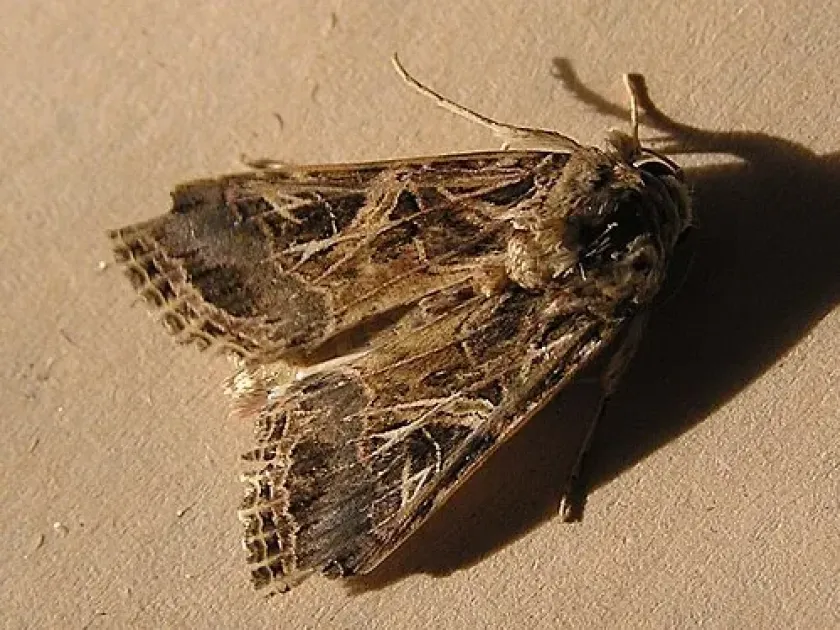
The adult moth possesses a wingspan of approximately 30 to 40 mm, featuring brownish-grey forewings with complex patterns and white-grey hindwings, which provide camouflage.
Females lay their eggs in clusters on the undersides of leaves, covering them with a distinctive layer of hair-like scales from their abdomen to shield them from predators and desiccation.
Larvae pass through six larval instars; their color is highly variable, ranging from light green to dark brown or near-black, typically marked with prominent longitudinal stripes.
Pupation occurs within the soil at depths of up to 10 cm, where the insect remains protected until the adult moth emerges to continue the reproductive cycle.
What it damages
As an extreme polyphagous species, this pest feeds on over 90 different plant species, making it a critical threat to cotton, various vegetables, and ornamental plants.
Early-stage larvae primarily feed on leaf tissues, creating small windows in the leaves, while later-stage larvae consume entire leaf blades, leaving only the primary veins behind.
Beyond foliage, the larvae cause severe damage by boring into reproductive parts, such as flower buds, developing fruit, and pods, rendering the harvest unmarketable.
In high-density infestations, the caterpillars can strip plants of all green tissues within a few days, leading to complete crop failure in localized areas.
The secondary damage caused by fungal and bacterial pathogens entering the wounds made by the larvae often exacerbates the total yield loss significantly.
When it appears
Adult moths typically become active during the spring, with flight activity escalating as temperatures rise consistently above the required developmental threshold.
Multiple generations occur throughout the growing season, with the total number of generations being highly dependent on the local climatic conditions and food availability.
Population spikes are most frequently observed during the summer months, as warmer temperatures accelerate the metabolic rate and shorten the life cycle of the insect.
In protected greenhouse environments, the pest can sustain continuous breeding cycles throughout the year, bypassing natural seasonal dormancy patterns.
As the season ends, the pest either enters diapause in the soil or continues to reproduce in warmer microclimates, ensuring the survival of the population until the next season.
Signs of infestation
Initial signs of infestation are the presence of egg masses on the underside of leaves, which appear as yellowish or beige fuzzy spots visible upon close inspection.
Small irregular holes in leaf tissue and the presence of granular frass (droppings) on the leaf surface indicate the activity of early-instar larvae.
Severe leaf skeletonization is a diagnostic sign of advanced larval stages, which have significantly higher nutritional requirements and voracious feeding habits.
Holes or bores found in fruit, pods, or buds indicate that the larvae have shifted their feeding preference to the plant's reproductive organs.
The presence of nocturnal moths caught in light traps or pheromone traps indicates the onset of a new generation and the urgent need for targeted management.
Control measures
Integrated Pest Management (IPM) strategies include the deployment of pheromone traps to monitor population density and determine the precise timing for intervention.
Cultural control measures, such as deep plowing after harvest, are effective in disturbing soil layers to destroy pupae and disrupt the pest's overwintering survival.
Biological control agents, including the application of Bacillus thuringiensis or the release of parasitic wasps like Trichogramma, are effective strategies for early-stage management.
Chemical control should be implemented using selective insecticides that target specific larval stages while minimizing the impact on beneficial insect populations.
- Crop rotation to minimize the availability of preferred host plants.
- Sanitation by removing crop residues where larvae or pupae might harbor.
- Frequent scouting and monitoring of fields during high-risk months.
- Managing weed populations that act as alternative host sources for the pest.
Taxonomy
- Latin name
- Spodoptera littoralis
- Order
- Lepidoptera (butterflies)
- Family
- Noctuidae
- EPPO code
- SPODLI
Discussion
No discussions yet — be the first.