
Fall armyworm
Spodoptera frugiperda
Description
How to identify
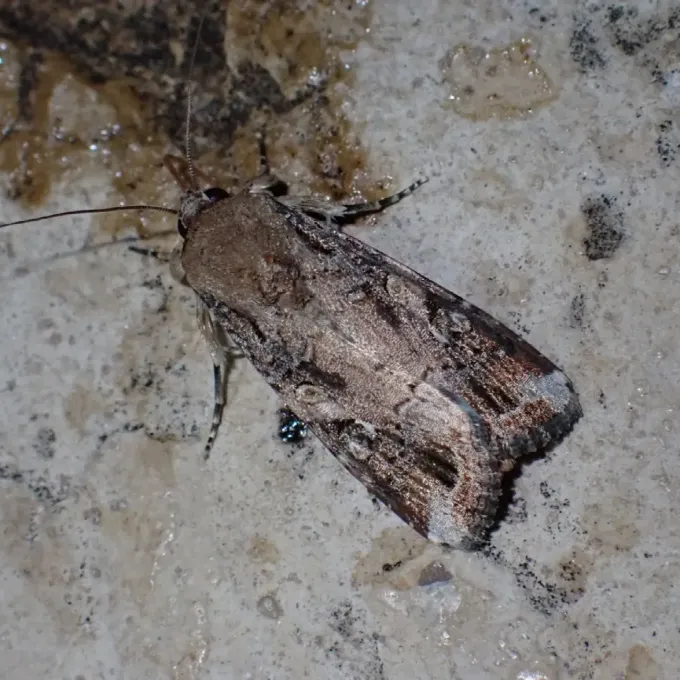
The fall armyworm (Spodoptera frugiperda) is a moth of the Noctuidae family. Adult moths have a wingspan of about 40 mm, with forewings typically mottled with shades of gray and brown and a characteristic pale spot near the tip.
The larvae progress through six instars, varying in color from light green to dark brown or nearly black. A diagnostic feature is the white, inverted Y-shaped suture on the head capsule of the larvae.
Females deposit eggs in clusters of 100 to 200, typically covered with a layer of grayish scales from the moth's body, which gives the egg masses a fuzzy, velvet-like appearance.
Pupation generally occurs in the soil, at a depth of 2 to 8 cm. The pupa is reddish-brown, approximately 15–18 mm long, and is encased in a silken, soil-lined chamber.
This species is highly migratory, capable of flying hundreds of kilometers per generation, which facilitates its rapid spread across continents and diverse ecological zones.
What it damages
Maize is the preferred host for the fall armyworm. Larvae consume leaf tissue, often causing complete defoliation if left unchecked, and will bore into reproductive parts of the plant.
The pest is highly polyphagous, documented on over 80 plant species including rice, sorghum, wheat, sugarcane, and various pasture grasses, making it a significant threat to food security.
Larval feeding on young plants can destroy the growing point (apical meristem), leading to plant death or stunted, deformed development that prevents normal ear formation.
In older plants, larvae penetrate the ear, consuming kernels and exposing the remaining grain to opportunistic fungi and bacteria, which can cause significant yield loss and mycotoxin contamination.
Total yield losses in maize can reach 100% in untreated fields during severe outbreaks, particularly when larval pressure coincides with early vegetative stages of the crop.
When it appears
Developmental speed is highly temperature-dependent. Under optimal conditions (25–30°C), the life cycle from egg to adult can be completed in approximately 30 days.
The number of annual generations varies significantly by geography, with tropical regions supporting continuous breeding throughout the year without diapause.
The species does not enter true diapause, meaning it cannot survive harsh winters with prolonged freezing temperatures. Instead, it relies on seasonal migration patterns to recolonize temperate areas.
Peak infestation levels typically occur mid-season. In agricultural landscapes, the presence of host crops throughout the year is the primary driver for sustained population growth.
Environmental conditions such as high humidity and frequent rainfall are highly favorable for population surges, as they improve larval survival and sustain the health of host plants.
Signs of infestation
Early-stage infestations are characterized by small, window-like feeding patches on leaves, where larvae have grazed on the surface tissue without penetrating the entire leaf blade.
A heavy accumulation of granular, sawdust-like frass (excrement) in the whorl of the maize plant is a definitive indicator of the presence of medium to late-instar larvae.
Tattered leaf edges, often described as a shot-hole appearance, are common as larvae grow larger and begin consuming the full thickness of the leaves.
In mature crops, the presence of ragged entrance holes in the side of the ears, usually plugged with frass, confirms that larvae are feeding on the developing grain.
Wilting of the central leaves (the "dead heart" symptom) is a severe sign of infestation, indicating that larvae have burrowed into the center of the plant stem.
Control measures
Integrated Pest Management (IPM) is essential for effective control. Monitoring with pheromone traps is the first line of defense to detect moth arrival and plan interventions.
Cultural controls include synchronous planting across local areas to prevent continuous crop availability and the destruction of crop residues post-harvest to kill pupae in the soil.
Chemical control focuses on applying targeted insecticides during early larval stages before the pests burrow deep into the whorl or ears where they are protected.
Biological control agents, such as the application of nuclear polyhedrosis viruses (NPV) or Bacillus thuringiensis, are effective and sustainable options for reducing larval populations.
- Utilization of resistant or Bt-transgenic maize varieties.
- Encouraging natural enemies like parasitic wasps and predatory bugs.
- Rotating insecticide chemical classes to avoid the development of resistance.
- Maintaining field hygiene by removing alternative weed hosts.
Taxonomy
- Latin name
- Spodoptera frugiperda
- Order
- Lepidoptera (butterflies)
- Family
- Noctuidae
- EPPO code
- LAPHFR
Discussion
No discussions yet — be the first.