
African armyworm
Spodoptera exempta
Description
How to identify
The African armyworm (Spodoptera exempta) is a notorious migratory moth species belonging to the family Noctuidae. It is widely recognized for its devastating swarming behavior.
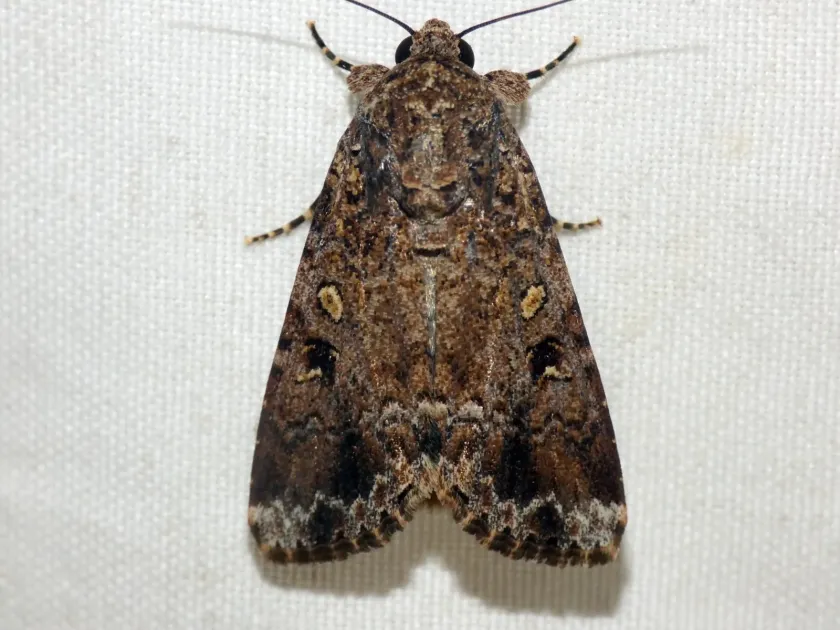
The adult moth has a wingspan of approximately 25-30 mm. Its forewings are mottled grey-brown, while the hindwings are translucent white with a dark, narrow border.
The larvae, known as caterpillars, exhibit polyphenism. In the solitary phase, they are green, whereas in the gregarious (swarming) phase, they turn jet-black with distinct longitudinal stripes.
The life cycle is rapid and highly synchronized. Depending on the ambient temperature, the entire development from egg to adult can be completed in just three to four weeks.
Female moths lay batches of hundreds of eggs, typically on the underside of leaves, covering them with specialized scales to protect the cluster from environmental stress and natural enemies.
What it damages
This pest primarily attacks members of the grass family (Poaceae), including maize, sorghum, rice, wheat, millet, and various types of pasture grasses.
When in the gregarious phase, the larvae move in massive numbers, referred to as 'armies', consuming all green vegetation in their path with extreme efficiency.
Early-instar larvae feed by scraping the epidermis, creating a window-like effect on the leaves. Older larvae consume entire leaf blades, leaving only the midribs intact.
Destruction of the growing point (apical meristem) in young maize plants leads to the death of the plant, resulting in significant yield loss.
Because they strip entire fields of foliage, they pose a severe threat to food security and livestock fodder availability in regions where they occur.
When it appears
Outbreaks of Spodoptera exempta are strongly linked to the onset of seasonal rainfall, which provides the succulent green vegetation needed for larval development.
The movement of adult moths is highly influenced by wind patterns, which can transport the insects over hundreds of kilometers to find newly emerging host plants.
The peak infestation period coincides with the main growing season of cereal crops, when the plants are at their most vulnerable vegetative stage.
During dry seasons, the population usually declines, though pupae can remain in the soil as a dormant stage until the return of favorable climatic conditions.
Farmers should be on high alert during the first few weeks after the initial rain of the season, as this is when the majority of eggs hatch.
Signs of infestation
The earliest symptom is the presence of 'windowing' on leaves, which is caused by young larvae scraping the leaf surface rather than consuming the whole leaf.
Dense clusters of caterpillars on the soil surface or at the base of plants are a primary visual sign of a heavy infestation in the swarming phase.
The rapid disappearance of plant foliage across a field or along the field margins indicates an advancing 'army' of caterpillars.
Accumulation of larval frass (droppings) on the leaves or at the plant base is a clear indication that caterpillars are feeding nearby.
- Transparent patches on leaves.
- Sudden foliage loss.
- Visible migration of black larvae.
- Stunted or dead corn whorls.
Control measures
Chemical control using insecticides (such as synthetic pyrethroids or organophosphates) is the most common method for immediate suppression of swarming larvae.
Pheromone traps are essential for monitoring adult moth populations, allowing farmers to predict potential outbreaks and prepare control measures.
Biological control options include the use of Bacillus thuringiensis (Bt) or entomopathogenic viruses, which are effective against larvae while minimizing environmental impact.
Cultivation and ploughing of fields after harvest can help destroy pupae residing in the soil, effectively reducing the population size for the next season.
Creating physical barriers, such as trenches or chemically treated boundary strips, can effectively halt the movement of larvae between adjacent fields.
Taxonomy
- Latin name
- Spodoptera exempta
- Order
- Lepidoptera (butterflies)
- Family
- Noctuidae
- EPPO code
- LAPHEX
Discussion
No discussions yet — be the first.