
Southern armyworm
Spodoptera eridania
Description
How to identify
The Southern armyworm (Spodoptera eridania) is a destructive member of the Noctuidae family, belonging to the order Lepidoptera. The adult moth typically has a wingspan of 30 to 40 mm and displays a grayish-brown pattern that provides excellent camouflage in its natural habitat.
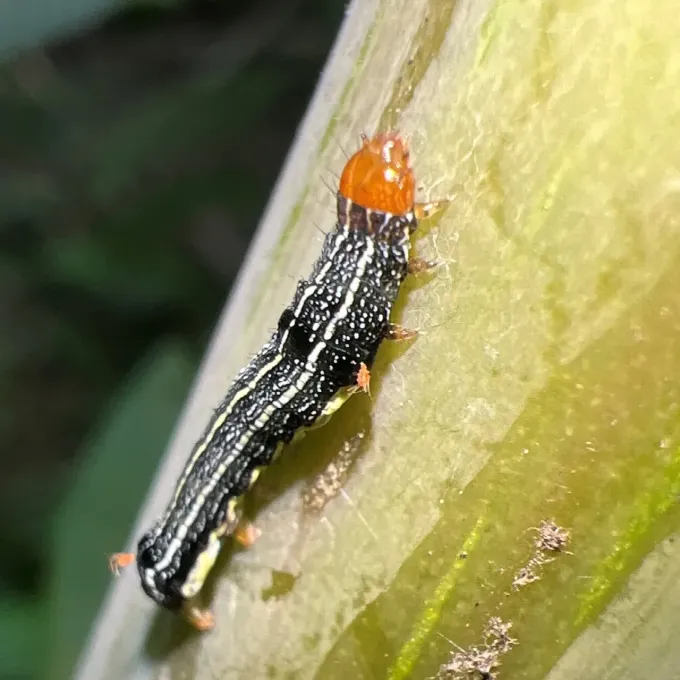
The larvae, or caterpillars, undergo several developmental stages (instars). They are highly variable in color, often changing from light green to a dark, velvet-like appearance with distinct longitudinal yellow or white stripes as they grow.
Pupation occurs in the soil, usually at a depth of 5 to 10 cm. The pupae are typically mahogany brown and are well-protected against environmental stresses, which contributes to the species' survival.
The life cycle varies significantly based on regional temperatures; in tropical or subtropical climates, the insect can remain active year-round, leading to overlapping generations.
Due to its high reproductive potential and ability to migrate, accurate identification is crucial. Professionals often rely on both morphological observation and pheromone trap monitoring to confirm the presence of this specific species.
What it damages
This species is a notorious polyphagous pest, meaning it attacks a wide array of agricultural, horticultural, and ornamental plants, causing substantial yield loss globally.
Common host crops include tomatoes, peppers, potatoes, soybeans, sweet potatoes, and various legumes. It can also cause significant damage to nursery stock and flowering plants.
Early instar larvae feed in colonies on the underside of leaves, causing skeletonization. As they grow older and larger, they disperse and become voracious feeders, capable of defoliating entire plants rapidly.
Besides leaf damage, the larvae frequently attack reproductive structures such as flower buds and fruits. By boring into these tissues, they ruin the marketable yield and invite opportunistic plant pathogens.
The economic damage is exacerbated by the larvae's rapid growth rate, allowing them to cause extensive devastation in a short period before growers might notice the initial infestation.
When it appears
The Southern armyworm thrives in warm, humid conditions. Activity typically peaks during the mid-to-late growing season when temperatures are consistently high.
Adult moths are nocturnal and are highly attracted to light sources and chemical lures. The female moth deposits egg masses on the lower surface of leaves, often covering them with hair-like scales from her abdomen.
Generation turnover is rapid, sometimes occurring within a 30-day period during peak summer heat. This allows the population to multiply exponentially if left unchecked throughout the season.
The pest exhibits migratory behavior, allowing it to re-infest areas or expand its range significantly during the growing season as adults fly in search of new, suitable host plants.
Winter survival is limited to warmer regions, as the pupae are sensitive to prolonged freezing temperatures, although they can persist in the soil in protected areas.
Signs of infestation
The most visible sign of an early infestation is the presence of skeletonized leaves. If you notice small, circular patches where the leaf tissue has been consumed, it indicates young larvae are at work.
Accumulation of larval frass (excrement) on the soil surface or the leaves is a strong indicator of an active population. The frass often appears as dark, pellet-like matter.
Defoliation is the primary sign of advanced infestations. As the larvae mature, they consume entire leaves, leaving only the midrib and larger veins intact.
On fruiting crops, watch for entry holes and irregular scarring on the skin of the produce. Rotting and secondary mold infections in these wounds are common symptoms.
- Stunted growth or wilting of the plant.
- Presence of egg masses covered in grayish-white, felt-like scales.
- Cluster feeding patterns on the underside of foliage.
Control measures
Integrated Pest Management (IPM) is essential for controlling the Southern armyworm. This includes cultural practices such as destroying weeds that act as alternative hosts.
Tilling the soil after harvest is highly recommended to disturb the pupation sites, exposing the pupae to desiccation and natural predators, which significantly reduces the next generation's population.
Monitoring using pheromone traps is standard practice for identifying the arrival of the moths. This allows farmers to target their interventions precisely to the early larval stages.
Biological control agents, particularly formulations of Bacillus thuringiensis (Bt), have proven effective when applied while the larvae are still in their early instars and vulnerable.
Chemical control should be used judiciously, prioritizing insecticides that are selective for Lepidoptera to minimize harm to beneficial insects. Rotating chemical classes is mandatory to avoid resistance.
Taxonomy
- Latin name
- Spodoptera eridania
- Order
- Lepidoptera (butterflies)
- Family
- Noctuidae
- EPPO code
- PRODER
Discussion
No discussions yet — be the first.