
Spodoptera armyworms
Spodoptera
Description
How to identify
The genus Spodoptera belongs to the order Lepidoptera and the family Noctuidae. These are highly destructive polyphagous pests, including significant species like S. frugiperda (fall armyworm) and S. littoralis (cotton leafworm).
Adult moths are medium-sized with a wingspan of up to 40 mm. Their forewings typically feature a mottled gray-brown color with complex patterns of spots and bands.
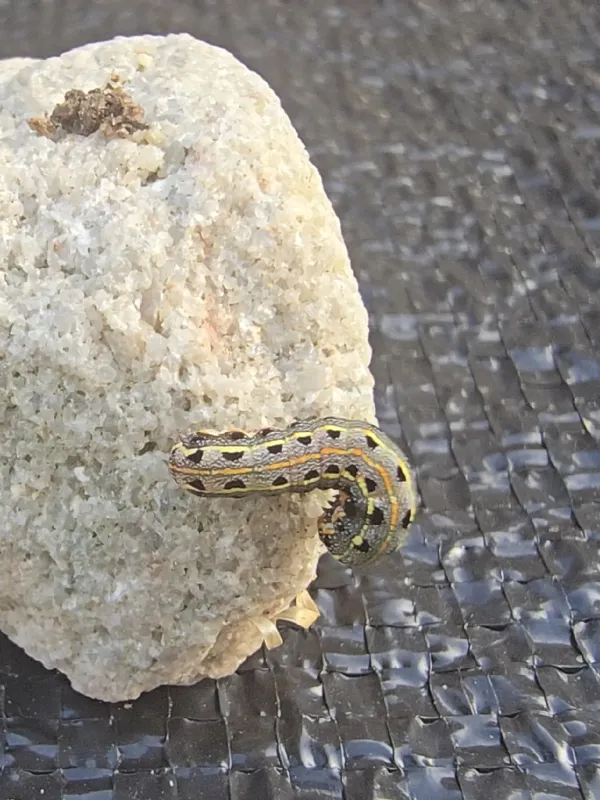
Larvae pass through 6 instar stages, varying in color from light green to nearly black. A common diagnostic feature is a pale inverted Y-shaped mark on the larval head capsule.
Pupae develop in the soil and are characterized by a smooth, brown, and hardened cuticle. They show remarkable resilience, allowing the population to survive varying environmental conditions.
The biological cycle is marked by high fecundity, where a single female can lay between 1,500 and 2,000 eggs in clusters, typically deposited on the underside of leaves.
What it damages
Spodoptera species are known as aggressive polyphages capable of attacking over 300 plant species, including major global economic crops.
Primary host plants include maize, rice, sorghum, cotton, and various vegetable crops such as tomatoes, peppers, and crucifers, as well as several legumes.
In early development stages, young larvae feed on leaf epidermis, resulting in "windowing" effects. As they mature, they advance to skeletonizing entire leaves.
Damage often extends to reproductive organs, where larvae bore into corn ears, flower buds, and fruits, leading to tissue necrosis and premature fruit drop.
Outbreaks of these pests can cause severe economic losses, often ranging from 50% to 100% of the total yield if intervention strategies are not implemented promptly.
When it appears
Adult activity occurs primarily at night. Females are strong fliers capable of long-distance migration, which facilitates the rapid spread of the pest across vast regions.
Development is temperature-dependent, with an optimum range of 25–30°C. In tropical climates, populations can breed continuously throughout the year.
In temperate zones, the first generation typically emerges in late spring, around May or June, once stable warm temperatures are established.
The number of generations per season is determined by the climate. In favorable conditions, up to 5–7 generations may occur, making continuous monitoring essential.
Overwintering usually takes place in the pupal stage within the soil. While some pupae survive mild winters, extreme cold remains a limiting factor for population growth.
Signs of infestation
The first sign of infestation is the discovery of egg masses covered with grayish scales, giving them a velvety or fuzzy appearance on leaf surfaces.
Visible "windowing" or translucent patches on leaves occur when young larvae graze the leaf surface, leaving the lower epidermis intact.
The presence of large amounts of frass (larval excrement) near the whorls or stems of plants is a clear indicator of heavy feeding by older larvae.
In corn, the wilting or "ragged" appearance of the central whorl leaf is a major warning sign that larvae have burrowed into the growing point.
Affected plant parts are highly susceptible to secondary infections by fungi and bacteria, frequently resulting in visible rot and decay around the feeding sites.
Control measures
Successful management relies on an Integrated Pest Management (IPM) approach that balances cultural, biological, and chemical interventions.
- Deployment of pheromone traps for pest monitoring and precise timing of control measures.
- Application of biological insecticides, particularly those based on Bacillus thuringiensis, for early larval control.
- Implementation of crop rotation and consistent weed control to remove alternative hosts for the larvae.
- Encouragement of natural enemies such as parasitic wasps and predatory bugs to keep populations in check.
- Use of targeted systemic insecticides from the diamide group upon reaching established economic injury thresholds.
Taxonomy
- Latin name
- Spodoptera
- Order
- Lepidoptera (butterflies)
- Family
- Noctuidae
- EPPO code
- SPODSP
Discussion
No discussions yet — be the first.