
Spilococcus
Spilococcus
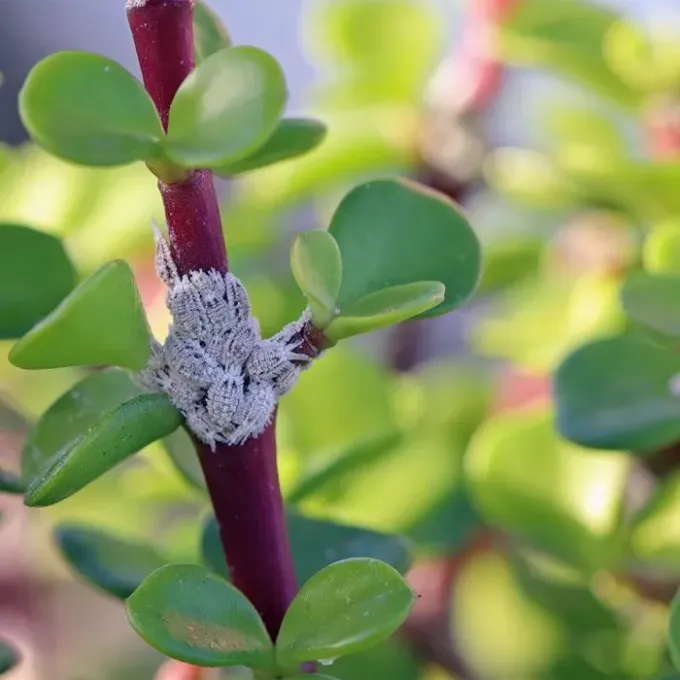
Description
How to identify
Spilococcus belongs to the mealybug family (Pseudococcidae) within the order Hemiptera. These small, sap-sucking insects are characterized by a waxy, flour-like secretion covering their bodies.
Adult females are typically oval-shaped, sessile, and lack wings. They are often found in clusters, well-protected by their waxy secretions, which provide a barrier against desiccation and predators.
Males are winged but short-lived, with their sole biological function being the fertilization of females. The nymphal stage, known as "crawlers," is the primary mobile phase responsible for dispersing the population.
The taxonomic classification reflects their high evolutionary adaptation to diverse host plants, allowing them to thrive in various indoor and outdoor environments.
Their morphological structure, including specialized mouthparts for piercing plant tissues, makes them highly efficient at extracting nutrients from the host.
What it damages
This pest affects a wide range of ornamental, fruit, and agricultural crops. They are frequently found in sheltered areas such as leaf axils, under bark scales, and near buds.
By feeding on plant sap, Spilococcus injects toxic substances into the host, leading to stunted growth, leaf deformation, and reduced overall plant vigor.
Feeding sites often become necrotic, providing entry points for secondary pathogens like fungi and bacteria, which further weaken the plant structure.
Severe infestations result in yellowing and premature leaf drop, which significantly impairs the plant's ability to undergo photosynthesis and reduces crop yields.
The accumulation of honeydew secreted by these mealybugs encourages the growth of sooty mold, which coats the foliage and blocks essential sunlight.
When it appears
In controlled environments such as greenhouses, Spilococcus can reproduce throughout the year, completing several generations in a single season.
In outdoor settings, activity usually peaks during the warm, dry months of spring and summer, which are optimal for their reproductive cycles.
The dispersal of the pest is most active during the crawler stage, which can be easily transported by wind currents, irrigation water, or human activity involving infested tools.
Developmental rates are temperature-dependent; warmer conditions significantly shorten the life cycle, leading to rapid population explosions.
During the onset of cooler temperatures, the insects may seek refuge in crevices, protected parts of the plant, or soil to overwinter until favorable conditions return.
Signs of infestation
The most prominent indicator of an infestation is the appearance of white, cotton-like masses on the stems, foliage, or fruit, often containing the insects themselves.
A sticky, shiny residue known as honeydew on the leaves and surrounding surfaces is a classic sign of mealybug presence and is often followed by the growth of black sooty mold.
Deformation of new growth, including curled or twisted leaves, is a common symptom resulting from the feeding pressure exerted by the pest colonies.
A gradual decline in plant health, characterized by loss of turgor and foliage discoloration, is a key diagnostic sign requiring a thorough inspection.
- Cotton-like white wax clusters on plant parts.
- Sticky honeydew buildup on leaves.
- Stunted shoot growth and leaf curling.
Control measures
Management strategies should begin with cultural practices, such as removing heavily infested plant parts and maintaining good sanitation in the growing area.
Biological control is highly recommended, utilizing natural enemies like predatory lady beetles or specific parasitoid wasps to reduce pest numbers naturally.
Chemical control using systemic insecticides is often the most effective approach, as the chemicals are absorbed by the plant and ingested by the sap-sucking insects.
It is crucial to follow a rotation of different insecticide classes to prevent the development of resistance within the pest population over multiple seasons.
Maintaining optimal plant health and moderate humidity levels can help mitigate the risk of infestation, as plants under stress are significantly more susceptible to attack.
Taxonomy
- Latin name
- Spilococcus
- Order
- Hemiptera (bugs, aphids, leafhoppers)
- Family
- Pseudococcidae
- EPPO code
- SLCCSP
Discussion
No discussions yet — be the first.