
Havila Dart
Spaelotis havilae
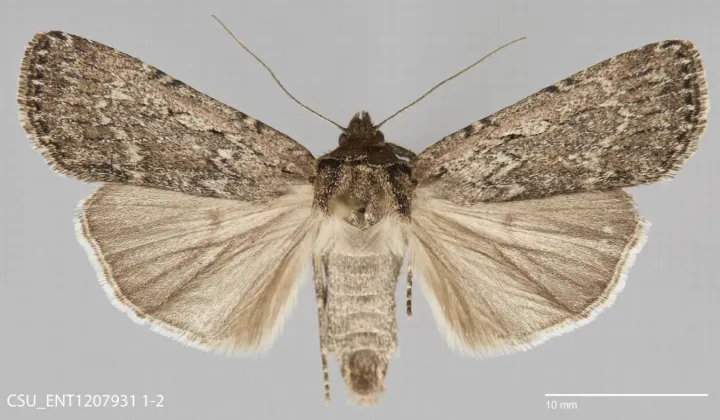
Description
How to identify
The Havila Dart (Spaelotis havilae) is a moth species belonging to the family Noctuidae. It is a well-adapted pest often found in various agricultural and semi-arid landscapes, where it maintains stable populations due to its resilient life cycle.
Adult moths possess a wingspan of approximately 35–45 mm. Their forewings are cryptically colored, typically in shades of grey and brown, which provides excellent camouflage against soil and plant debris during the day. Hindwings are usually paler, often with dark margins.
The larvae, known as cutworms, are the primary stage of concern for farmers. They have a robust, cylindrical body with a hardened head capsule, evolved for biting through plant stems. Their coloration helps them blend into the soil environment during daylight hours.
Pupation occurs within a subterranean cell constructed of soil particles. This stage is crucial for the insect's survival during unfavorable periods, protecting the developing moth from temperature extremes and surface predators.
Precise identification of this species often requires professional entomological examination, specifically of genital structures, as it shares morphological similarities with other members of the Spaelotis genus.
What it damages
The Havila Dart is a polyphagous pest, meaning it feeds on a wide range of agricultural crops. It is particularly damaging to early-stage cereal, pulse, and vegetable crops, which are most vulnerable to feeding damage.
The cutworm larvae are nocturnal feeders. They damage crops by chewing through the base of stems at the soil level, causing the plant to wilt, topple, and eventually die. This often leads to sparse stands and significant yield loss.
In addition to cutting stems, larvae can feed on young foliage and subterranean plant parts. In high-density populations, this can lead to total crop failure within localized patches, necessitating immediate intervention.
The physical stress caused by larval feeding makes the remaining plants more susceptible to secondary pathogenic infections, which further complicates the health of the crop and reduces overall quality.
Economic damage is exacerbated by the cryptic nature of the larvae, as they remain hidden beneath the soil surface during the day, making them difficult to detect until substantial damage has already occurred.
When it appears
This species generally completes one generation per year. Larvae typically overwinter in the soil, emerging in the spring to feed on fresh plant material. This timing coincides with the seedling stage of many major crops.
Adult flights usually occur in the summer months. During this period, mating and oviposition take place, with females laying eggs on the soil or on decaying organic matter to provide a future food source for the emerging larvae.
The most critical period for crop protection is the early spring, when overwintered larvae resume active feeding. Agronomists must monitor fields closely during this window to prevent early-season crop thinning.
Pupation occurs later in the season, typically in mid-to-late summer. The duration of the pupal stage is influenced by local soil moisture and temperature, which determine the timing of the next adult emergence.
Weather conditions significantly impact population dynamics. Dry, warm springs often favor larval survival and activity, while excessive spring rainfall can lead to higher mortality rates due to the proliferation of entomopathogenic fungi.
Signs of infestation
The most common sign of infestation is the sudden wilting or lodging of seedlings without apparent external damage to the foliage. Closer inspection of the base of the stem will reveal clean-cut marks.
Creating "holes" or sparse patches in fields of young crops is a clear indicator of larval activity. As the larvae move between plants, they create visible trails of destruction across the field.
Nocturnal monitoring is the most effective way to confirm the presence of the pest. Using a flashlight after dark allows for the observation of cutworms on the surface of the soil feeding on plants.
The presence of fine, dark granular frass (excrement) near the base of damaged plants provides further evidence of larval activity in the immediate vicinity.
Light traps are highly effective for detecting adult moth flights. Tracking moth catches helps predict potential larval pressure and assists in the timing of protective measures.
Control measures
Effective management of the Havila Dart requires an integrated pest management (IPM) approach. Cultural practices, such as deep autumn tillage, are essential for disrupting the larval and pupal stages in the soil.
Field sanitation is critical; controlling weeds in and around the field denies the larvae their primary food source during the early spring before the crop emerges or establishes itself.
Chemical control via insecticides is warranted when larval populations exceed the economic threshold. Applications should be timed for the evening hours to maximize contact with active larvae.
Biological control options, such as the application of Bacillus thuringiensis or other biological agents, provide a viable and environmentally friendly alternative for controlling young larval stages.
- Conduct deep autumn plowing to expose pupae to predators and weather.
- Utilize pheromone traps for early detection of adult moth flights.
- Apply insecticides in the evening during peak larval activity.
- Maintain weed-free fields to reduce alternate food sources.
Taxonomy
- Latin name
- Spaelotis havilae
- Order
- Lepidoptera (butterflies)
- Family
- Noctuidae
- EPPO code
- AGROHA
Discussion
No discussions yet — be the first.