
Simyra insularis
Simyra insularis
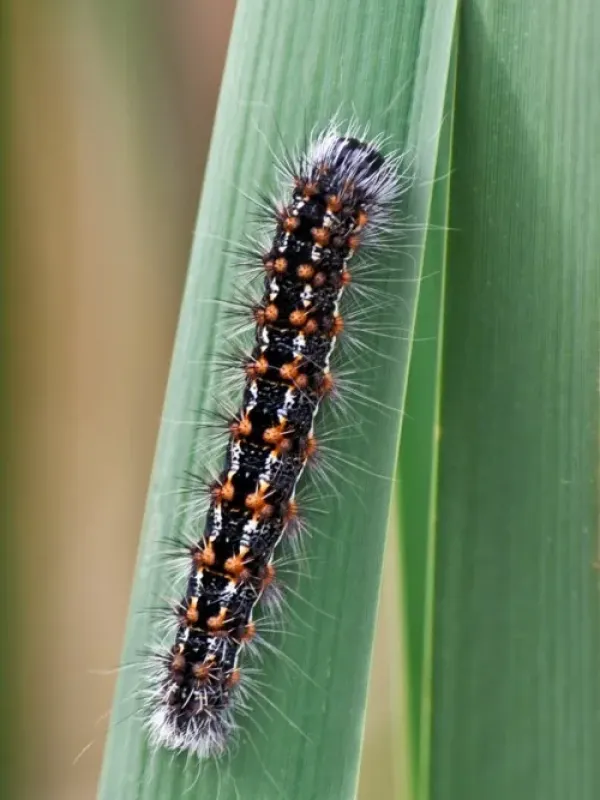
Description
How to identify
Simyra insularis is a moth species belonging to the Noctuidae family, within the order Lepidoptera. These moths are generally nocturnal and exhibit physical characteristics common to other members of the cutworm or owlet moth family.
The larvae, which are the primary stage causing damage, are distinct due to their hairy bodies. These hairs serve as a defensive mechanism against predators, allowing the caterpillars to thrive in various agricultural environments.
Pupation typically occurs in the soil or within plant debris, where the larva creates a silken cocoon for protection. This stage is relatively resistant to environmental factors and certain types of pesticides.
Adult moths are primarily active at night and are attracted to light, which makes light traps an effective tool for monitoring population density and tracking the emergence of new generations.
Accurate identification is essential, as the larvae share physical similarities with other related noctuid species, requiring professional inspection or microscopic analysis of larval features.
What it damages
This pest affects various agricultural crops, with a particular preference for cereal grains and grasses. The larvae feed on the vegetative parts of plants, including leaves and stems, leading to defoliation.
Beyond cultivated crops, Simyra insularis can also feed on various wild grasses that act as alternative hosts. This adaptability allows the population to persist throughout the entire growing season.
Damage caused by feeding reduces the plant's leaf surface area, which directly impacts photosynthetic efficiency and overall biomass production, eventually leading to yield reduction.
In high-density infestations, the larvae can consume significant portions of foliage, severely stressing the plant and leaving it vulnerable to subsequent diseases or secondary pest attacks.
Economic damage is most critical during the vegetative stages of plant development, where stunted growth caused by feeding can prevent the crop from reaching its full potential.
When it appears
The seasonal activity of Simyra insularis is primarily driven by temperature. Adult moths typically emerge in late spring or early summer, following the end of the winter diapause.
The number of annual generations depends on regional climate conditions, with warmer regions potentially supporting multiple overlapping cycles that increase the pressure on crops.
The summer months are characterized by peak larval feeding, as caterpillars require abundant plant material to support their rapid development prior to pupation.
During the onset of autumn and colder weather, the insect undergoes a transition into the pupal stage, settling into the soil or plant litter to survive the winter period.
Effective pest management schedules depend on correctly predicting these seasonal transitions to apply control measures when the larvae are most susceptible.
Signs of infestation
Initial signs of an infestation include the appearance of irregular holes or notched edges on the leaves, starting from the leaf margins and moving toward the midrib.
The presence of larval frass (droppings) on the soil or leaves is a reliable indicator of active feeding by a high density of caterpillars, even if the larvae themselves are hidden.
Stunted plant growth and visible yellowing of tissues often suggest damage to the vascular system or stem of the plant caused by larval boring or heavy feeding.
In some cases, the formation of silk webbing between leaves serves as a protective structure for the larvae during development or when preparing to pupate.
Field scouting should prioritize areas with uneven plant growth, as these are often the starting points for localized outbreaks of this noctuid pest.
Control measures
Cultural control is the first line of defense; deep autumn plowing is highly effective at disrupting pupal stages in the soil, significantly reducing the overwintering population.
Crop rotation is crucial in preventing the buildup of pest populations, as changing host plants forces the insects to relocate and reduces the likelihood of severe outbreaks.
Chemical control involving systemic or contact insecticides may be necessary if the larval density exceeds the economic threshold, ensuring that treatments are applied at the correct developmental stage.
Biological control, such as the application of Bacillus thuringiensis or the introduction of parasitic wasps, provides an environmentally sustainable alternative to traditional synthetic chemicals.
- Regular monitoring using light or pheromone traps.
- Deep tillage after harvest to kill pupae.
- Implementation of diverse crop rotation.
- Targeted insecticide applications during early larval stages.
- Control of weeds that host the larvae.
Taxonomy
- Latin name
- Simyra insularis
- Order
- Lepidoptera (butterflies)
- Family
- Noctuidae
- EPPO code
- SIMRIN
Discussion
No discussions yet — be the first.