
Black flies
Simulium
Description
How to identify
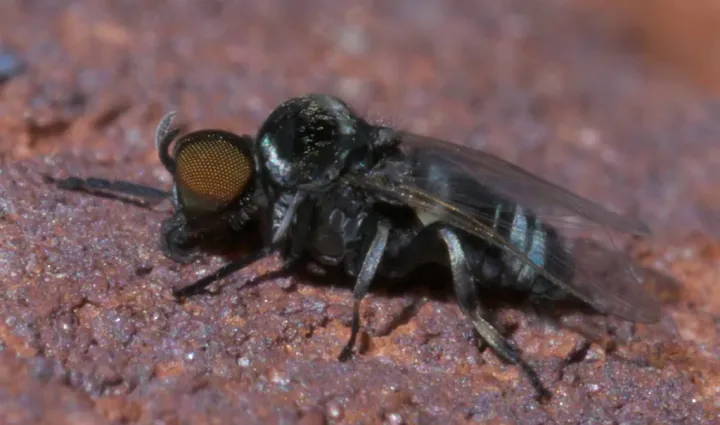
Black flies (family Simuliidae, genus Simulium) belong to the order Diptera. These are tiny blood-sucking insects, typically ranging from 2 to 6 mm in length.
Their body has a stout appearance, short antennae, and powerful mouthparts. Unlike mosquitoes, black flies are active daytime predators.
The larvae of black flies inhabit exclusively running water, attaching themselves to submerged rocks or vegetation. They possess a cylindrical shape and a specialized attachment organ.
Adults often have a pronounced humped back, which is why they are sometimes called buffalo gnats. Their coloration ranges from black to brown or grey.
The insect undergoes a complete metamorphosis: egg, larva, pupa, and adult. Their life cycle is intrinsically linked to aquatic environments during the early stages.
What it damages
While black flies are primarily known as serious pests in animal husbandry, causing simulidotoxicosis in livestock, they also indirectly impact plant production.
Although they do not directly consume plant foliage, mass swarms of insects disrupt field operations and routine crop maintenance tasks.
The damage to plants is linked to their role as vectors for various pathogens, which can be transmitted through contact with damaged plant tissues.
The secretions and the consequences of their aggressive swarming behavior can contribute to the development of secondary fungal infections on crops.
The constant presence of black fly swarms near fields reduces the productivity of workers, making proper care for agricultural plantings significantly more difficult.
When it appears
The flight period of black flies begins with the onset of consistent warmth, when the water temperature in streams and rivers reaches optimal levels for larval development.
Population peaks usually occur in May and June, coinciding with the period of active growth for most agricultural crops.
Their activity is directly dependent on weather conditions: they prefer calm, warm, and overcast days with high atmospheric humidity.
The duration of the season can vary depending on geographical latitude and the proximity of permanent sources of running water.
By the end of summer, the black fly population naturally declines, although outbreaks can occasionally occur in early autumn under favorable conditions.
Signs of infestation
The primary sign of black fly presence is the observation of buzzing swarms near water bodies and lowlands, particularly during morning and evening hours.
Their presence is easily noticed by the sudden agitation of livestock grazing near infested areas.
On plants themselves, one may observe clusters of tiny black spots, which are adult insects resting on the undersides of leaves.
The presence of larvae in irrigation canals or flowing waterways also indicates a high probability of a large adult population emerging soon.
A characteristic sign is the specific, highly irritating noise produced by massive colonies of insects in the immediate vicinity of humans.
Control measures
The most effective control measure is the eradication of larvae in their breeding sites by treating running waters with approved biological agents.
The application of insecticides in fields is justified only during massive infestations to protect personnel working with agricultural crops.
- Use of personal repellents for field workers.
- Clearing bank vegetation where adults tend to hide.
- Use of fine-mesh netting on greenhouses as a mechanical barrier.
- Maintaining proper water flow to prevent stagnation in irrigation systems.
It is crucial to recognize that black fly control requires a comprehensive approach and should be coordinated at the regional agricultural level.
Taxonomy
- Latin name
- Simulium
- Order
- Diptera (flies)
- Family
- Simuliidae
- EPPO code
- SIMUSP
Discussion
No discussions yet — be the first.