
Wels catfish
Silurus glanis
Description
How to identify
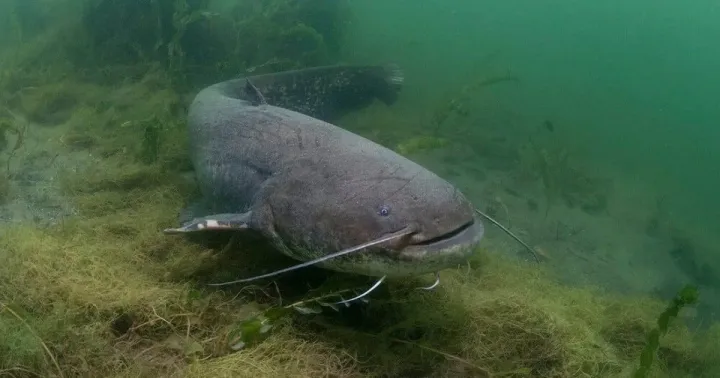
The Wels catfish (Silurus glanis) belongs to the order Siluriformes and family Siluridae. It is a large, scaleless fish characterized by a broad, flat head and long barbels around the mouth used for sensing.
These fish possess a massive body and a very large mouth filled with numerous small, backward-pointing teeth, making them apex predators in freshwater environments.
Their coloration is generally dark grey to black on the dorsal side, with lighter, yellowish-white undersides, providing camouflage against the muddy bottoms of rivers and ponds.
The biology of the species is notable for its high tolerance to low oxygen levels, which enables it to thrive in stagnant or eutrophic environments where other fish might struggle.
Spawning occurs during the warmer months, with the species building nests among aquatic vegetation where they protect their eggs until hatching.
What it damages
In the context of commercial aquaculture, the Wels catfish is often considered a major pest because it aggressively preys on the juveniles of valuable farmed fish species.
Their predatory behavior significantly reduces the survival rate of carp, tench, and other species, leading to direct economic losses for the fish farming operation.
Beyond direct consumption, their presence creates high-stress conditions for farmed fish, leading to decreased feed intake, slower growth rates, and increased susceptibility to disease.
Large individuals can also inflict physical damage on pond infrastructure, including the destruction of nets and the erosion of pond embankments via burrowing.
The opportunistic nature of the Wels catfish allows it to consume whatever is available, making it a constant threat to the equilibrium of managed fishery systems.
When it appears
The activity of the Wels catfish is highly dependent on water temperature; the species remains dormant in deep holes during the cold winter months.
As spring approaches and water temperatures rise above 10-12 degrees Celsius, they become active and start feeding to recover from the winter fast.
Summer is the peak feeding season when the fish are most voracious, actively hunting in both shallow and deep waters to maximize their biomass growth.
In autumn, as water temperatures begin to drop, their metabolic activity slows down, and they gradually reduce their feeding frequency and predatory intensity.
The most critical period for pond management is the transition from spring to summer, when young fry are introduced and become vulnerable to predation.
Signs of infestation
A primary indicator of Wels catfish presence is a significant and unexplained decline in the fish population within a pond, especially following the introduction of fry.
Observable changes in the behavior of the farmed fish population include schooling patterns that avoid deeper areas or persistent restlessness during the night.
Physical evidence on harvested fish, such as bite marks, lateral skin lesions, or scale loss, often serves as a definitive sign of predator activity in the pond.
During the night, loud splashing sounds or disturbances on the water surface are common signs of the Wels catfish hunting near the pond edges.
Visual inspections of pond banks may reveal eroded areas or cavities where large catfish might be resting or establishing a temporary refuge.
Control measures
Total pond drainage and bed sanitization during the off-season is the most effective method for completely eradicating any Wels catfish population from a fish farm.
When drainage is not feasible, specialized fishing equipment, including bottom lines, traps, and selective netting, must be used to remove the predators systematically.
Installing high-quality filtration screens and barriers at all water supply inlets is essential to prevent wild fry or adult catfish from entering the controlled pond environment.
Regular monitoring of fish health and diversity is recommended to identify the presence of predators early before they reach sizes that can cause massive damage.
If necessary, professional fish removal using authorized methods should be performed to protect the primary commercial crop and maintain pond productivity.
Taxonomy
- Latin name
- Silurus glanis
- Family
- Siluridae
- EPPO code
- SILUGL
Discussion
No discussions yet — be the first.