
Mandarin moth
Sideridis mandarina
Description
How to identify
The Mandarin moth (Sideridis mandarina) is a lepidopteran insect belonging to the Noctuidae family. This species is recognized as a pest in various agricultural and horticultural systems, with adults characterized by nocturnal habits and cryptic coloration.
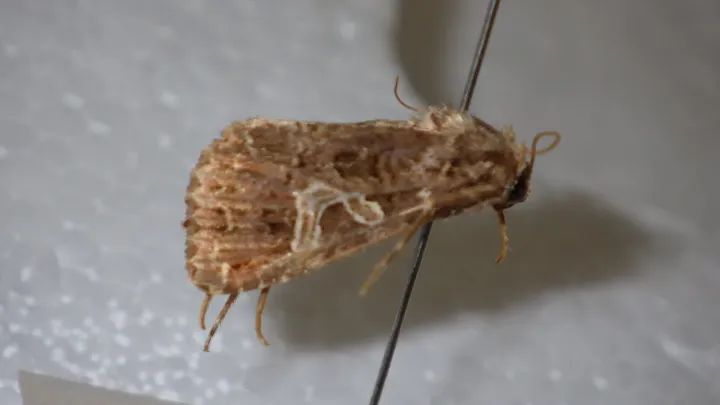
The adult moth features brownish-grey forewings, providing effective camouflage against soil surfaces and plant stems during the day. Hindwings are generally lighter in color, aiding in identification during professional entomological surveys.
Larvae, commonly known as caterpillars, exhibit high feeding activity and are the primary life stage responsible for crop damage. They possess a classic noctuid body structure with functional prolegs, allowing for efficient movement across plant surfaces.
The life cycle involves egg deposition on host plants, followed by larval development, pupation in the soil, and emergence of the adult moth. The pupal stage is particularly adapted for overwintering, ensuring the species' survival across seasons.
Understanding the morphological features of each life stage is crucial for accurate field identification and the subsequent implementation of targeted pest management strategies in commercial farming.
What it damages
Damage caused by Sideridis mandarina primarily occurs during the larval stages. Caterpillars feed on the foliage, initially causing skeletonization and later consuming entire leaves, which severely impacts the plant's photosynthetic capacity.
Beyond leaf consumption, the pest frequently attacks the reproductive parts of crops, including flower buds and young fruits. This feeding behavior often leads to significant yield losses and decreases the overall quality of agricultural produce.
In some instances, larvae target the stems and root crowns of young seedlings. This can cause the plants to wilt and die, leading to reduced stand density and potential economic losses for farmers early in the growing season.
The pest is a generalist, meaning it can infest a wide range of botanical hosts. Its ability to shift between different crop species makes it a persistent threat in regions with diverse agricultural plantings.
Severe infestations can lead to complete defoliation of host plants if left unmanaged. Such conditions create entry points for secondary pathogens, further exacerbating the damage caused by direct herbivory.
When it appears
The activity of the Mandarin moth is largely dictated by environmental temperature and photoperiod. Adult flight typically commences in spring as night temperatures rise, signaling the start of the primary mating and oviposition phase.
Peak larval activity occurs during the warmer summer months. During this period, the rate of development accelerates, and population densities can increase rapidly if conditions remain conducive to their growth.
Multiple generations may occur within a single growing season, depending on the climatic conditions of the specific geographic region. This necessitates continuous field monitoring to track population fluctuations.
As autumn approaches, the population undergoes a transition toward the overwintering stage. The final generation of larvae typically burrows into the soil to pupate, where they remain dormant throughout the winter months.
Field managers should adjust their pest control efforts based on local phenological observations, as the exact timing of emergence and peak feeding can vary significantly from year to year.
Signs of infestation
Early signs of infestation include the presence of small, window-like holes in the leaves. These are created by young caterpillars that feed on the soft leaf tissue while leaving the epidermis intact.
The presence of larval excrement, appearing as small, dark pellets on leaves or the soil surface, is a definitive indicator of an active caterpillar population feeding within the canopy.
Ragged leaf margins are indicative of late-instar larvae, which are capable of consuming larger portions of the plant. Significant loss of biomass can often be observed in affected crop sections.
Wilting plants that are not suffering from water stress may suggest damage to the roots or stem base caused by caterpillars. Inspecting the soil around the base of such plants often reveals the presence of larvae.
Nighttime visual inspections using flashlights or the use of light traps are the most reliable methods for detecting adult activity, providing early warning for potential infestation outbreaks.
Control measures
Cultural control measures, such as deep autumn ploughing, play a vital role by exposing soil-dwelling pupae to harsh winter conditions, predation, and mechanical damage, effectively reducing the overwintering population.
Sanitation practices, including the removal of weeds and crop residues, eliminate essential feeding and shelter sites for the larvae, thereby lowering the population pressure on the primary crop.
Biological control agents, such as specific entomopathogenic bacteria or viral preparations, provide an environmentally friendly alternative to chemical pesticides, particularly when applied during the early larval stages.
Chemical control should be employed strategically and only after monitoring reveals that the economic threshold of damage has been reached. Rotating insecticide classes is recommended to manage resistance development.
- Implementing diverse crop rotations to disrupt the pest's life cycle.
- Deploying pheromone traps for accurate monitoring of flight activity.
- Encouraging natural predators and parasitoids in the field.
- Targeting applications during the most susceptible larval stages.
Taxonomy
- Latin name
- Sideridis mandarina
- Order
- Lepidoptera (butterflies)
- Family
- Noctuidae
- EPPO code
- POLIMA
Discussion
No discussions yet — be the first.