
Silver Y
Sideridis
Description
How to identify
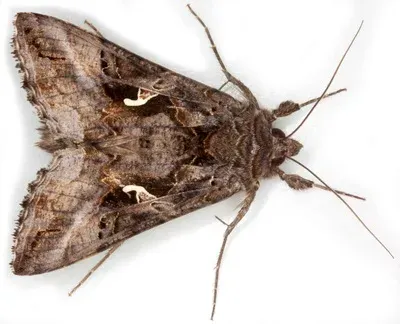
The Silver Y moth (Autographa gamma) is a highly mobile migratory moth belonging to the Noctuidae family. It earns its common name from the distinct silver-colored mark on its forewings, which bears a striking resemblance to the Greek letter gamma.
Adult moths have a wingspan of approximately 40 to 45 mm. The forewings are typically a mottled brown or violet-grey, providing excellent camouflage against soil and bark, while the hindwings are lighter with a darker marginal band.
The larvae, or caterpillars, of the Silver Y are known as semi-loopers because they possess only three pairs of prolegs. This physical trait forces them to move in a characteristic looping fashion, similar to the inchworms found in the Geometridae family.
The caterpillars are generally light to mid-green, often decorated with several thin, pale longitudinal stripes running along their sides. They grow to a length of about 40 mm before they prepare to pupate.
Pupation occurs within a loose, white silken cocoon. These cocoons are typically spun between leaves, in crevices of plant stems, or among plant debris on the soil surface, where they camouflage well as they darken from green to dark brown.
What it damages
As a polyphagous species, the Silver Y moth poses a significant threat to a wide range of agricultural crops, including legumes, sugar beets, potatoes, sunflowers, and various greenhouse or field vegetables.
Young larvae initially feed on the underside of leaves, creating small, circular holes known as "window-feeding." As they mature and increase in size, they transition to consuming entire leaf segments, often leaving only the midribs and larger veins behind.
Heavy infestations can lead to severe defoliation, which severely limits the plant's capacity for photosynthesis. This reduction in energy production inevitably leads to stunted growth, reduced yields, and lower quality of the harvestable product.
In addition to leaf destruction, the caterpillars can bore into the succulent parts of vegetable crops or fruit, leading to internal damage. This not only destroys the market value of the produce but also introduces pathogens that cause rapid rot and decay.
The pest's migratory behavior means that populations can suddenly explode in an area, catching farmers off guard. This rapid influx requires farmers to be highly vigilant during the growing season to prevent irreversible crop loss.
When it appears
The Silver Y moth is a migratory species, and its appearance in northern latitudes often begins in late spring, as moths arrive on warm southerly winds. The timing of their arrival can vary significantly from year to year.
The life cycle is rapid, especially during warm, humid summers. In temperate regions, the species can produce multiple generations within a single season, leading to overlapping populations that can persist from early summer through to late autumn.
The moths are active flyers and are frequently attracted to artificial light sources at night. Their movement patterns are strongly influenced by prevailing wind directions, which act as a transport mechanism for long-distance migration across continents.
Winter survival is limited in colder climates, where most pupae perish. However, the species' ability to recolonize large areas through migration every spring makes it a persistent agricultural challenge that cannot be solved by winter conditions alone.
Monitoring for the start of the season involves the use of pheromone-baited traps or sweep netting to detect the first influx of adults, which provides a crucial window for applying preventative measures before larvae hatch in high numbers.
Signs of infestation
The earliest signs of a Silver Y infestation are the small "window" marks on leaf surfaces. Careful inspection of the underside of the leaves in the morning or evening often reveals the presence of small, green larvae.
Dark, granular frass (droppings) deposited on leaves or on the soil below the plant canopy are reliable indicators that feeding is occurring. If you see frass, the larvae are likely nearby and actively eating.
Seeing adult moths flying in zig-zag patterns over crops during the day, particularly when disturbed, indicates a well-established local population. At night, their presence near outdoor lights confirms their activity.
Leaves that are folded or webbed together signify that the larvae are preparing to pupate. Finding these silk-bound structures is a clear indicator that the generation has completed its feeding cycle and will soon emerge as adults.
Visible damage to the plant's growing tips or boreholes in fruits should be treated as high-priority signs. These damages suggest that the population has reached levels that require immediate intervention to protect the integrity of the crop.
Control measures
Effective control starts with robust agronomic practices. Deep autumn plowing is a highly effective way to bury and destroy pupae residing in the soil, significantly reducing the starting population for the following season.
Biological control, including the use of Bacillus thuringiensis (Bt) sprays, is highly recommended for organic and integrated pest management systems. Bt is effective against early-instar larvae while being gentle on beneficial insects.
Chemical control should be employed strictly based on economic thresholds. Insecticides such as synthetic pyrethroids or organophosphates are commonly used, but applications should be timed for the evening when the larvae are most active.
Because the Silver Y moth can quickly develop resistance to certain classes of chemicals, rotating insecticides with different modes of action is essential for long-term efficacy and preventing the survival of resistant individuals.
Integrated Pest Management (IPM) strategies, which combine pheromone monitoring, habitat management, and targeted chemical applications, offer the most sustainable approach to keeping Silver Y moth populations below damaging levels.
Taxonomy
- Latin name
- Sideridis
- Order
- Lepidoptera (butterflies)
- Family
- Noctuidae
- EPPO code
- SIDESP
Discussion
No discussions yet — be the first.