
Mediterranean corn stalk borer
Sesamia cretica
Description
How to identify
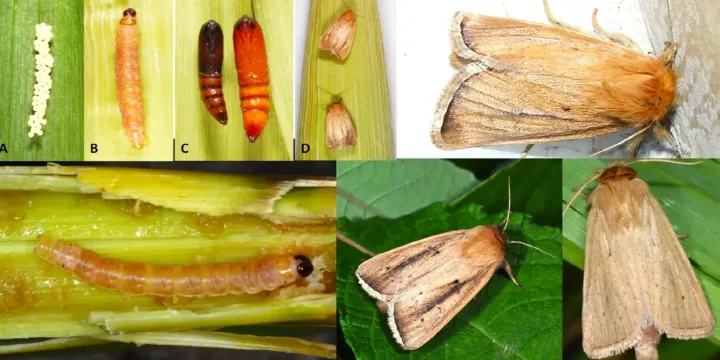
The Mediterranean corn stalk borer (Sesamia cretica) is a moth belonging to the Noctuidae family, with a wingspan ranging from 30 to 35 mm.
The adult moth features ochre-yellow to reddish-brown forewings, typically marked with a darker central spot that serves as a key identification characteristic.
The larvae are cream-colored with a brown head and distinctive reddish-brown longitudinal stripes along the dorsal side of their bodies.
Eggs are typically laid in small clusters beneath the leaf sheaths, where they are protected from environmental extremes and natural predators.
Pupation occurs within the larval tunnels inside the corn stalk or in the soil, with the pupae having a shiny dark brown appearance.
What it damages
The primary host for this pest is maize (corn), but it can also cause significant damage to other graminaceous crops like sorghum and millet.
The larvae cause direct damage by boring into the stalks, which severs the vascular tissue and disrupts the movement of nutrients and water.
When the borer destroys the growing point (apical meristem) of young plants, it leads to the characteristic condition known as "dead heart" or wilting.
Feeding within the ear of the maize creates entry points for various secondary pathogens, leading to fungal infections and significant grain quality degradation.
Stalk tunneling weakens the structural integrity of the plant, often leading to lodging during high winds, which complicates mechanical harvesting.
When it appears
The first generation usually emerges in spring, triggered by rising temperatures typically above 15 degrees Celsius (59 degrees Fahrenheit).
Moth activity peaks during the early growth stages of the maize, often coinciding with the rapid vegetative growth phase (V5 to V10 stages).
In Mediterranean climates, the pest can complete two to three generations per growing season, making consistent monitoring essential for control.
Winter is typically survived in the larval stage, remaining dormant within maize stalks, stubble, or deep cracks in the soil until spring.
The period from mid-summer onwards is when larval infestation is most severe, affecting both the vegetative structure and the developing ears.
Signs of infestation
Initial signs include small, window-like feeding spots on the leaves or small holes near the base of the leaf sheath created by young larvae.
The most alarming sign is the wilting of the central leaves, which indicates that the larvae have bored into the stalk and destroyed the growing point.
The presence of fine, brownish frass (larval excrement) at the entry points on the stalk is a clear indicator of active borer infestation.
Deformed or withered ears, coupled with visible boring holes on the husks, are signs of infestation during the late reproductive stages of the crop.
- Wilting of the plant's central leaf (dead heart).
- Visible entrance holes at the stalk nodes.
- Accumulation of frass around leaf bases.
Control measures
Cultural control is highly effective, starting with the deep incorporation of crop residues into the soil through plowing to eliminate overwintering larvae.
Rotating crops and destroying alternative host grasses near maize fields help to significantly reduce the local population of the pest.
Chemical control should be timed precisely to target the larvae before they bore into the stalks, as they are shielded once they are inside.
Biological control methods, including the release of Trichogramma wasps, can significantly reduce egg populations when deployed at the right time.
Integrated Pest Management (IPM) using pheromone traps is recommended to track adult flight and initiate control measures only when thresholds are met.
Taxonomy
- Latin name
- Sesamia cretica
- Order
- Lepidoptera (butterflies)
- Family
- Noctuidae
- EPPO code
- SESACR
Discussion
No discussions yet — be the first.