
African sugarcane borer
Sesamia calamistis
Description
How to identify
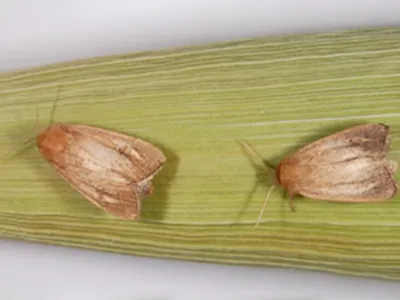
The African sugarcane borer (Sesamia calamistis) belongs to the Noctuidae family within the order Lepidoptera. The adult moth has a wingspan of approximately 25–35 mm, with straw-colored forewings featuring distinct dark markings.
The larvae, which reach 30–40 mm in length, are smooth and cream-colored with a characteristic dark brown head. These larvae are highly mobile in their early stages and quickly seek shelter inside the host plants.
Eggs are laid in clusters beneath the leaf sheaths of host plants, protected by scales secreted by the female. This behavior makes them difficult to target with many conventional insecticides during the egg stage.
The biological cycle is heavily influenced by regional climate. In tropical environments, the species can be multivoltine, completing multiple generations per year and causing sustained pressure throughout the growing season.
Identification is best achieved through field scouting for early-stage damage and the use of pheromone traps, which specifically attract male moths, providing data on population density and migration patterns.
What it damages
This pest is a significant threat to cereal crops, most notably maize, rice, sorghum, and sugarcane. It can also survive on wild grasses, which act as alternative hosts during off-seasons.
The primary damage is caused by larvae boring into the stems. This feeding disrupts the plant's vascular system, leading to stunted growth, reduced nutrient uptake, and overall yield loss.
In maize, infestation of the growing point often results in the "dead heart" symptom, where the central leaf wilts and dies, effectively stopping the development of the plant.
In rice, larval feeding within the stem often leads to "whiteheads," where the panicles fail to develop grain and appear prematurely bleached. This results in significant quantitative and qualitative losses.
Advanced infestations weaken the structural integrity of the stem, leading to lodging, which not only causes direct yield loss but also complicates harvest operations and increases the risk of mold growth.
When it appears
Activity typically occurs throughout the crop's growth phase. In tropical zones, the pest remains active as long as host plants are available and temperatures are favorable for development.
High humidity and moderate-to-warm temperatures accelerate the lifecycle of the moth, leading to rapid population growth. Drought conditions may slow down activity but can force larvae to aggregate in remaining green host tissues.
Larval populations often build up during the wet season, as rainfall promotes vigorous growth of both crops and wild grasses, providing abundant food sources for consecutive generations.
Overwintering occurs in the larval stage, tucked inside crop residues or the crowns of perennial grasses. As temperatures rise, larvae pupate and emerge as adults to start the cycle anew.
Effective management requires monitoring from the earliest seedling stages, as younger plants are disproportionately susceptible to damage that can lead to complete plant failure.
Signs of infestation
The presence of the borer is first signaled by tiny entry holes in the stem, often surrounded by "frass" (larval excrement), which looks like sawdust scattered near the base or on leaves.
Wilting of the central leaf whorl is a clear indicator of inner stem damage. Upon splitting the stem, one can usually find the larval gallery filled with excrement and plant debris.
In rice fields, look for patches of bleached, empty panicles. These whiteheads are easy to spot from a distance and are a hallmark symptom of severe stem borer activity.
Stem fragility is a common late-stage symptom. If plants collapse in patches without strong wind, it strongly suggests internal structural damage caused by borers.
- Dead heart symptoms on young maize.
- Sawdust-like frass at entry holes.
- Premature whiteheads on rice panicles.
- Increased lodging of crops in the field.
Control measures
Cultural practices, such as the complete destruction of crop residues immediately after harvest, are essential. Plowing the field helps expose overwintering larvae to predators and desiccation.
Crop rotation remains a cornerstone of management. By planting non-host crops in consecutive seasons, farmers can break the lifecycle and drastically reduce the local borer population.
Chemical control with systemic insecticides is effective if applied early, before the larvae burrow deep into the stem. Timing is critical, as later applications are often ineffective.
Biological control, utilizing natural enemies like parasitoid wasps (e.g., Cotesia species), can keep populations in check if the agricultural ecosystem is managed to support these beneficial insects.
In regions where available, cultivating Bt-maize varieties provides an excellent, high-efficacy solution, protecting the crop from within by targeting larvae as soon as they begin to feed.
Taxonomy
- Latin name
- Sesamia calamistis
- Order
- Lepidoptera (butterflies)
- Family
- Noctuidae
- EPPO code
- SESACA
Discussion
No discussions yet — be the first.