
Scutellonema
Scutellonema
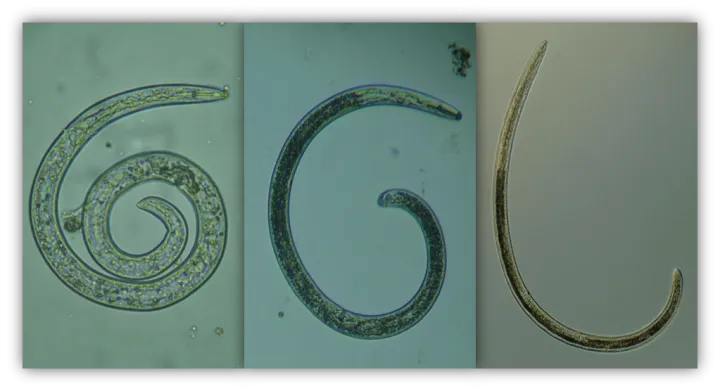
Description
How to identify
Scutellonema is a genus of plant-parasitic nematodes belonging to the order Tylenchida, family Hoplolaimidae. These microscopic organisms are widespread in soil and associated with the roots of many plants.
Adult individuals possess a vermiform body, typically measuring between 0.5 and 1.5 mm in length. A diagnostic morphological feature of this genus is the presence of a distinct scutellum (a shield-like structure) near the tail region.
Equipped with a sturdy stylet, these nematodes pierce root cells to extract nutrients. This feeding behavior classifies them as semi-endoparasites or ectoparasites depending on the specific environmental context.
Reproduction is typically amphimictic, though parthenogenesis is documented in several species. Eggs are laid in the surrounding soil or directly on the host plant roots.
The life cycle encompasses an egg stage, four larval stages, and the adult stage. Development from egg to adult usually takes several weeks under favorable soil conditions, allowing for rapid population growth.
What it damages
Scutellonema species are polyphagous, meaning they attack a broad range of agricultural crops, including cereals, legumes, vegetables, and ornamental plants, as well as banana and coffee plantations.
The primary damage occurs on the root system. Continuous feeding causes tissue lesions and necrosis, which significantly compromise the root's ability to absorb water and nutrients.
Wounds created by the nematode stylet act as entry points for secondary pathogens, such as soil-borne fungi and bacteria, which exacerbate the damage and lead to plant decay.
Above-ground symptoms include stunted growth, chlorosis, and reduced vigor, which often mimic nutrient deficiencies or drought stress, making early detection complex.
In severe infestations, the total root mass is significantly reduced, leading to lodging, poor yield performance, and, in extreme cases, the total loss of the crop.
When it appears
The activity of Scutellonema is highly dependent on soil temperature and moisture levels. Optimal temperatures for reproduction generally fall between 20°C and 28°C.
Populations tend to reach their peak during the active growing season when root exudates are most abundant, providing the necessary signals for nematode migration toward the roots.
During unfavorable conditions, such as extreme heat or cold, these nematodes can enter a state of dormancy or diapause, allowing them to survive in the soil for extended periods.
Spring warming triggers the reactivation of dormant populations, as they begin to seek out new root systems for feeding and subsequent colony expansion.
In irrigated fields, consistent soil moisture promotes a more stable environment for nematode activity, increasing the risk of widespread infestation compared to rain-fed areas.
Signs of infestation
Early symptoms are often subtle, manifesting as localized patches of stunted plants within a field that fail to respond to standard fertilization protocols.
Root systems may appear sparse or show signs of abnormal branching. Microscopic examination often reveals dark necrotic lesions, particularly on the root tips and cortex.
Foliar symptoms may include leaf yellowing (chlorosis) and permanent wilting, even when soil moisture appears adequate for healthy plants.
The presence of Scutellonema is confirmed by extracting samples from the soil and root tissue and examining them under a microscope to identify the characteristic scutellum.
Field observation showing uneven plant development is a reliable indicator that further diagnostic testing for soil-borne pathogens should be conducted.
Control measures
Strict phytosanitary measures are the first line of defense, aiming to prevent the movement of contaminated soil and planting stock between agricultural areas.
Crop rotation using non-host or antagonistic crops, such as marigolds, rapeseed, or mustard, can significantly reduce the nematode population in the soil over time.
Thermal treatment (steam sterilization) is a highly effective control method for greenhouses and nursery beds but is generally impractical for large-scale field use.
Chemical nematicides can be utilized in high-infestation scenarios, though they must be applied according to strict regulatory guidelines to minimize environmental impact.
- Regular cleaning of farm machinery to prevent cross-contamination.
- Use of certified nematode-free seeds and seedlings.
- Deep tillage practices to disrupt the vertical distribution of nematodes.
- Organic soil amendments to promote a healthy microbial community that may suppress nematode growth.
Taxonomy
- Latin name
- Scutellonema
- Order
- Nematodes
- Family
- Hoplolaimidae
- EPPO code
- SCUNSP
Discussion
No discussions yet — be the first.