
The Herald
Scoliopteryx libatrix
Description
How to identify
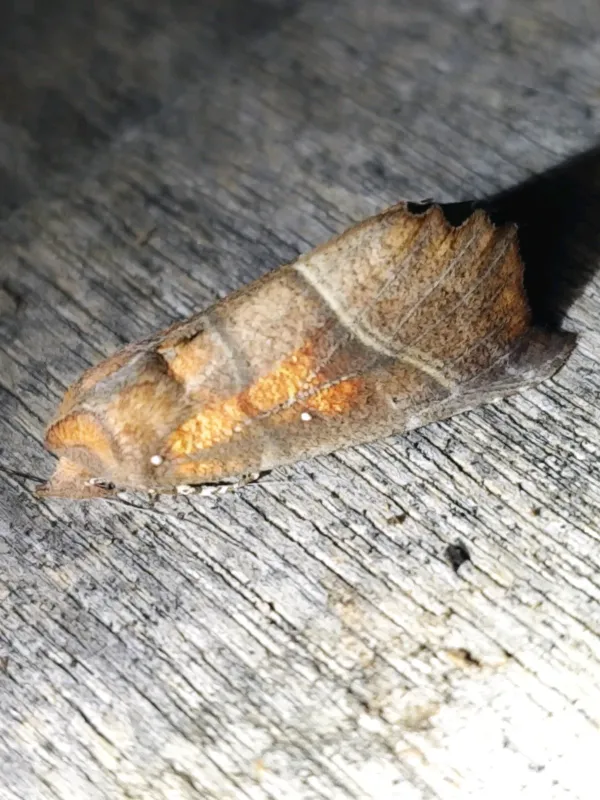
The Herald moth, scientifically known as Scoliopteryx libatrix, is a unique species in the Erebidae family, famous for its resemblance to a dry, crumpled leaf.
Adult moths have a wingspan of about 40–45 mm. The forewings are distinctively scalloped along the margins, which is the primary identifying feature.
The coloration is a combination of brown, orange, and grey, providing excellent camouflage against tree bark and decaying organic matter.
The larvae are bright green with white or yellow lateral lines and short, fine hairs, making them well-adapted to living on the undersides of leaves.
Pupation occurs within a silken cocoon, which the caterpillar constructs by folding over the edge of a leaf and securing it with dense silk threads.
What it damages
The primary hosts for the larvae are members of the Salicaceae family, most notably willow (Salix) and poplar (Populus) species.
In garden settings, these caterpillars may feed on fruit trees including apple, pear, and cherry, causing damage to the foliage.
Larval feeding results in ragged edges along the leaf margins, often leading to partial or complete defoliation of specific shoots or branches.
High infestations in nurseries can significantly hinder the growth and vigor of young trees, leading to economic losses in wood production.
While often considered a minor pest, in favorable years, their cumulative impact on the photosynthetic capacity of trees can be quite detrimental.
When it appears
Unlike many other moths, the Herald moth overwinters as an adult, often seeking shelter in cool, damp places like sheds, hollows, or bark crevices.
Adults emerge from hibernation in early spring, often being among the first lepidopterans to be observed in temperate regions.
The larvae are active during the summer months, typically reaching their peak feeding stage in early to mid-summer.
The life cycle usually spans one generation per year, though warmer climates may allow for a partial second generation.
After completing their larval stage, the pupae undergo development within their folded leaf shelters before emerging as new adults by late summer.
Signs of infestation
Early warning signs include irregular, notched holes along the leaf margins, which indicate the presence of feeding larvae.
Rolled or folded leaves held together by silk strands at the tips of branches are a sure sign of pupation activity.
Droppings (frass) found on the foliage or on the ground beneath the canopy signify active feeding in the higher parts of the tree.
Observations of motionless, leaf-like moths resting on bark during the autumn or early spring signify their hibernation sites.
- Ragged leaf margins.
- Leaves rolled or folded with silk.
- Presence of silken cocoons inside foliage.
- Loss of leaf density in affected branches.
Control measures
Monitoring populations can be achieved through the use of light traps, which help in assessing the size of the overwintering adult population.
For small infestations, manual removal and destruction of the folded leaves containing pupae is a highly effective, non-chemical control measure.
Biological control using formulations of Bacillus thuringiensis is recommended when larvae are in their early instars to minimize chemical impact.
Broad-spectrum insecticides should be avoided to protect local beneficial insect populations and predators that naturally prey on the larvae.
Maintaining a healthy garden ecosystem, including nesting sites for insectivorous birds, is a robust long-term strategy for managing the Herald moth.
Taxonomy
- Latin name
- Scoliopteryx libatrix
- Order
- Lepidoptera (butterflies)
- Family
- Noctuidae
- EPPO code
- SCOXLI
Discussion
No discussions yet — be the first.