
Goose barnacle
Scalpellum scalpellum
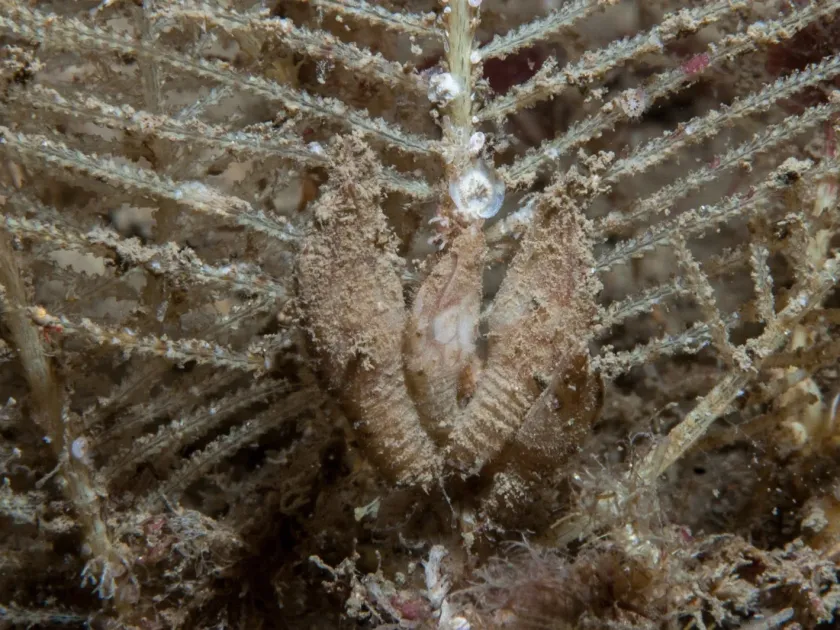
Description
How to identify
The goose barnacle (Scalpellum scalpellum) is a marine crustacean belonging to the order Cirripedia and the family Scalpellidae. It is a sessile organism that anchors itself to hard surfaces in marine environments.
The body is comprised of a flexible stalk and a capitulum protected by calcified plates. These plates serve as a protective shell, shielding the organism from predators and environmental stress.
As a suspension feeder, the barnacle uses its thoracic appendages, known as cirri, to filter food particles from the water column. It thrives in various depths where water currents provide nutrients.
Its biological cycle is strictly tied to oceanic conditions, including salinity levels and water movement, which prevents it from surviving in terrestrial environments.
The organism is scientifically classified as a part of marine biodiversity, playing a specific ecological role within its own habitat.
What it damages
The goose barnacle does not cause any damage to agricultural crops, garden plants, or forestry. It is exclusively a marine organism and does not interact with terrestrial plant species.
There is no mechanism for this organism to damage plant tissues, roots, or leaves, as its morphology and biology are incompatible with life on land.
Agronomic literature does not classify this barnacle as a pest. It has no relevance to crop protection or integrated pest management strategies for plants.
Any concerns regarding crop failure or plant infestation attributed to this species are entirely unfounded, as they cannot thrive outside of a marine ecosystem.
The economic impact of this species on land-based farming is zero, as it remains confined to the marine environment throughout its entire life cycle.
Control measures
No protection measures are necessary for plants against the goose barnacle. Using pesticides or herbicides is completely ineffective and unnecessary in this context.
Control strategies for this species are limited to marine engineering, such as applying anti-fouling coatings to ship hulls to prevent colonization.
In agricultural settings, no monitoring or control programs are required, as the species presents no risk to productivity.
Environmental regulations generally protect marine life, and as this species does not interfere with human agricultural activity, no management action is warranted.
Focusing on genuine agricultural pests is recommended, while leaving marine barnacles to fulfill their role in the natural sea ecosystems.
Taxonomy
- Latin name
- Scalpellum scalpellum
- Family
- Scalpellidae
- EPPO code
- ZCALSC
Discussion
No discussions yet — be the first.