
Tasmanian devil
Sarcophilus harrisii
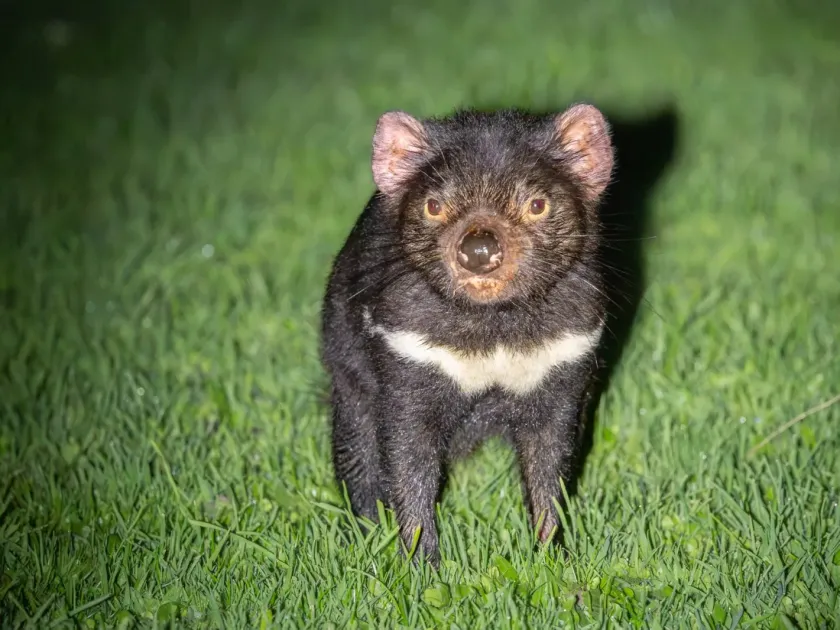
Description
How to identify
The Tasmanian devil is the largest extant carnivorous marsupial, endemic to the island of Tasmania in Australia. It belongs to the family Dasyuridae and is the only living member of the genus Sarcophilus.
Physically, the animal is characterized by a stocky build, short limbs, and a large, powerful head. Its fur is typically black, often featuring distinctive white patches on the chest or flanks.
The species possesses an exceptionally strong bite force, which allows it to crush bones with ease. This anatomical feature makes it one of the most efficient scavengers in its natural habitat.
These animals are primarily nocturnal, spending their daylight hours hidden in dens, hollow logs, or thick vegetation to avoid direct exposure to environmental disturbances.
The taxonomic classification places them in the order Dasyuromorphia. Their unique morphology and behaviour have made them a significant subject of ecological and genetic research worldwide.
What it damages
It is crucial to clarify that the Tasmanian devil is not a plant pest. As a strict carnivore, it has no biological interest in agricultural crops, fruits, or vegetation.
The species does not consume plant tissue, nor does it cause any mechanical damage to stems, roots, or harvestable produce. There is no evidence of interaction with crops.
In an agronomic context, the animal is considered harmless to farming operations. It does not possess the dietary habits that would categorise it as a threat to food security.
The species does not impact soil structure or irrigation systems. Its ecological function is strictly limited to predation and scavenging on animal-based organic matter.
Farmers do not need to concern themselves with the animal's presence, as it does not disrupt crop growth cycles or pose any risk to agricultural yields.
When it appears
The life cycle of the Tasmanian devil is governed by the seasonal climate of Tasmania. Mating occurs annually, ensuring that offspring are born during favourable months.
The development of the young takes place within the mother's pouch, providing protection during the early stages of life. After weaning, the sub-adults gradually establish independence.
Activity levels remain relatively constant throughout the year, although fluctuations may occur depending on ambient temperature and available food resources in the wild.
The species demonstrates high adaptability to the changing seasons within its natural habitat. Their biological rhythms are perfectly synchronised with the environmental conditions.
There are no seasonal patterns of "infestation" because the animal is an indigenous predator and does not congregate in cultivated fields or managed plantations.
Control measures
Because the Tasmanian devil is not an agricultural pest, no control measures or plant protection protocols are required or recommended for this species.
The species is strictly protected by law. Any attempt to trap, harm, or interfere with these animals is a criminal offence under both Australian and Tasmanian legislation.
If there is a concern regarding the safety of livestock or property, the recommended approach is to secure the premises with appropriate fencing to deter interaction.
The use of pesticides, traps, or any chemical deterrents is strictly prohibited and scientifically unnecessary, as the animals pose no threat to plant health.
The most effective strategy is to maintain a respectful distance, allowing these native predators to continue their essential role in the local ecosystem's balance.
Taxonomy
- Latin name
- Sarcophilus harrisii
- Family
- Dasyuridae
- EPPO code
- SRCPHA
Discussion
No discussions yet — be the first.