
Grey flesh fly
Sarcophaga dux
Description
How to identify
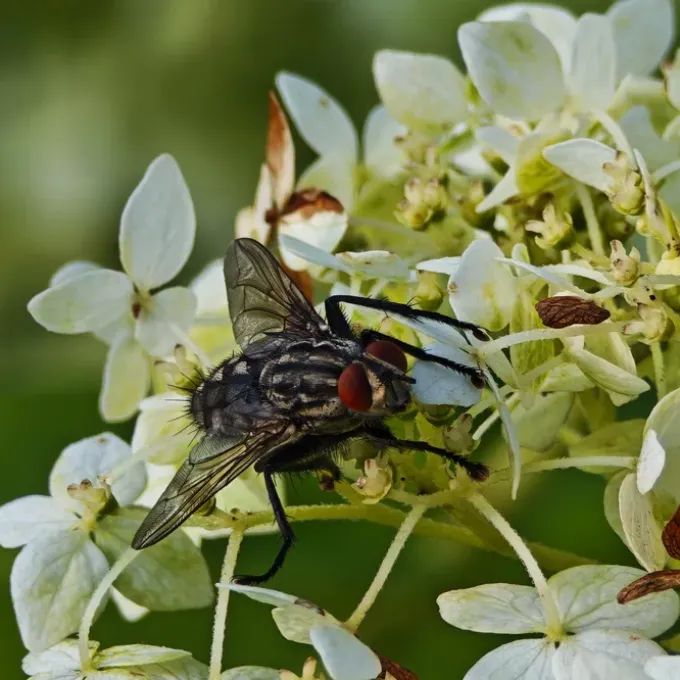
The grey flesh fly (lat. Sarcophaga dux) belongs to the Sarcophagidae family within the order Diptera. These are robust flies that typically measure between 10 and 15 mm in length.
The insect is easily recognized by its ash-grey coloration and the presence of three distinct dark longitudinal stripes on the thorax.
The abdomen features a characteristic checkerboard pattern that shifts appearance depending on the light angle, a key identifying feature of the species.
They possess large, reddish-brown eyes and legs covered with dense black setae, which provide them with excellent sensory capabilities in their environment.
Unlike many other fly species, they are primarily active during the day, often seen basking on warm surfaces before seeking out egg-laying sites.
What it damages
The primary damage is caused by the larval stage, which feeds on organic matter, including damaged or rotting tissues of various vegetable and melon crops.
Crops such as tomatoes, cucumbers, squashes, and pumpkins are particularly susceptible, especially when fruits are in contact with the ground or have minor injuries.
Larvae invade the fruit through existing wounds or soft spots, aggressively feeding on the interior pulp and significantly reducing the market value of the produce.
Beyond direct feeding damage, the larvae introduce bacteria and fungi, which trigger rapid decay, leading to total loss of the infested fruit within a short timeframe.
In high-density populations, the larvae can infest healthy tissues that are nearing maturity, turning a productive field into a hub of agricultural waste.
When it appears
The seasonal activity of Sarcophaga dux typically commences when average daily temperatures reach +15°C, usually in late spring or early summer.
Adults remain active throughout the summer, with population peaks occurring during the hottest months when growth cycles are at their fastest.
The species is ovoviviparous, meaning the female retains eggs within her body and deposits live, active larvae directly onto the substrate or host plant.
Under optimal conditions, the life cycle from larva to adult is short, allowing for multiple generations to develop throughout a single growing season.
They overwinter in the puparium stage, usually buried in the soil or hiding under heavy debris where they can find sufficient shelter from cold weather.
Signs of infestation
The primary indicator of an infestation is the development of soft, darkened areas on fruits that rapidly expand and turn into mushy decay.
Upon inspecting the affected fruit, one can find yellowish-white larvae tunneling through the flesh, often accompanied by a foul-smelling liquid discharge.
Plants may exhibit signs of premature wilting if the larvae migrate to the stem or root crown, causing damage to the plant's internal vascular system.
Excessive mold growth often follows the initial larval damage, as the fly facilitates the spread of various opportunistic phytopathogens.
- Darkening and softening of the fruit skin.
- Presence of live larvae inside the fruit pulp.
- Strong, unpleasant putrid odor.
- Rapid spread of decay across multiple fruits.
Control measures
Good agricultural hygiene is the cornerstone of control, including the prompt removal and disposal of all crop waste and damaged fruits from the field.
Regular monitoring of fruit health is essential to identify infestations early and prevent the larvae from completing their life cycle and pupating in the soil.
The use of traps with food-based lures or pheromones can effectively reduce the population of adult flies without the need for broad-spectrum chemical sprays.
Biological control agents, such as entomopathogenic fungi or specialized bacteria, can be applied to suppress larval development in high-risk areas.
Chemical control should be used sparingly, focusing on systemic insecticides only when infestation thresholds are exceeded, while always respecting pre-harvest intervals.
Taxonomy
- Latin name
- Sarcophaga dux
- Order
- Diptera (flies)
- Family
- Sarcophagidae
- EPPO code
- SARCMS
Discussion
No discussions yet — be the first.