
Aldrich’s flesh fly
Sarcophaga aldrichi
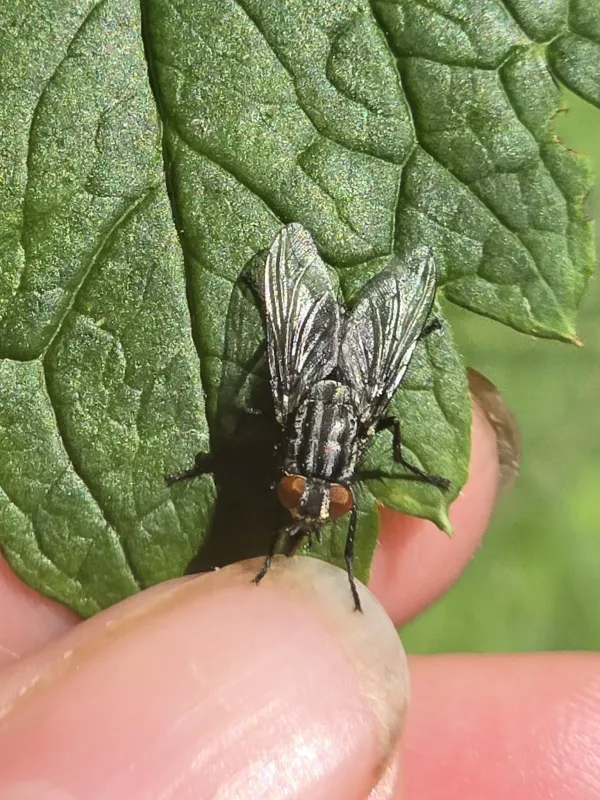
Description
How to identify
Sarcophaga aldrichi, commonly known as Aldrich’s flesh fly, is a dipteran species belonging to the Sarcophagidae family. They are robust flies typically characterized by a grey thorax with three distinct black longitudinal stripes.
The abdomen exhibits a checkerboard pattern, a classic trait of many flesh flies. Their bodies are covered in dense, bristle-like hairs, which assist in their movement and protection within complex environments.
Adult flies usually measure between 10 to 15 millimeters in length. They possess reddish-brown eyes and a spongy mouthpart adapted for consuming liquid food sources found in their natural habitat.
As members of the Sarcophagidae family, they are known for being viviparous, often depositing larvae directly onto or near the host, rather than laying eggs like many other fly species.
Identification to the species level is complex and often relies on the examination of the male genitalia, as external morphology is remarkably similar across the genus Sarcophaga.
What it damages
Aldrich’s flesh fly is primarily recognized as a parasitoid rather than a direct plant pest. It targets the larvae and pupae of various forest insects, notably leaf beetles that feed on poplar and other broadleaf trees.
While the fly does not feed on plant tissue itself, its impact on the insect community can be significant. By parasitizing forest insects, it can shift the population dynamics of herbivores and other beneficial species.
In cases of large-scale outbreaks of host insects, these flies can significantly reduce the host population, which is sometimes perceived as a beneficial service in forestry management.
However, excessive parasitism of beneficial predatory insects by Sarcophaga aldrichi could potentially disrupt biological control mechanisms, leading to instability in forest insect populations.
Research focuses on the fly's interaction with the forest canopy, where it actively seeks out larvae hidden in foliage, exerting pressure on the pest populations inhabiting these trees.
When it appears
The activity of Sarcophaga aldrichi adults is highly seasonal, typically peaking from late spring through the summer months, depending on the local climate and temperature gradients.
Adult flies emerge from hibernation as temperatures rise, perfectly timing their lifecycle to coincide with the availability of suitable host larvae in the environment.
They are most active on warm, sunny days when they are frequently observed flying in search of mating partners and hosts to deposit their larvae upon.
The length of the developmental cycle is temperature-dependent, usually taking several weeks. This allows for multiple generations per year in favorable climatic conditions.
As the weather cools in early autumn, the flies gradually decrease their activity and seek shelter, eventually entering a dormant phase to survive the winter season.
Signs of infestation
The primary sign of the presence of this species is the observation of dead or decaying host insect larvae that show evidence of internal parasitoid development, often characterized by exit holes.
A reduction in the population density of leaf beetles on trees that were previously heavily infested is a strong indicator of successful parasitoid activity by the fly.
There are no direct signs of damage to the host plant, such as leaf discoloration or tissue necrosis, as the fly only interacts with the insect fauna on the plant surface.
High counts of adult grey flesh flies on the trunks or foliage of susceptible trees serve as a qualitative signal of the ongoing reproductive activity of the species.
Dissection of host pupae in laboratory settings often reveals the presence of larvae or puparia of the flesh fly, confirming the infestation and the fly's successful life cycle.
Control measures
General management of Sarcophaga aldrichi is rarely required, as it often acts as a natural biological control agent against other forest pest species.
Forestry management practices should focus on maintaining a balanced ecosystem. The indiscriminate use of broad-spectrum insecticides should be avoided to protect the parasitoid population.
Monitoring programs using pheromone traps or sticky boards can be implemented to track adult activity and ensure that populations remain within natural fluctuations.
Silvicultural methods, such as maintaining healthy tree stands, help prevent pest outbreaks that would otherwise lead to massive surges in the flesh fly population.
- Monitoring adult population density.
- Preserving natural habitat structures.
- Judicious use of chemical pest control.
- Support for indigenous biological control.
Taxonomy
- Latin name
- Sarcophaga aldrichi
- Order
- Diptera (flies)
- Family
- Sarcophagidae
- EPPO code
- SARCAL
Discussion
No discussions yet — be the first.