
Sacculina
Sacculina
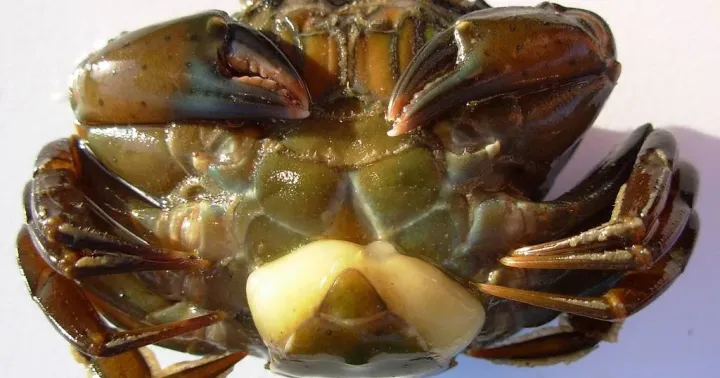
Description
How to identify
Sacculina is a genus of highly specialized parasitic crustaceans belonging to the order Rhizocephala. These organisms have undergone extreme evolutionary simplification, losing most organ systems typical for free-living crustaceans.
The adult form consists of the externa, a sac-like reproductive structure located under the crab's abdomen, and the interna, a root-like system that penetrates the host's body to absorb nutrients.
The life cycle begins with nauplius larvae that eventually transform into cypris larvae. These larvae attach to the crab and inject their cellular mass into the host.
Once inside, the parasite grows into a network that spreads through the crab's body, effectively hijacking its physiological processes to sustain its own growth.
This genus is part of the family Sacculinidae, recognized for its obligate parasitic relationship with various species of decapod crustaceans.
What it damages
Sacculina is not a plant pest and does not affect agricultural crops, as its biological niche is strictly limited to the marine environment and crab hosts.
The primary impact of the parasite is the complete sterilization of the host. By releasing specific chemicals, the parasite stops the crab's reproductive cycle entirely.
In addition to sterility, male crabs infected by Sacculina often undergo physical feminization, developing characteristics typical of female anatomy.
For the shellfish industry and commercial fisheries, this parasite represents a threat as it depletes populations of crabs and interferes with their natural reproduction.
While not a danger to crops, the organism serves as a subject of extensive research regarding host-parasite interactions and hormonal regulation in marine ecosystems.
Control measures
There are no chemical or large-scale control measures for Sacculina in wild habitats, as it is a natural component of marine biodiversity.
In aquaculture environments, control is achieved through manual inspection of specimens and the immediate removal of any crab showing signs of the external sac.
Preventative measures include strict quarantine protocols to ensure that introduced individuals do not carry the parasite into closed farming systems.
Management practices focus on sanitation and water filtration to filter out free-swimming larvae before they can reach the crab population.
Future efforts in aquaculture involve improving detection technology to identify early-stage infections before the reproductive externa is formed.
Taxonomy
- Latin name
- Sacculina
- Family
- Sacculinidae
- EPPO code
- SCCLSP
Discussion
No discussions yet — be the first.