
Sugarcane mealybug
Saccharicoccus sacchari
Description
How to identify
The sugarcane mealybug (Saccharicoccus sacchari) is a significant pest belonging to the order Hemiptera and the family Pseudococcidae.
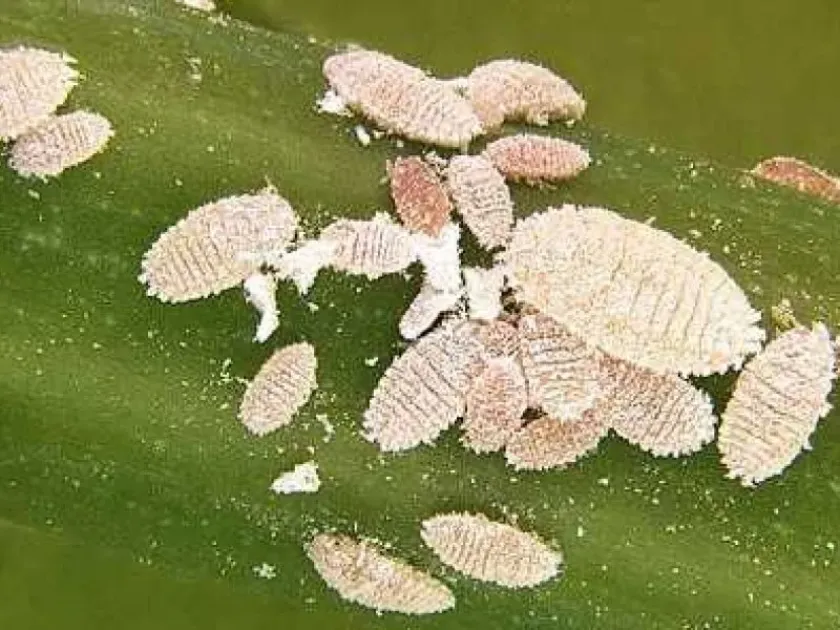
These insects are characterized by a soft, oval body covered in a white, waxy, mealy secretion that provides protection against external environmental factors.
Adult females are sedentary, living in colonies, while the adult males are winged but short-lived, with the primary purpose of reproduction.
The first-instar nymphs, known as crawlers, are mobile and serve as the main stage for the dispersal of the pest across the field.
The life cycle is temperature-dependent, allowing for multiple generations per year in tropical and subtropical growing regions.
What it damages
The primary host for this species is sugarcane, but it is also known to infest other grasses, including sorghum and various wild forage grasses.
Mealybugs feed by inserting their piercing-sucking mouthparts into the plant tissue, specifically targeting the nodes under the leaf sheaths.
This feeding activity removes essential nutrients and sap from the plant, which severely stunts growth and reduces the quality of the sugar yield.
In addition to sap loss, the secretion of honeydew promotes the growth of sooty mold, which blocks light and impairs the plant's photosynthetic capacity.
Heavy infestations can lead to internode shortening and, in severe cases, the death of young tillers, particularly under moisture stress conditions.
Signs of infestation
The presence of white, cotton-like masses under the leaf sheaths of the lower nodes is the most definitive sign of an infestation.
Increased ant activity on the stems is a common indicator, as ants tend to farm the mealybugs to collect the sugary honeydew they produce.
Visual symptoms on the plant include yellowing and drying of the lower leaves, which eventually turn brown and die prematurely.
When peeling back the leaf sheaths, one can observe clustered colonies of insects ranging from small, mobile crawlers to stationary adults.
Stunted growth patterns and reduced vigor of the sugarcane stalks compared to healthy plants also signal an underlying pest presence.
Control measures
Utilizing clean, pest-free seed cane is the most effective preventative measure to ensure that new plantings remain free of the mealybug.
Hot water treatment of seed setts before planting is a standard agricultural practice to eliminate latent mealybug populations within the plant tissue.
Biological control agents, such as predatory beetles and parasitic wasps, play a vital role in maintaining the pest population below economic thresholds.
Systemic insecticides may be applied in cases of high infestation to penetrate the protective leaf sheaths and target the feeding insects directly.
Maintaining good field sanitation, including the removal of crop debris and control of alternative host weeds, prevents the migration of pests between seasons.
Taxonomy
- Latin name
- Saccharicoccus sacchari
- Order
- Hemiptera (bugs, aphids, leafhoppers)
- Family
- Pseudococcidae
- EPPO code
- PSECSA
Discussion
No discussions yet — be the first.