
Romanomermis culicivorax
Romanomermis culicivorax
Description
How to identify
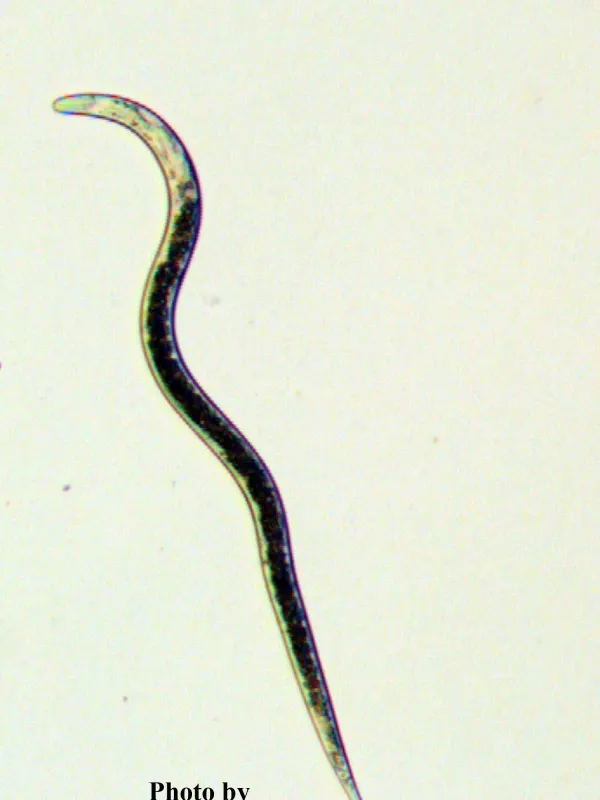
Romanomermis culicivorax is a microscopic entomopathogenic nematode belonging to the order Mermithida, family Mermithidae. Visually, adults appear as slender, whitish, thread-like worms measuring up to 1-2 cm in length.
The species is highly specialized as a parasite of aquatic invertebrates. Unlike phytopathogenic nematodes, this species poses no threat to crops, ornamental plants, or soil health.
The infective juvenile stage is highly motile in water. It uses specialized sensory organs to locate mosquito larvae, making it a powerful biological tool for mosquito population management.
In their natural habitat, these nematodes survive as eggs in the soil or at the bottom of water bodies, waiting for suitable environmental conditions to hatch.
Professional identification of this species requires morphometric analysis under high-magnification microscopy, as species within the Mermithidae family often share similar morphological characteristics.
What it damages
It is important to emphasize that Romanomermis culicivorax is not a plant pest. In agricultural and environmental sciences, it is classified as a beneficial entomopathogen.
The primary target of this nematode is the larvae of blood-sucking mosquitoes in the family Culicidae. It serves as a natural regulator that reduces mosquito populations in water bodies.
By controlling mosquitoes, this nematode indirectly protects agricultural workers and livestock from the stress and disease risks associated with mosquito infestations.
The parasitic process involves the nematode larva penetrating the mosquito larva's hemocoel, where it consumes internal tissues, ultimately leading to the death of the host.
This biological control method is environmentally friendly, causing no harm to the ecosystem, crops, or non-target beneficial insects like pollinators.
When it appears
The biological activity of Romanomermis culicivorax is directly dependent on water temperature and weather conditions. Optimal infection rates occur during the warmer months of the year.
The ideal temperature range for nematode development and host infection is between +20°C and +30°C. Below +15°C, the nematode activity slows down significantly.
The peak emergence of infective larvae usually coincides with the spring and summer breeding cycles of mosquitoes, ensuring a synchronized and efficient control of the host population.
Water availability is crucial; if breeding sites dry out, the nematode population may enter a dormant phase until water levels are restored.
Development is confined to aquatic environments, including stagnant ponds, flooded areas, and slow-moving streams where mosquito larvae typically congregate.
Signs of infestation
The primary sign of the nematode's activity is a significant reduction in the number of mosquito larvae in areas where they were previously abundant.
Infected mosquito larvae often exhibit altered behavior, such as sluggishness or an inability to dive, and they often stay closer to the water surface than healthy larvae.
Microscopic examination of dead larvae typically reveals the presence of a developing nematode occupying a significant portion of the host's body cavity.
A reduction in the number of adult mosquitoes (imagines) near treated water bodies serves as a practical indicator of the success of the biological control effort.
The absence of larvae in historical mosquito breeding sites despite warm temperatures and adequate organic matter may indicate successful colonization by the nematode.
Control measures
No control measures against Romanomermis culicivorax are needed, as it is a beneficial organism. Instead, the focus is on conservation and augmentation of its populations.
To ensure effectiveness, the use of broad-spectrum chemical insecticides in the water should be avoided, as these substances can be toxic to the nematodes.
Maintaining a balanced aquatic environment with minimal pollution is essential for the survival and long-term establishment of the nematode population.
When implementing biological control programs, avoid sudden changes in water pH or oxygen levels, which could disrupt the lifecycle of the beneficial nematodes.
Storage and handling of bio-preparations containing Romanomermis culicivorax must be done according to strict protocols, avoiding direct sunlight and temperature extremes.
Taxonomy
- Latin name
- Romanomermis culicivorax
- Order
- Nematodes
- Family
- Mermithidae
- EPPO code
- REEINI
Discussion
No discussions yet — be the first.