
Large Wainscot
Rhizedra lutosa
Description
How to identify
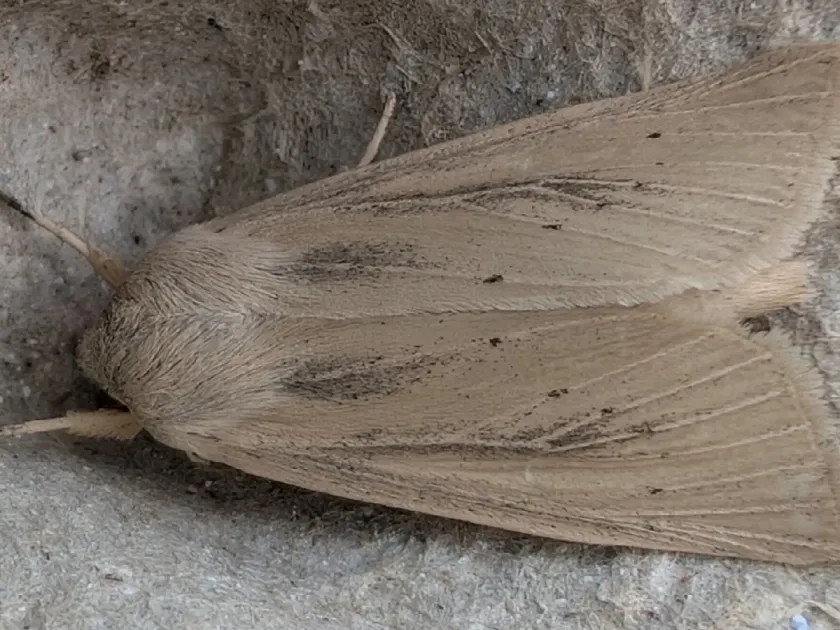
The Large Wainscot (Rhizedra lutosa) is a moth of the family Noctuidae. The adult moth has a wingspan ranging from 45 to 55 mm, characterized by its pale, ochreous-yellow forewings with faint darker veins.
The hindwings of this species are generally paler, often whitish or cream-colored, lacking the distinct patterns seen on the forewings, which helps them blend into wetland vegetation.
The larvae, or caterpillars, grow up to 60 mm long. They possess a yellowish-white body, a distinctive brown head, and dark chitinous plates on their segments, making them easily identifiable upon close inspection.
The pupa is dark reddish-brown, encased within a strong, silk-lined cocoon found either in the soil or within the hollowed stems of its host plant, providing protection from environmental stressors.
These moths are nocturnal by nature, spending their daylight hours resting in dense vegetation, which makes them difficult to spot without dedicated light trapping methods.
What it damages
The primary damage is caused by the larvae, which are stem-borers. They penetrate the base of the stems and the root systems of various grass species, effectively cutting off the plant's nutrient supply.
While commonly associated with reeds (Phragmites), the larvae frequently attack cereal crops like wheat and rye, particularly when these crops are grown in damp conditions near wetlands or irrigation ditches.
The larvae eat out the central part of the stem, moving upward, which leads to the death of the central shoot, a condition often referred to as "deadheart" in agricultural terminology.
Economic damage is often localized but can be significant, leading to reduced tillering, lower grain weight, and overall thinning of the crop stand in the affected areas of the field.
Beyond direct physical damage, the wounds created by the larvae provide entry points for various fungal and bacterial pathogens, leading to secondary plant diseases that further reduce yield.
When it appears
The adult moth flight period typically occurs in late summer and early autumn, spanning from August to October, during which time mating and oviposition take place.
Eggs serve as the overwintering stage of the life cycle. They are deposited in the soil or on plant debris, where they remain dormant throughout the winter months until the warmth of spring.
Larval activity begins in spring, with the most destructive feeding period occurring from May through June as the caterpillars grow rapidly and require high energy intake.
Pupation occurs during the summer months, typically in June or July, when the mature larvae settle in a secure site to undergo metamorphosis into the adult moth form.
Environmental conditions, particularly soil moisture levels and temperature, play a crucial role in the timing and success of each life cycle stage, favoring populations in wetter regions.
Signs of infestation
The earliest signs of infestation include the wilting and yellowing of the central leaf of the plant, which becomes brittle and can be easily pulled from the stem base.
Evidence of larval entry, such as small boreholes at the base of the plant stem, is usually accompanied by fine frass (larval excrement) deposited near the entrance or on the ground.
The appearance of "deadheart" symptoms, where individual tillers turn white and die off while the rest of the plant remains green, is a hallmark sign of stem-boring activity.
Inspecting the soil around the base of the plant or splitting the stem reveals the presence of larvae, especially during early morning or evening hours when they may be more active.
- Wilting of the central leaf.
- Entry holes in the stem base.
- Dieback of individual shoots.
- Frass accumulation near the plant crown.
Control measures
Effective cultural control includes deep autumn plowing of field margins, which disrupts the overwintering egg sites and destroys many young larvae before they can establish.
Managing weeds, particularly creeping grasses like couch grass (Elymus repens), is essential as these plants act as reservoir hosts for the moth, allowing populations to persist near cultivated fields.
Crop rotation remains a primary strategy to manage this pest. Avoiding the planting of sensitive cereal crops in fields adjacent to reed beds or poorly drained areas helps reduce infestation risks.
When infestation levels exceed economic thresholds, the application of systemic insecticides is necessary. These treatments should target the early larval stages before the caterpillars move deep into the stems.
Monitoring using light traps or pheromone baits can help agriculturalists predict the flight season, enabling more precise timing of protective measures and maximizing the efficacy of chemical applications.
Taxonomy
- Latin name
- Rhizedra lutosa
- Order
- Lepidoptera (butterflies)
- Family
- Noctuidae
- EPPO code
- RHZDLU
Discussion
No discussions yet — be the first.