
Large Wainscot
Rhizedra
Description
How to identify
The Large Wainscot (Rhizedra lutosa) is a moth of the Noctuidae family. It is a specialist species that primarily inhabits marshy areas where its host plant, common reed, grows in abundance.
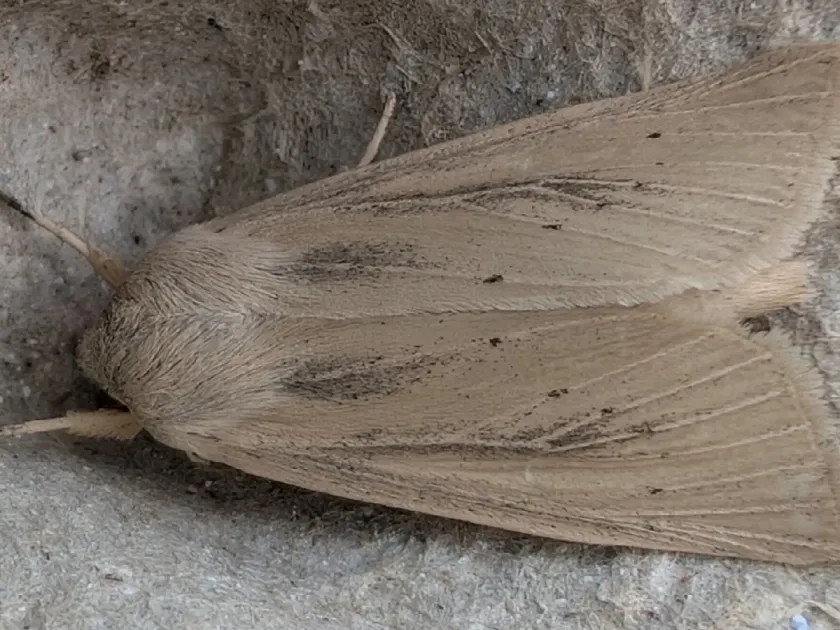
The adult moth has a wingspan of approximately 40–50 mm. Its forewings are characterized by a pale yellowish or sandy-brown color, which provides excellent camouflage against the withered stems of reeds.
The larvae are smooth-bodied, growing up to 50 mm in length, with a light-colored body and a distinctively darkened head capsule. They are adapted for endophagous life, dwelling inside the stems of plants.
The life cycle typically includes one generation per year, with the species overwintering in the egg stage. Pupation occurs in late summer within the plant stems or just below the soil surface.
As a nocturnal insect, the Large Wainscot is highly attracted to light, which makes it a common species monitored by entomologists and farmers using light traps for population tracking.
What it damages
While their primary host is the common reed (Phragmites australis), the larvae can infest various cereal crops, including wheat, barley, and maize, particularly in fields adjacent to wetlands.
The larvae inflict damage by boring into the stems of cereal plants. This feeding activity destroys the vascular tissue, preventing the transport of nutrients and water to the head of the plant.
Early-stage larvae can cause significant physiological stress to the plant, while older larvae often cause the collapse or premature death of the stem, leading to total yield loss of the affected tiller.
The economic impact of the Large Wainscot is usually localized, yet it can be severe in fields bordering reed beds, where migration of larvae or egg-laying adults is more frequent.
Severe infestations manifest as patches of dying plants, which negatively affect the overall field density and uniformity of the crop throughout the growing season.
When it appears
Adult moths emerge and are active during late summer and early autumn, specifically from late August through October, which marks the peak period for mating and oviposition.
The species survives the winter in the egg stage, which is deposited on the stems or sheaths of host plants. The eggs are highly resilient to cold and moisture, ensuring successful overwintering.
Larval hatching typically begins in the spring, once temperatures are sufficiently high to support development. This is a critical period for monitoring as the young larvae start feeding on tender shoots.
The larval stage extends until mid-summer, providing ample time for the caterpillars to complete their development and achieve the necessary mass for pupation.
By late summer, the larvae finish their development and transform into pupae, concluding the primary life cycle phases before the next generation of adults begins to fly.
Signs of infestation
The earliest symptom of infestation is the yellowing or sudden wilting of the central leaf of a cereal tiller, often referred to as "deadheart" formation.
Close inspection of the stem base reveals entry holes created by the larvae, often accompanied by the presence of frass (larval waste) that looks like brownish dust or granules.
Stems infested by the Large Wainscot larvae become weak and brittle, often snapping near the base under light wind pressure, which is a clear diagnostic indicator of stem-boring activity.
Probing or cutting open the affected stem usually reveals the larva inside, confirming the identity of the pest responsible for the damage.
Monitoring the edges of fields near wetlands during the flight period (autumn) using light traps or pheromone lures can help detect population build-ups before the next season.
Control measures
Effective management focuses on habitat modification, such as removing or mowing reeds and other wild grasses in areas surrounding agricultural fields to reduce potential breeding sites.
Cultural practices, including deep ploughing of field edges and stubble after harvest, are highly recommended to bury and destroy overwintering eggs.
- Maintain a buffer zone between crop fields and natural marshland habitats.
- Promote crop rotation to break the cycle of pest colonization in high-risk areas.
- Use systemic insecticides only as a targeted measure when larval presence is confirmed and before they become deeply established in the stems.
Biological control methods include the conservation and release of natural parasitoids, such as Trichogramma wasps, which target the moth's eggs and help keep populations in check.
Timely identification of the pest is crucial because once the larvae have bored into the deep layers of the stem, chemical protection becomes significantly less effective due to the larvae's protected position.
Taxonomy
- Latin name
- Rhizedra
- Order
- Lepidoptera (butterflies)
- Family
- Noctuidae
- EPPO code
- RHZDSP
Discussion
No discussions yet — be the first.