
Glassy cutworm
Resapamea stipata
Description
How to identify
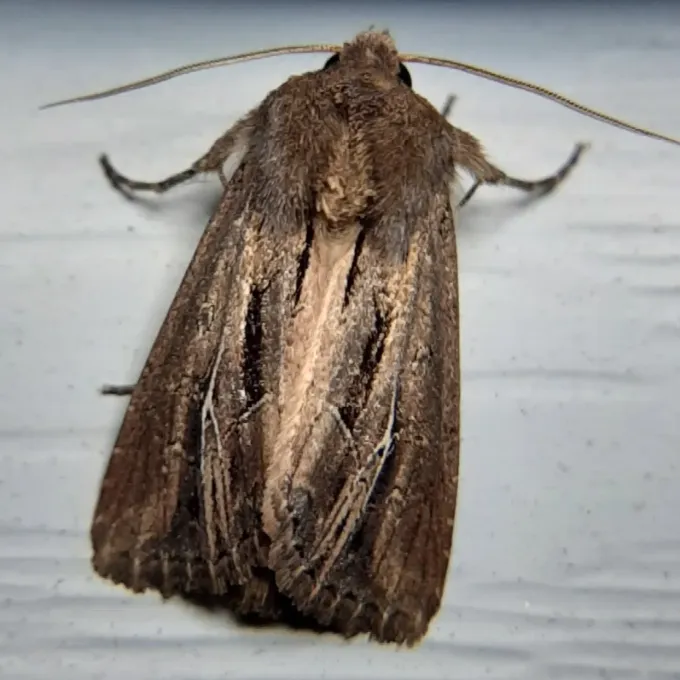
The Glassy cutworm (Resapamea stipata) is a member of the Noctuidae family, commonly known as owlet moths. The adult moth features a wingspan of approximately 35-40 mm, with greyish-brown forewings that display subtle dark markings and wavy lines.
The larvae, which are the damaging stage, grow up to 40 mm in length. They are typically translucent or light-colored with a distinct, shiny, dark brown head capsule that helps them navigate through plant tissues.
As nocturnal insects, the adults are seldom seen during the day, remaining hidden in grass or debris. Their eggs are laid in clusters, often near the base of host plants or on soil clods.
The species relies on specific host plants to complete its life cycle. Taxonomic identification in the field is usually performed by observing the specific larval morphology and the nature of the damage caused to the plants.
Proper identification is crucial for managing outbreaks, as distinguishing between this and other cutworm species ensures the correct selection of control methods.
What it damages
The Glassy cutworm primarily feeds on various grasses and cereal crops, including wheat, barley, rye, and corn. They are also known to thrive in areas with abundant wild grassy weeds.
The larvae are stem-borers; they enter the base of the plant and consume the internal tissues. This feeding behavior destroys the growing point and often leads to the death of the central shoot.
Young plants are particularly vulnerable to infestation, as a single larva can effectively kill a plant, leading to significant stand loss within the field.
Older plants may survive but suffer from reduced vigor, stunted growth, and increased susceptibility to secondary infections or environmental stressors.
Outbreaks can lead to economic losses if the larval population is high, as the damage is hidden inside the stem and often goes undetected until irreversible harm is done.
When it appears
The Glassy cutworm typically overwinter in the egg stage, which remains dormant on crop residues or in the soil near host plants throughout the winter months.
Larvae hatch in the spring as temperatures rise, usually coinciding with the early growth stages of cereal crops. They immediately begin feeding on the nearest suitable stems.
The larval stage lasts for several weeks, during which they grow through several instars. This is the period when they are most destructive to commercial crops.
Pupation takes place in the soil near the base of the host plants, typically in early summer. The pupal stage lasts about two to three weeks before the adults emerge.
The adult moth cycle typically consists of one generation per year, with activity peaking in mid-summer when mating and egg-laying occur.
Signs of infestation
The earliest indicator of a Glassy cutworm infestation is the appearance of "dead heart" symptoms, where the central leaf of a cereal plant wilts and dies.
Careful inspection of the plant base often reveals entry holes created by the larvae. The presence of frass (larval waste) near these holes is a strong sign of active boring.
If the stem is carefully dissected, the larva can often be found inside, occupying the chamber created by its consumption of the plant's internal structure.
Field patches that exhibit stunted or dying plants in the spring should be investigated for this pest, especially if the field was previously overgrown with grasses.
Monitoring adult flight using light traps can provide a warning of potential larval problems for the next planting season, allowing for timely preventative actions.
Control measures
Cultural control is the most effective way to manage the Glassy cutworm. This involves rigorous weed control, particularly of perennial grasses that serve as hosts for the larvae.
Tillage practices, such as fall plowing, can bury eggs or disrupt overwintering sites, significantly reducing the survival rate of the population for the following year.
Crop rotation away from cereals to broad-leaved crops can effectively break the life cycle of the pest, as the larvae are highly dependent on graminaceous hosts.
If chemical control is necessary, applications should be timed precisely to target early larval stages before they bore into the stems, where they become protected from insecticides.
Integrated Pest Management (IPM) strategies, including the use of pheromone traps, help determine the need and timing for intervention, ensuring environmental safety and efficiency.
Taxonomy
- Latin name
- Resapamea stipata
- Order
- Lepidoptera (butterflies)
- Family
- Noctuidae
- EPPO code
- LUPEST
Discussion
No discussions yet — be the first.