
Spiny mealybug
Rastrococcus spinosus
Description
How to identify
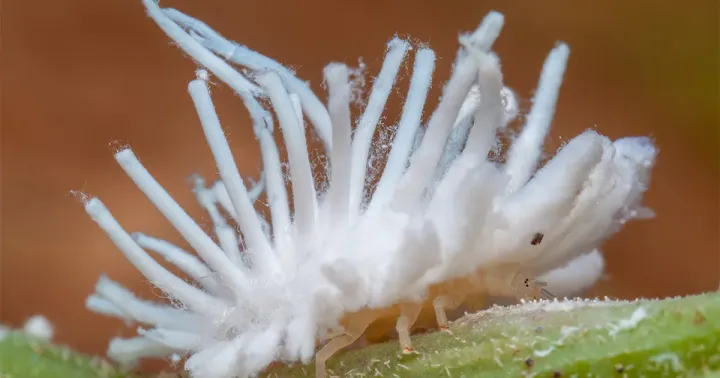
The spiny mealybug (Rastrococcus spinosus) belongs to the Pseudococcidae family within the order Hemiptera. Adult females are characterized by an oval body shape covered in a waxy secretion with long lateral filaments that give them a spiny appearance.
The name of this pest is derived from these prominent waxy projections. The insect typically appears as a white, cottony or mealy mass, which serves as a protective layer for the female and her eggs, camouflaging them against the plant surface.
The first instar larvae, often called 'crawlers', are the primary mobile stage. These tiny insects actively move across the plant or can be dispersed by wind and animal vectors to reach new feeding sites on the host.
Adult females are sedentary and tend to aggregate on the underside of leaves, along the veins, or in protected crevices of bark. They possess specialized mouthparts adapted for piercing plant tissues and sucking out nutrient-rich sap.
Adult males are rarely observed, as they are winged, very short-lived, and do not feed. Their main role is to locate sessile females for reproduction, which allows the species to maintain its populations efficiently throughout the growing season.
What it damages
Rastrococcus spinosus is a significant polyphagous pest affecting a wide range of tropical and subtropical plants, including citrus, mango, banana, coffee, and several ornamental shrub species.
By constantly extracting plant sap, the infestation causes systemic weakness. This manifests as yellowing leaves, premature leaf drop, and stunted growth, which severely compromises the overall physiological health of the host plant.
During feeding, the insects secrete large amounts of honeydew. This sugary substance accumulates on leaf surfaces and serves as a substrate for sooty mold fungi, which create a black layer that significantly inhibits the plant's photosynthetic capacity.
Fruit damage is a major concern, as the feeding activity leads to deformation, discoloration, and potential fruit abortion. For commercial orchards, this results in reduced harvest quality and lower market value of the produce.
In severe cases, entire branches or young saplings can wither and die. The pest's ability to reproduce rapidly and its wide host range make it a challenging economic threat in international agricultural trade.
When it appears
The lifecycle of the spiny mealybug is heavily influenced by ambient temperature and relative humidity. In tropical climates, the insect exhibits continuous reproduction without any clear seasonal dormancy periods.
High temperatures and consistent humidity accelerate the development from egg to adult. This enables multiple, overlapping generations to occur throughout the year, making consistent monitoring and management essential.
In temperate regions or during cooler periods, population growth slows down significantly. However, the pest remains active in protected environments like greenhouses, where it can survive and proliferate despite external weather conditions.
Dispersal between plants is primarily mediated by crawlers, which can be blown by the wind or transported via human activity. Contaminated nursery stock is one of the most common ways this pest is introduced to new areas.
While the pest prefers warm, humid conditions, it exhibits resilience to moderate weather fluctuations by finding refuge in sheltered areas of the tree, ensuring that a population core remains to re-infest the plant when conditions improve.
Signs of infestation
The most visible sign of infestation is the presence of white, cottony waxy clusters on the undersides of leaves or along succulent stems. These clusters are indicative of active colony development.
Sticky honeydew secretions found on foliage or fruit are early warning signs of mealybug presence. Over time, these sticky patches become blackened by sooty mold, making the plant look dirty and unhealthy.
Deformation of new growth, such as curling leaves or stunted shoots, occurs as the mealybugs congregate on tender plant tissues. This disruption of growth often leads to reduced fruit set and poor vigor.
Increased ant activity on the plant is a strong indicator of an existing mealybug colony. Ants form a symbiotic relationship with the mealybugs, protecting them from predators in exchange for the sugary honeydew they produce.
- White waxy tufts or powder on shoots.
- Sticky honeydew coating leaves.
- Black sooty mold covering plant surfaces.
- High density of ants on branches.
- Yellowing and distortion of terminal buds.
Control measures
Management of the spiny mealybug requires an Integrated Pest Management (IPM) approach. This starts with strict phytosanitary measures to ensure that new plant material is free from infestation before introduction.
Pruning and destroying heavily infested branches is an effective physical control measure. This not only removes a significant portion of the population but also improves canopy ventilation, which can make the environment less favorable for the pest.
Biological control is highly effective in sustainable agriculture. The introduction of natural enemies, such as parasitoid wasps or ladybird beetles, can suppress mealybug numbers naturally without the need for broad-spectrum chemical inputs.
When chemical intervention is necessary, systemic insecticides applied via soil drenching or systemic foliar sprays are preferred. These chemicals travel through the plant's vascular system, ensuring the pest consumes the insecticide while feeding.
Controlling ant populations is a critical support measure. By using sticky bands on tree trunks to block ant access, you deny the mealybugs their natural protectors, allowing indigenous predator populations to reduce the pest count effectively.
Taxonomy
- Latin name
- Rastrococcus spinosus
- Order
- Hemiptera (bugs, aphids, leafhoppers)
- Family
- Pseudococcidae
- EPPO code
- RASTSI
Discussion
No discussions yet — be the first.