
Soybean looper
Rachiplusia nu
Description
How to identify
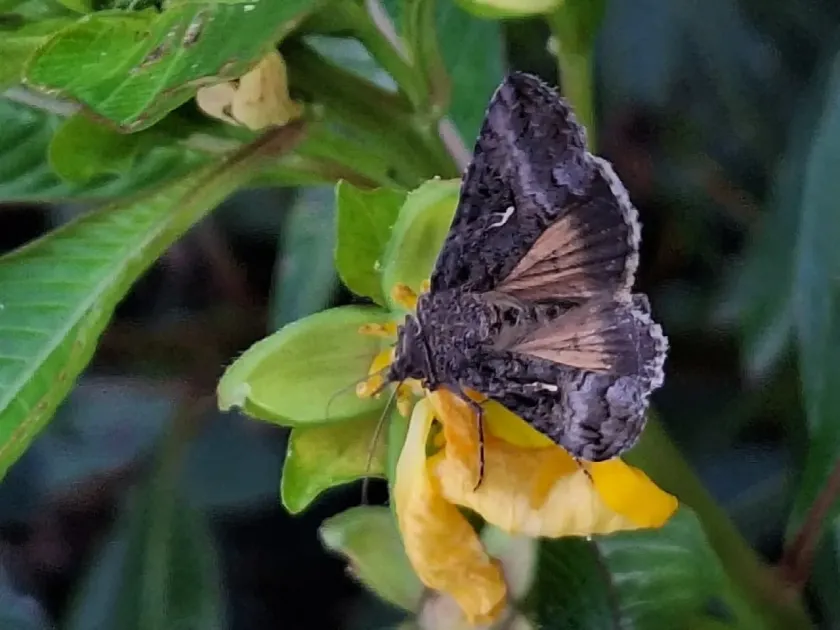
The soybean looper (Rachiplusia nu) is a nocturnal moth belonging to the Noctuidae family. The adult insect has a wingspan ranging from 35 to 40 millimeters. The forewings are grayish-brown with a metallic sheen, featuring a distinct mark in the center that resembles the Greek letter "gamma" or a silvery droplet.
The larvae, or caterpillars, of this species have a unique morphology: they possess only three pairs of prolegs, which causes them to arch their bodies when moving, similar to inchworms. The body of the caterpillar is green with longitudinal white stripes along the sides, providing excellent camouflage on the leaves of host plants.
The pupa of the pest develops inside a loose cocoon, which the caterpillar spins on leaves or within plant debris. The color of the pupa changes from light green to dark brown before the adult emerges. The biology of this species is optimized for rapid biomass accumulation during the larval stage.
This is a heat-loving, migratory species that actively spreads over long distances in search of food. Optimal conditions for reproduction include high humidity and moderately warm weather, typically found in Southern Europe and parts of Eurasia.
Generations develop at an accelerated pace, allowing the pest to produce multiple cycles per growing season in favorable climates. The intensity of reproduction is directly dependent on the temperature regime and the availability of flowering plants for adult nectar feeding.
What it damages
This pest is a polyphage that affects a wide range of agricultural crops. Crops at risk include legumes (soybeans, peas, chickpeas), oilseeds (sunflowers), and vegetable crops, including tomatoes, cabbage, and potatoes.
Young larvae feed primarily on the underside of the leaves, consuming the epidermis and creating characteristic "windows." As they mature, they shift to feeding on the entire tissue, destroying a significant portion of the leaf blade and leaving only the skeletonized veins.
The economic impact of Rachiplusia nu lies in the drastic reduction of the plant's photosynthetic area, leading to stunted growth and yield loss. During outbreaks, caterpillars can damage reproductive organs: buds, flowers, and even young pods, leading to direct commercial product losses.
The pest poses a particular danger during the flowering and pod-filling stages of soybeans. Defoliation prevents the plant from properly filling the seeds, resulting in shriveled grains and a significant drop in harvest quality.
The wounds caused by the loopers provide "entry gates" for secondary phytopathogenic infections, including fungal and bacterial rots, which further weaken the plant and accelerate death in cases of severe infestation.
When it appears
Moth flight begins in the spring after the soil warms up to critical thresholds. The first generation develops on weeds, after which the adults migrate to crop fields to lay eggs.
Adult activity occurs during twilight and nighttime hours; during the day, the moths hide under leaves or in thick vegetation. The mass emergence of caterpillars often coincides with the period of active crop growth, making plants highly vulnerable to these phytophages.
One life cycle requires approximately 30 to 45 days, depending on ambient temperatures. In southern regions, two to three generations can develop per season, making pest control a continuous effort throughout the summer.
By autumn, the pest population can reach peak levels, threatening late-planted crops. The insects overwinter as pupae in the topsoil or plant debris, showing high resilience to adverse environmental factors.
Monitoring for the pest is conducted using pheromone traps and light traps, which help determine the timing of adult flight and allow for the precise scheduling of insecticide applications.
Signs of infestation
The main signal of the pest's presence is the occurrence of skeletonized leaves and caterpillar droppings (frass) on the surface of the leaf blade. Visual inspection of the leaf undersides allows for the detection of both egg clusters and young larvae.
A characteristic sign is the presence of silk webbing, which caterpillars sometimes use to tie leaf edges together, creating protective shelters. When plants are shaken, caterpillars often drop to the ground and curl into a circle.
- Appearance of transparent spots on leaves ("windows").
- Rough feeding on leaf edges ("raggedness").
- Presence of black or green granular frass under the plants.
- Damage to reproductive parts (buds, pods).
- Discovery of pupae in loose cocoons on plant leaves.
Control measures
Agrotechnical methods include deep autumn plowing, which helps destroy pupae in the soil, as well as thorough weed control, as weeds serve as reservoirs for the pest at the beginning of the season.
The biological control method includes the use of bio-insecticides based on Bacilus thuringiensis, which show high efficacy against young larvae. The use of entomophages, such as Trichogramma, released during the peak egg-laying period, is also effective.
Chemical control is justified when the economic threshold of damage is reached. Insecticides from groups such as organophosphates, pyrethroids, and insect growth regulators are applied to ensure a rapid decrease in population density.
It is critical to rotate products from different chemical classes to prevent the development of resistance in the Rachiplusia nu population. Applications should be performed in the evening when the pest is most active.
Integrated Pest Management (IPM) involves combining monitoring, biological agents, and targeted pesticide use. This approach minimizes the pesticide load on the agroecosystem while maintaining high efficiency in controlling looper populations.
Taxonomy
- Latin name
- Rachiplusia nu
- Order
- Lepidoptera (butterflies)
- Family
- Noctuidae
- EPPO code
- RACHNU
Discussion
No discussions yet — be the first.