
Bordered sallow
Pyrrhia umbra
Description
How to identify
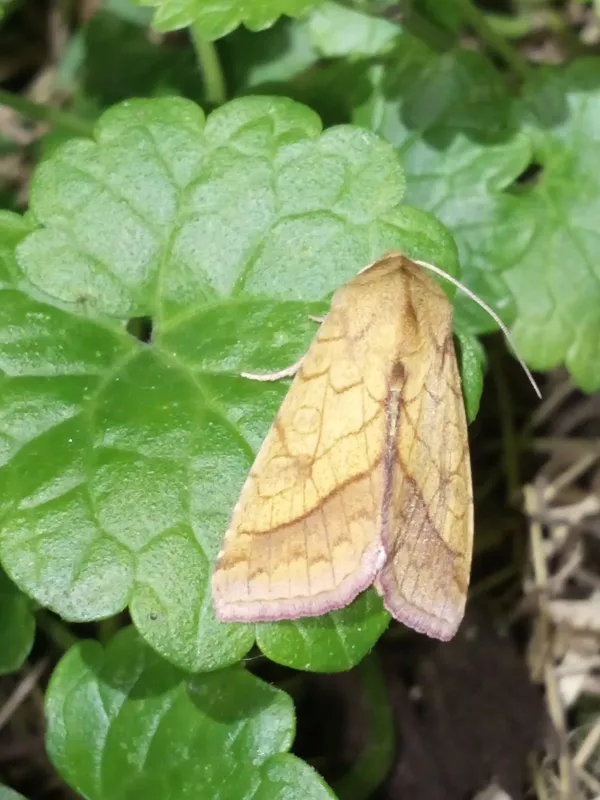
The Bordered sallow (Pyrrhia umbra) is a moth of the family Noctuidae. The adult moth has a wingspan of approximately 30–35 mm, with forewings that display a vibrant ochre-yellow to reddish-brown coloration, marked by distinct dark cross-lines.
The larvae, or caterpillars, reach a length of up to 40 mm. Their appearance is variable, usually appearing green to reddish-brown, which provides excellent camouflage against their host plants. They possess fine tubercles and longitudinal lines along their bodies.
This species typically undergoes one generation per year, although two generations may occur in warmer climates. The life cycle involves complete metamorphosis, consisting of egg, larva, pupa, and adult stages.
Pupation occurs in the soil, where the insect overwinters. Adults emerge in late spring or early summer, with the mating period typically occurring shortly after emergence.
Females lay eggs on the leaves and flowers of host plants. The eggs hatch within a week or two, depending on the ambient temperature and humidity levels in the field.
What it damages
The Bordered sallow is considered a polyphagous species but shows a marked preference for legumes, including chickpeas, peas, and various ornamental plants like roses.
The larvae are the primary damaging stage. They begin by feeding on foliage but quickly move to consume buds, flowers, and developing seed pods as they reach later instars.
In pulse crops, the caterpillars bore into the pods, directly consuming the seeds inside. This results in significant quantitative and qualitative yield losses at harvest time.
Damage to the pods often leads to secondary infections by fungi or bacteria, as the wounds created by the larvae provide easy access for plant pathogens.
In ornamental horticulture, the moth is known for damaging the buds of flowers, which significantly reduces the aesthetic value of the plant and its marketability.
Signs of infestation
Early signs of infestation include irregular holes in the leaves, often referred to as windowing, caused by young larvae feeding on the leaf epidermis.
As larvae grow, they create larger, more obvious entry holes in seed pods or buds. These entry points are frequently accompanied by frass (larval excrement) accumulation around the damage site.
The presence of adult moths can be detected using light traps or pheromone traps during the nocturnal hours when the insects are most active for mating and egg-laying.
Observing stunted or damaged flower buds in ornamental plantings is a key indicator that larvae are feeding within the floral structures, hidden from plain sight.
Regular field scouting, particularly during the flowering and pod-filling stages, is essential for identifying the presence of caterpillars before significant economic damage occurs.
Control measures
Effective cultural control includes deep autumn plowing of fields. This practice disturbs the soil, exposing the pupae to environmental stressors and natural predators, thereby reducing their survival rate.
Management of host weeds in and around the field margins is critical, as these plants serve as alternate hosts that support the pest population throughout the growing season.
Chemical control should be timed to coincide with the early larval stages, as younger caterpillars are significantly more susceptible to insecticides than older, mature ones.
Biological control agents, such as formulations based on Bacillus thuringiensis, offer a targeted approach to managing the moth population without causing harm to beneficial insects.
The use of integrated pest management (IPM) strategies, combining pheromone monitoring and timely targeted spraying, is the most sustainable way to protect crops from Pyrrhia umbra.
Taxonomy
- Latin name
- Pyrrhia umbra
- Order
- Lepidoptera (butterflies)
- Family
- Noctuidae
- EPPO code
- PYHIUM
Discussion
No discussions yet — be the first.