
Pteromalids
Pteromalus
Description
How to identify
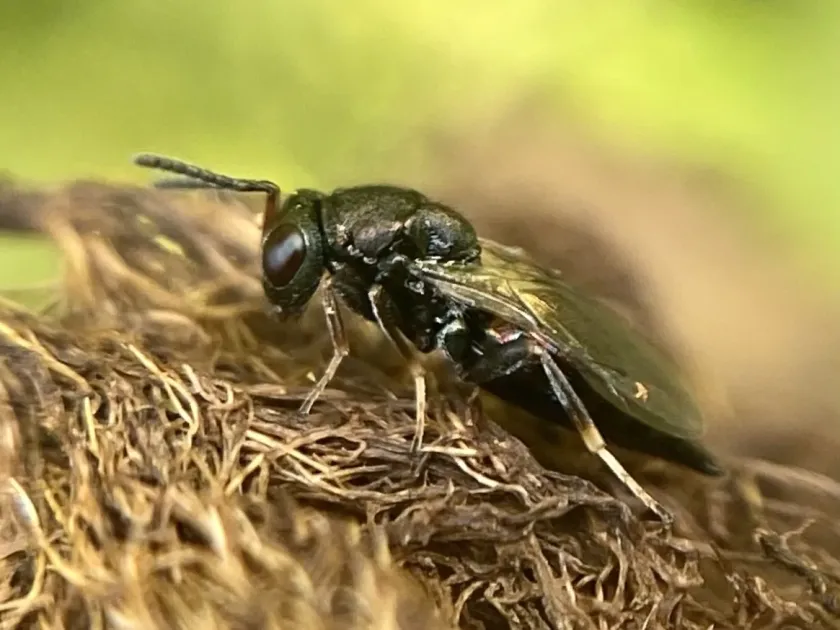
Pteromalids (family Pteromalidae, order Hymenoptera) are a diverse group of small parasitic wasps. Most species range from 1 to 5 mm in length and often exhibit a metallic green, bronze, or black coloration.
They are distinguished by their complex wing venation and specific thoracic structure. Their elbowed antennae serve as a key morphological feature for professional identification.
In agronomy, these insects are valued as highly efficient natural enemies of various pests. They are not pests themselves; rather, they serve as biocontrol agents in agricultural ecosystems.
Identifying them in the field is difficult due to their microscopic size, and species-level identification usually requires laboratory conditions and professional entomological equipment.
They are widely distributed in agroecosystems, inhabiting fields, orchards, and greenhouses where their hosts are present.
What it damages
Pteromalids do not damage crops or plant tissues. They do not feed on plant sap, leaves, or roots, making them harmless to agricultural cultivation.
Their role is strictly parasitic. They target the larvae and pupae of various pests, effectively reducing the damage caused by those pests to the actual crops.
While some species may act as secondary parasitoids, the overall impact of Pteromalidae on crop production is overwhelmingly positive, as they regulate pest populations.
They are essentially partners for farmers, working to suppress the spread of harmful beetles, moths, and other insects that threaten the yield.
The misconception that they are pests arises from a lack of awareness regarding their ecological function as natural biological control agents.
When it appears
Their activity period begins in spring when ambient temperatures become consistently warm, allowing adults to emerge from their overwintering sites.
Several generations can occur throughout the summer. The rate of development is strictly dependent on the availability of hosts and the prevailing weather conditions.
As autumn approaches, the insects prepare for diapause, seeking shelter in soil debris or inside the remains of their hosts to survive the cold season.
The population peaks of these parasitoids closely follow the outbreaks of their respective hosts, acting as a natural check and balance within the environment.
In controlled environments like greenhouses, their activity can be continuous throughout the year if the host population is maintained and environmental conditions are stable.
Signs of infestation
Since they do not cause plant damage, there are no characteristic symptoms of "pest infestation" associated with them. Their presence is usually signaled by the decline of pest outbreaks.
A closer inspection of pest pupae or remains in the field may reveal tiny, clean-cut exit holes, which indicate that a Pteromalid has emerged after completing its life cycle inside.
The sudden collapse of a pest population without human intervention is often a direct result of effective activity by these beneficial parasitoid wasps.
Surveys using sweep nets are the most common agricultural practice for assessing the density of these beneficial insects within a field.
Observing a high number of tiny metallic wasps around blooming weeds or crop foliage suggests a healthy population of parasitoids is present.
Control measures
As beneficial insects, the "control" strategy for Pteromalids involves conservation and promoting their presence rather than eradication.
It is vital to avoid broad-spectrum insecticides that are toxic to parasitoids, especially during the stages when these wasps are active.
Providing flower strips and hedgerows around crop areas helps ensure they have access to nectar, which is essential for their longevity and reproduction.
- Reducing reliance on synthetic chemical pesticides.
- Applying selective biorational pesticides that spare beneficial insects.
- Preserving natural habitats and wintering sites.
- Integrating biological control programs in greenhouses.
By protecting Pteromalids, farmers contribute to sustainable agriculture and reduce the necessity for heavy chemical applications.
Taxonomy
- Latin name
- Pteromalus
- Order
- Hymenoptera
- Family
- Pteromalidae
- EPPO code
- PTERSP
Discussion
No discussions yet — be the first.