
West African lungfish
Protopterus annectens
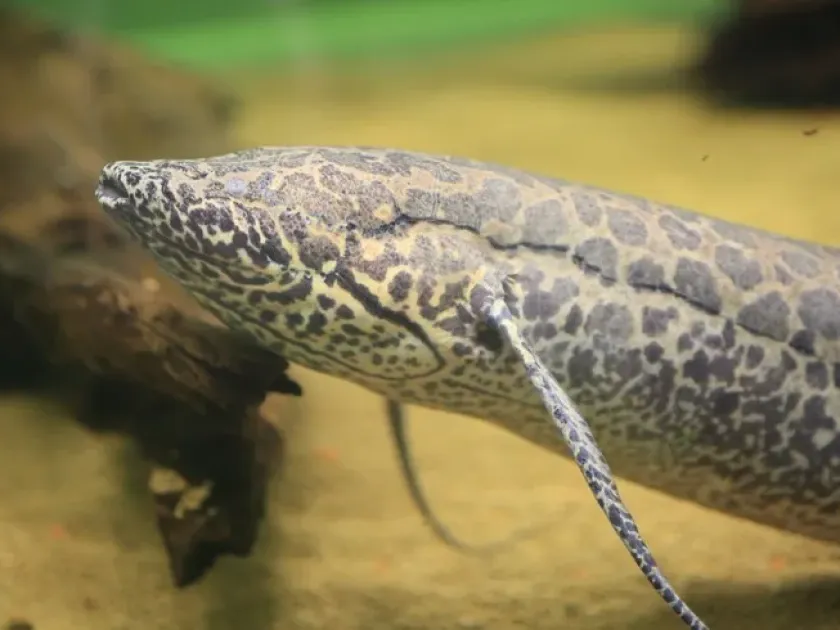
Description
How to identify
The West African lungfish (Protopterus annectens) belongs to the order Dipnoi, family Protopteridae. It is a freshwater fish capable of breathing atmospheric air using lungs.
The fish has a serpentine body covered in small scales and unique filamentous pectoral and pelvic fins. Adult specimens can reach lengths of up to one meter.
These fish are known for their ability to survive long periods of drought by burrowing into mud and forming a protective mucus cocoon. In this state of estivation, the fish can survive for months.
From a biological standpoint, this species is strictly carnivorous. Its diet consists of mollusks, crustaceans, and smaller fish, rather than plant material.
It is crucial to clarify that classifying this species as a plant pest is scientifically incorrect. The lungfish does not damage crops at any stage of its life cycle.
What it damages
The West African lungfish does not damage agricultural crops. It does not feed on leaves, roots, stems, or fruits of any crops grown in agricultural practices.
This species is native to African water bodies and has no dietary interest in terrestrial or aquatic agricultural crops.
In aquaculture systems, such as rice paddies, the presence of this fish might actually assist in controlling populations of harmful invertebrates rather than causing damage.
The absence of harm is supported by the species' dietary specialization, which excludes plant tissues from its natural diet throughout all stages of its development.
Therefore, for the plant production sector, the West African lungfish poses no danger and does not require any pest management strategies.
Control measures
Since the West African lungfish is not an agricultural pest, no specific crop protection measures are required against this species.
Any attempts to eradicate this fish in agricultural zones are unjustified from a plant protection perspective and could negatively impact the local ecosystem.
If population control is needed in aquaculture settings, standard fisheries management practices should be used, which are distinct from crop protection.
Agronomists should focus on identifying genuine entomological or phytopathological threats rather than non-phytophagous biological entities.
If the fish is found in irrigation or drainage systems, it should be viewed as a component of the local aquatic biota that does not influence the phytosanitary status of the fields.
Taxonomy
- Latin name
- Protopterus annectens
- Family
- Protopteridae
- EPPO code
- PTPTAN
Discussion
No discussions yet — be the first.