
Golden Plusia
Polychrysia moneta
Description
How to identify
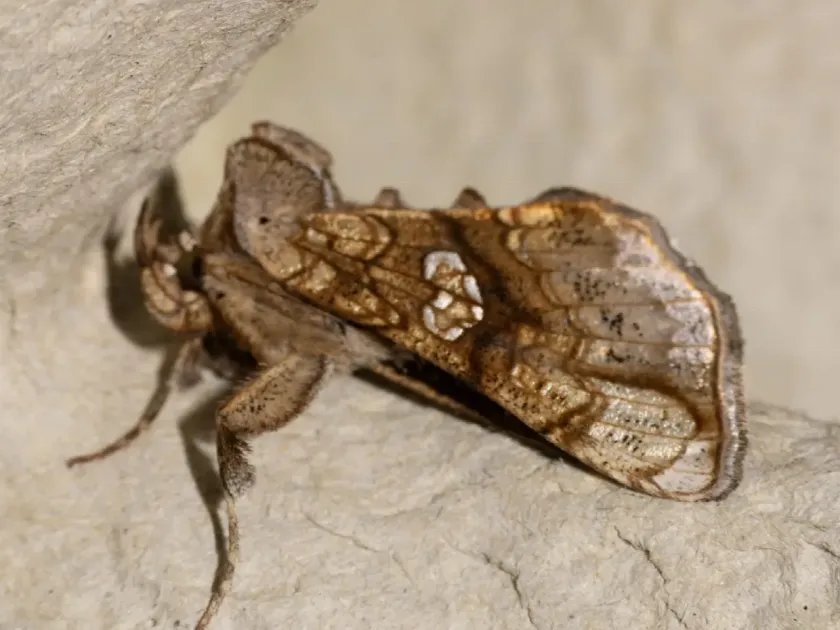
The Golden Plusia (Polychrysia moneta) is a nocturnal moth belonging to the Noctuidae family, specifically the Plusiinae subfamily, known for its metallic appearance.
Adult moths typically have a wingspan of 35–40 mm. Their forewings feature a distinctive golden or copper metallic sheen, with a prominent central mark resembling a coin.
The larvae, or caterpillars, are usually light green with faint longitudinal stripes, which provides excellent camouflage while feeding on the leaves of host plants.
The pupae are typically encased in a thick, white silken cocoon, which the larvae spin on the underside of leaves or within folded leaf edges.
As a specialist pest, it relies on specific plants for its life cycle, which makes it easier to monitor in garden settings where these hosts are grown.
What it damages
This moth primarily targets plants in the Ranunculaceae family, with Aconitum (monkshood) and Delphinium being the most frequent hosts for its larvae.
The caterpillars are voracious feeders; they consume the leaf blade, often leaving only the tougher veins behind, which significantly damages the plant's aesthetic value.
In addition to foliage, heavy infestations can lead to caterpillars feeding on floral buds, causing deformities and preventing normal blooming of the flowers.
The feeding damage creates entry points for various bacterial and fungal pathogens, potentially weakening the plant's overall health and vigor during the growing season.
Repeated defoliation by several generations of caterpillars can exhaust the energy reserves of perennials, leading to poor growth or failure to flower the following year.
When it appears
Adult moths are generally active from late spring through mid-summer, during which time they mate and lay eggs on the host plants.
The larval stage is most active during June and July, coinciding with the peak vegetative growth and bud formation stages of Aconitum and Delphinium.
Under favorable weather conditions, the moth can complete multiple generations in a single season, extending the risk of infestation until early autumn.
The moths are nocturnal, meaning they travel and lay eggs during the night, often moving between garden sections to find fresh foliage for their offspring.
Pupation occurs during mid-summer, and the cycle continues as new moths emerge to lay the next batch of eggs for the season.
Signs of infestation
The primary sign of infestation is the presence of irregular, ragged holes in the foliage of host plants like monkshood and delphiniums.
Scrutinizing the undersides of the leaves often reveals the green caterpillars resting motionless along the midribs to avoid detection by predators.
Dark granular droppings, known as frass, appearing on the leaves below feeding sites are a clear indication that caterpillars are actively feeding nearby.
Visible thinning of leaf tissue or skeletonized foliage is a sign that the caterpillars have progressed to later instars and are consuming larger amounts of plant material.
Watching for the distinctive metallic-looking moths flying around garden lights or near flower beds at night can also serve as an early warning system.
Control measures
Manual removal of caterpillars is a practical and effective solution for small home gardens, especially when done in the early morning or evening hours.
Biological insecticides containing Bacillus thuringiensis are highly effective against these caterpillars while remaining safe for beneficial insects and pollinators.
If the infestation exceeds acceptable levels, systemic insecticides approved for ornamental use can be applied to protect the foliage during the peak feeding season.
Good garden hygiene, such as removing weeds from the Ranunculaceae family and cleaning up plant debris in autumn, reduces wintering sites for the pupae.
Promoting a healthy garden ecosystem by encouraging natural predators like birds and parasitic wasps can help keep the population of the Golden Plusia in check.
Taxonomy
- Latin name
- Polychrysia moneta
- Order
- Lepidoptera (butterflies)
- Family
- Noctuidae
- EPPO code
- PLUSMO
Discussion
No discussions yet — be the first.