
Silver Y moths
Plusia
Description
How to identify
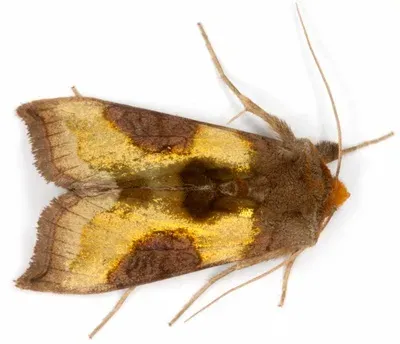
The Silver Y moth (Plusia, also classified as Autographa gamma in many contexts) belongs to the Noctuidae family, order Lepidoptera. Its name comes from the distinct, metallic, Y-shaped marking on its forewings.
These moths have a wingspan ranging from 30 to 45 mm. Their cryptic coloration allows them to blend in perfectly with natural surroundings, making them difficult to spot during the daylight hours.
The larvae, known as loopers, possess fewer abdominal prolegs than other species of cutworms. Consequently, they move by arching their backs in a characteristic loop-like motion.
Larvae are typically green, sometimes with faint longitudinal stripes, which acts as excellent camouflage on the host plants they feed upon during their developmental stages.
Pupation occurs within a loose, webbed cocoon that is usually attached to the underside of leaves or hidden among dry vegetation, providing protection against environmental fluctuations.
What it damages
The Silver Y moth is a polyphagous pest, meaning it feeds on a wide variety of plant species. This adaptability makes it a significant threat to many agricultural and horticultural crops.
Common host plants include various vegetables such as cabbage, potatoes, and beets, as well as field crops like soybeans, peas, and sunflowers. High infestations can result in total crop failure.
Adult moths feed primarily on nectar and do not damage crops directly. The economic impact is caused exclusively by the larvae, which are voracious consumers of leaf tissue.
Young larvae start by creating small windows in the leaf epidermis, but as they grow, they proceed to consume entire leaves, often leaving behind nothing but the main structural veins.
Extensive defoliation drastically reduces the plant's photosynthetic capacity, leading to stunted growth, delayed maturation, and a significant loss in both quality and total yield.
When it appears
The appearance of the first generation of adults typically begins in late spring or early summer, following the arrival of sustained warmer temperatures suitable for mating.
Females deposit eggs individually or in small clusters on the underside of host leaves. The incubation period lasts between one to two weeks, depending on the ambient temperature.
Larval development typically lasts about three to four weeks, during which they progress through several instars. In temperate regions, multiple generations can occur within a single season.
Pupae or late-instar larvae are responsible for overwintering. They often seek shelter in the soil or within protective plant debris, enabling them to survive harsh winter conditions.
Mass outbreaks are often correlated with wet and warm summers, which provide optimal conditions for the survival of early-stage larvae and accelerate the overall reproductive cycle.
Signs of infestation
The most noticeable sign of a Silver Y moth infestation is the presence of irregular, ragged holes in the leaves of host plants, created by the larvae's feeding activity.
Careful inspection of the underside of leaves during the morning or evening is recommended, as the larvae are highly active during these periods and hide when temperatures rise.
Visible frass (excrement) on the leaf surfaces or at the base of the plant serves as a clear indicator of active feeding by a growing population of caterpillars.
Infested plants may exhibit signs of wilting or general decline, as the loss of leaf surface area hampers the plant's ability to maintain water balance and energy production.
Adult moths can be spotted flying in the early evening hours. Their presence near crops should alert farmers to monitor for eggs and early-stage larval activity.
Control measures
Effective management begins with cultural practices, such as deep autumn plowing to disturb the soil and expose overwintering pupae to predators and environmental stress.
Weed management is a crucial preventive measure, as wild hosts often serve as primary breeding grounds for the moth before they move into high-value cultivated fields.
Biological control agents, including Bacillus thuringiensis sprays, are highly effective against larvae and are generally safer for beneficial insects and the environment.
When the population exceeds the economic threshold, targeted insecticide applications are necessary. Always ensure that systemic or contact-based chemicals are used according to safety guidelines.
Integrated Pest Management (IPM) programs, which involve monitoring and combining multiple control tactics, are the most reliable way to maintain population levels below harmful limits.
Taxonomy
- Latin name
- Plusia
- Order
- Lepidoptera (butterflies)
- Family
- Noctuidae
- EPPO code
- PLUSSP
Discussion
No discussions yet — be the first.