
Striped eel catfish
Plotosus lineatus
Description
How to identify
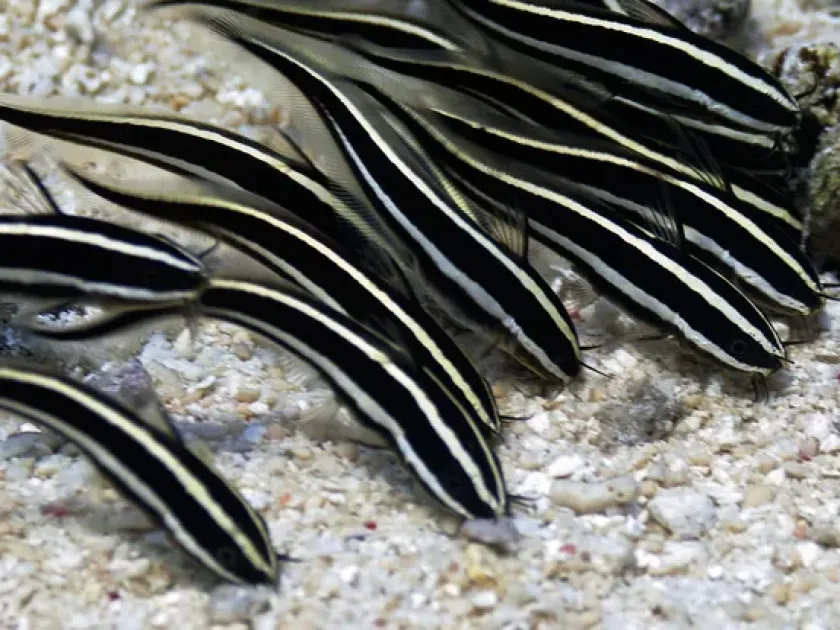
The striped eel catfish, scientifically known as Plotosus lineatus, belongs to the family Plotosidae. It is easily recognized by its eel-like body shape and distinctive longitudinal white or yellowish stripes running along its dark brown or black skin.
The species possesses highly venomous spines located in its pectoral and dorsal fins. These spines are capable of inflicting severe, painful wounds on both predators and humans handling the fish.
Juvenile catfish are known to aggregate in tight, ball-shaped schools. This schooling behavior is a sophisticated defense mechanism used to deter predators while foraging in shallow coastal waters.
It displays remarkable physiological plasticity regarding salinity, allowing it to move seamlessly between marine environments, estuaries, and brackish coastal lagoons.
Adults can grow up to 32 cm in length. Their aggressive nature and ability to adapt to various environments make them a formidable invasive species in regions outside their native range.
What it damages
The striped eel catfish poses a significant threat to aquaculture and coastal fisheries by preying on the fry of commercially valuable fish species and various crustaceans.
Their sharp venomous spines are strong enough to damage aquaculture nets and mesh enclosures, creating breaches that allow the catfish to enter and facilitate the escape or predation of cultivated stocks.
The venomous nature of the fish creates serious occupational health hazards for aquaculture workers, leading to potential injuries during routine maintenance or harvest procedures.
By outcompeting local species for food and shelter, Plotosus lineatus disrupts the natural balance within managed water bodies, leading to decreased overall productivity.
The economic impact involves both the direct loss of harvest and the increased operational costs associated with net repairs and managing the risks posed by this venomous predator.
When it appears
Seasonal patterns for the striped eel catfish are heavily influenced by water temperature and reproductive cycles. They exhibit high levels of activity during warmer months.
Spawning often occurs in shallow, protected coastal areas, leading to a surge in the population of juvenile schooling fish during spring and summer months.
As water temperatures drop in temperate regions, adult populations tend to retreat to deeper waters, though they remain active in controlled environments like large aquaculture tanks.
Migratory behavior is linked to nutrient availability and water salinity gradients in estuaries, which can dictate the presence of the fish near human-made facilities throughout the year.
Understanding these seasonal movements is crucial for aquaculture managers to implement preemptive exclusion strategies before mass colonization occurs.
Signs of infestation
Primary indicators of an infestation include an unexplained decline in juvenile stock numbers within ponds or cages, pointing toward predation by intruders.
Physical evidence of the species is often found in the form of damaged mesh netting, specifically punctures and tears caused by the catfish's rigid fin rays.
Visual confirmation of distinctively striped "balls" of juvenile fish moving synchronously is a reliable sign that a local population has established itself.
The occurrence of painful injury cases among staff who have handled water equipment or fish catches serves as a critical warning that Plotosus lineatus is present.
Regular environmental monitoring and the use of specialized bait-traps are effective ways to identify and quantify the presence of the striped eel catfish in sensitive areas.
Control measures
Effective control measures focus on the physical exclusion of the species through the use of high-strength, puncture-resistant netting for all aquaculture cages.
Routine inspection of perimeter defenses is essential to ensure that no breach points exist, especially since the catfish use their spines to exploit and expand small openings.
Active culling through targeted trapping programs during the peak activity season significantly reduces the pressure of the invasive population on farm resources.
The implementation of strict safety protocols, including the use of puncture-proof gloves and proper handling tools, is vital to protect farm personnel from venomous stings.
Collaboration with local maritime authorities to monitor and mitigate the spread of Plotosus lineatus is necessary to maintain the ecological integrity of coastal waters.
Taxonomy
- Latin name
- Plotosus lineatus
- Family
- Plotosidae
- EPPO code
- PLOTLI
Discussion
No discussions yet — be the first.