
Pipunculus campestris
Pipunculus campestris
Description
How to identify
Pipunculus campestris, commonly known as a type of big-headed fly, belongs to the family Pipunculidae within the order Diptera.
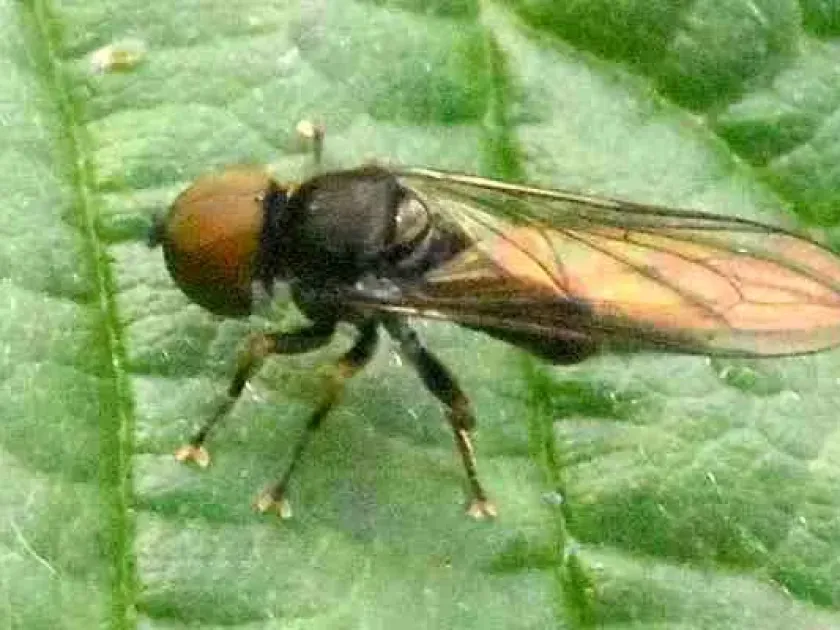
These flies are easily recognized by their massive compound eyes that dominate the head, giving them an exceptionally wide field of vision.
They are generally small, dark-colored flies that are frequently spotted hovering over low-lying vegetation where their hosts, leafhoppers, are abundant.
The larvae are specialized endoparasitoids, adapted to develop internally within the bodies of their insect hosts.
The identification of these flies is best achieved by entomologists through detailed examination of the male genitalia, as external morphology is quite similar among related species.
What it damages
Pipunculus campestris is classified as a beneficial insect rather than a crop pest, as it does not consume plant tissues or damage produce.
The species acts as a biological control agent by parasitizing various leafhopper species (Cicadellidae), which are significant agricultural pests.
The larva matures inside the host body, ultimately killing the leafhopper, which prevents the host from reproducing and further damaging crops.
By keeping leafhopper populations in check, these flies indirectly protect crops from physical damage and the transmission of various plant viruses.
Farmers benefit from the presence of these parasitoids, as they provide an effective and free natural regulation of herbivorous insect populations.
When it appears
Adult flies are most active during the spring and summer months, aligning their lifecycle with the population peak of their leafhopper hosts.
The lifecycle includes several developmental stages, starting from eggs laid directly into the host and ending with adult flies emerging from the soil.
These flies usually overwinter as pupae or late-stage larvae within the soil or deep inside the dried stalks of vegetation.
Multiple generations may occur in a single year depending on the regional climate, ensuring a continuous presence of parasitoids during the growing season.
Warmer temperatures significantly accelerate the metamorphosis process, leading to higher activity levels during mid-summer months.
Control measures
There is no reason to control or eradicate Pipunculus campestris, as they are valuable allies in sustainable integrated pest management programs.
Agrotechnical efforts should focus on preserving these populations by reducing the use of toxic, broad-spectrum insecticides on farmlands.
Maintaining floral borders around fields provides necessary nectar sources for adult flies, increasing their longevity and reproductive success.
Implementation of selective pesticide programs ensures that the chemical control of primary pests does not cause secondary outbreaks by killing off beneficial parasitoids.
- Avoid non-selective insecticide spraying during the peak flight season of parasitoid flies.
- Maintain perennial vegetation strips around crop fields to support healthy parasitoid populations.
Taxonomy
- Latin name
- Pipunculus campestris
- Order
- Diptera (flies)
- Family
- Pipunculidae
- EPPO code
- PIPUCA
Discussion
No discussions yet — be the first.