
Portuguese man o' war
Physalia physalis
Description
How to identify
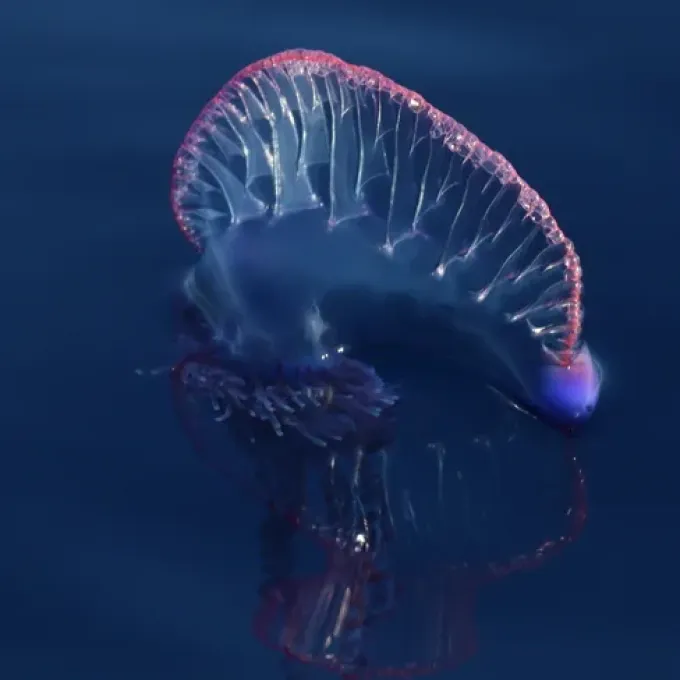
Physalia physalis, commonly known as the Portuguese man o' war, belongs to the phylum Cnidaria and the class Hydrozoa.
It is a colonial siphonophore consisting of specialized zooids that function together as a single organism in marine environments.
The organism floats on the ocean surface using a gas-filled bladder, trailing long tentacles that contain powerful stinging cells.
This species is found exclusively in tropical and subtropical ocean waters and does not exist in agricultural or terrestrial environments.
It is strictly a marine organism and has no biological mechanism to parasitize or consume terrestrial plant tissues.
What it damages
The Portuguese man o' war causes zero damage to agricultural, horticultural, or silvicultural crops.
There is no ecological, biological, or agricultural link between this marine species and any terrestrial plant diseases or pests.
The confusion regarding its status as a "pest" stems solely from the naming similarity to the plant genus Physalis.
While the plant Physalis (groundcherry or cape gooseberry) can be attacked by various insects, the marine Physalia is not related to these issues.
Farmers and agronomists do not face any threats to crop yields from this marine hydrozoan under any environmental conditions.
Control measures
There are no control measures for Physalia physalis in the context of agronomy, as it poses no threat to farming operations.
Do not apply any pesticides, herbicides, or agricultural chemicals to manage this organism, as such actions are useless and environmentally hazardous.
Proper pest management should focus on recognized agricultural threats to crops, excluding marine animals from consideration.
Always verify the scientific classification of a reported pest to ensure that resources are not wasted on biologically impossible scenarios.
Agrochemical documentation should correctly identify the biological nature of pests to avoid confusion between botanical names and marine organisms.
Taxonomy
- Latin name
- Physalia physalis
- Family
- Physalidae
- EPPO code
- PYLSPH
Discussion
No discussions yet — be the first.