
Pubic louse
Phthirus pubis
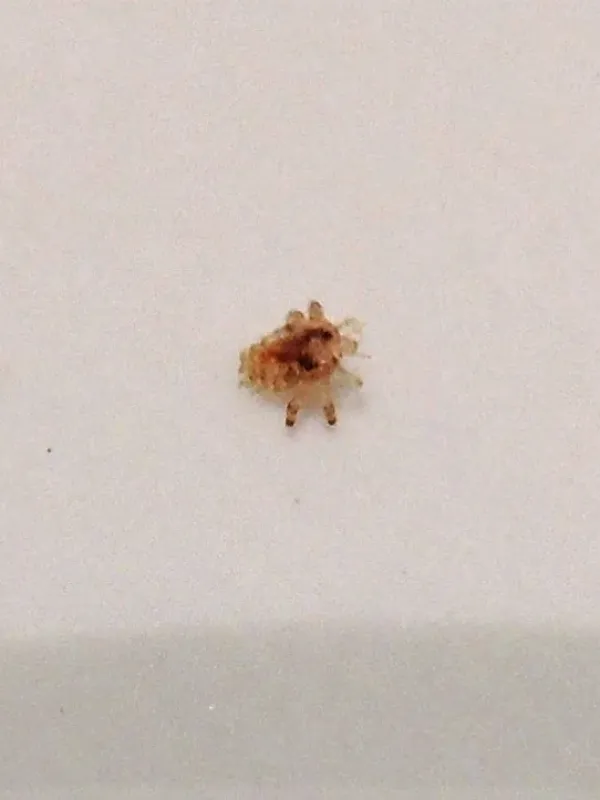
Description
How to identify
The pubic louse (Phthirus pubis) is a highly specialized ectoparasite of humans, belonging to the order Phthiraptera and the family Pthiridae. Unlike plant pests, this insect possesses morphology strictly adapted for clinging to the hair of mammals.
The adult insect has a crab-like appearance and measures approximately 1.5–2 mm in length. Its legs are equipped with powerful hook-like claws, specifically evolved to grasp human hair of a certain diameter typical of the pubic region.
The life cycle of the insect consists of three stages: egg (nit), nymph, and adult. The entire development process occurs exclusively on the host's body, which provides the necessary constant temperature and food source — blood.
Reproduction occurs year-round under favorable conditions involving close human contact. Outside the host's body, the parasite loses activity quickly and dies within 24 hours due to the lack of nutritional intake.
This species is not a phytophage or xylophage and cannot survive on plant materials. It lacks the biting or sucking mouthparts required to manipulate plant tissues, rendering it entirely harmless to agro-ecosystems.
What it damages
It is crucial to emphasize that the pubic louse does not damage any agricultural crops, ornamental plants, or trees. It causes no harm to forestry or agriculture, as it has no trophic connections with the botanical world.
The term "pest" regarding Phthirus pubis applies strictly within the field of medical entomology, not agronomy. The parasite feeds exclusively on human blood, causing dermatological reactions for the human host.
In agronomic practice, incorrect mentions of this species as a plant pest are the result of taxonomic confusion or the misuse of biological databases. Agronomists do not engage in controlling this species in the field.
Any claims regarding "crop infestation" by pubic lice are false or pseudoscientific. Plant tissues do not contain the necessary nutrients to sustain this type of arthropod.
The harm to humans involves inducing itching, secondary infections from scratching, and general psychological discomfort, which has no correlation with the damage to vegetative plant organs.
Control measures
Plant protection methods, such as the use of insecticides, fungicides, or agrotechnical practices, are completely ineffective and pointless concerning this object, as it does not inhabit agro-ecosystems.
In the event of detecting this parasite, treatment is conducted strictly with medicinal products (pediculicides) according to healthcare professional recommendations, rather than agrochemical crop protection methods.
Prevention of the insect’s presence involves maintaining personal hygiene and limiting close contacts, rather than applying chemical treatments to fields or greenhouses.
The use of agricultural pesticides to control this parasite is categorically unacceptable, as it poses health risks to humans and violates ecological standards for agrochemical usage.
For the disinfection of clothing and household items, specialized sanitary methods are utilized, which share no commonality with agricultural pest control procedures.
Taxonomy
- Latin name
- Phthirus pubis
- Family
- Pthiridae
- EPPO code
- PHTHPU
Discussion
No discussions yet — be the first.